
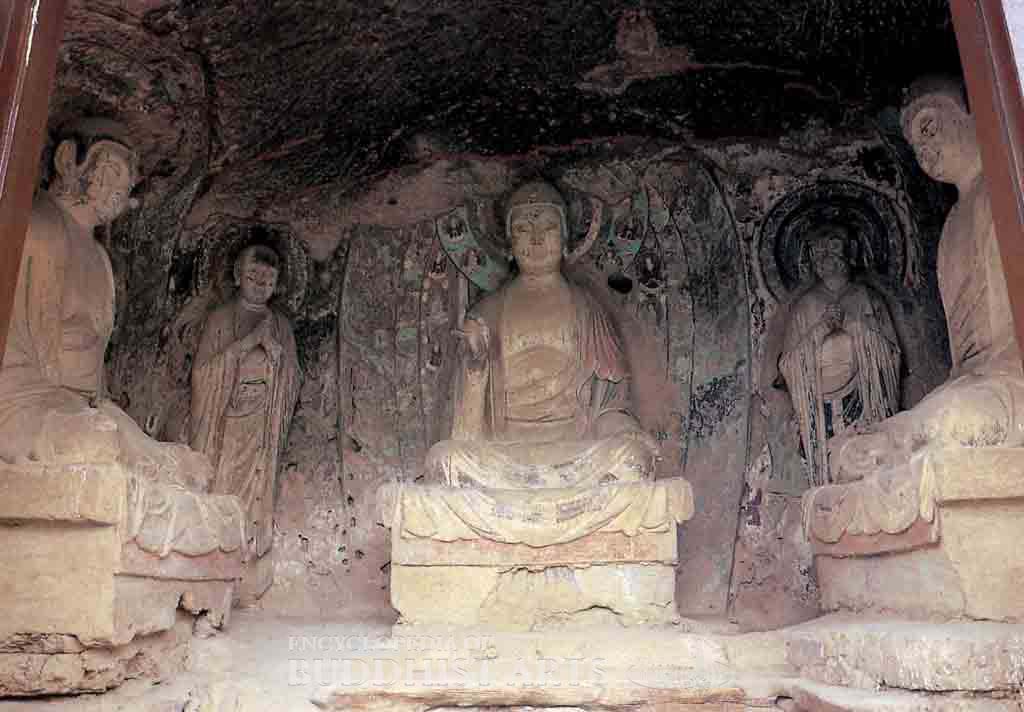
Maijishan Niche 90
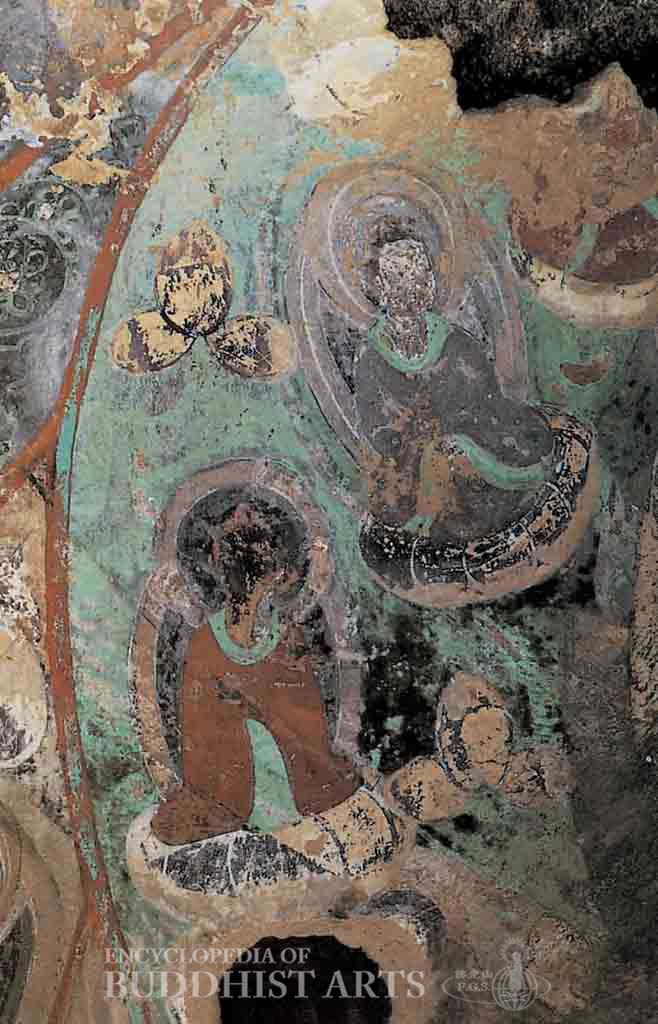
Maijishan Niche 90: Nimbus of the Buddha (detail) (back wall)
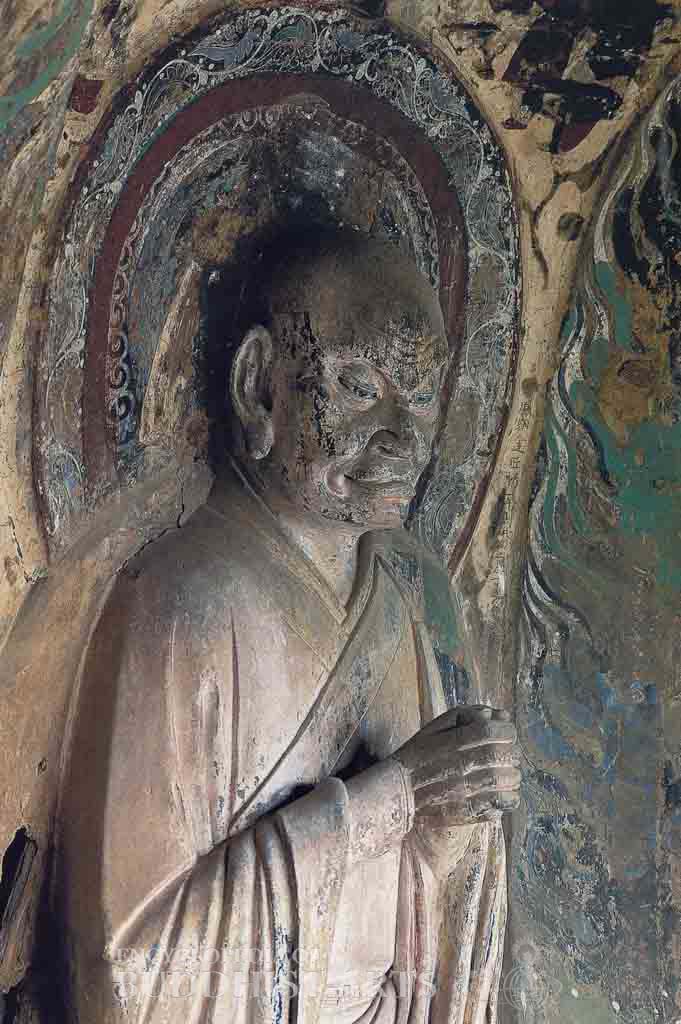
Maijishan Niche 90: Mahakasyapa (detail)
Clay
Maijishan Niche 90
CHINA, Gansu, Tianshui
Situated in the middle section of the west cliff, this large, open grotto was first constructed during the Northern Wei dynasty (386–534), and further developed in the Song dynasty (960–1279). It has a vaulted ceiling, and is 4.7 m in width and 4.4 m in height. On the niche’s U-shaped altar, 90 cm in height, there are statues of three Buddhas and two disciples, which were restored in the Song dynasty. The sculptor’s skill is revealed through the natural and lifelike appearance of the statues, as well as through a Mahakasyapa statue at the right side of the back wall, emphasizing the depth of ascetic practice. The statues are sculpted in a traditional Chinese fashion.
The ceiling of the grotto, as well as the upper sections of the three side walls, has flaked off. However, the mandorla of the Buddha on the back wall, as well as various lower segments of the murals, have been preserved. The murals consist of two layers. The bottom layer has worn away and is indiscernible. The top layer, with brilliant and exquisite colors, was painted during the Northern Wei dynasty. The edge of the ring on the Buddha’s nimbus is decorated with Buddha images. The outer ring of the mandorla is decorated with flame patterns, followed by successive rings of honeysuckle patterns, Buddha images, flame patterns, and bead strings. Painted in the gaps between the mandorla and the statue are seven to eight figures making offerings. Marked in black ink, the folds of these figures are quite clear. The black ink appears identical to the ink used to write the inscriptions in front of these figures, although the inscriptions are not easily recognizable.
For more details, go to the Encyclopedia of Buddhist Arts: Caves M-Mo, page 806.
Cite this article:
author = Hsingyun and Youheng and Johnson, Peter and Mankuang and Huntington, Susan and Edson, Gary and Neather, Robert,
booktitle = {Encyclopedia of Buddhist Arts: Caves M-Mo},
pages = 806,
title = {{Maijishan Niche 90}},
volume = 7,
year = {2016}}