
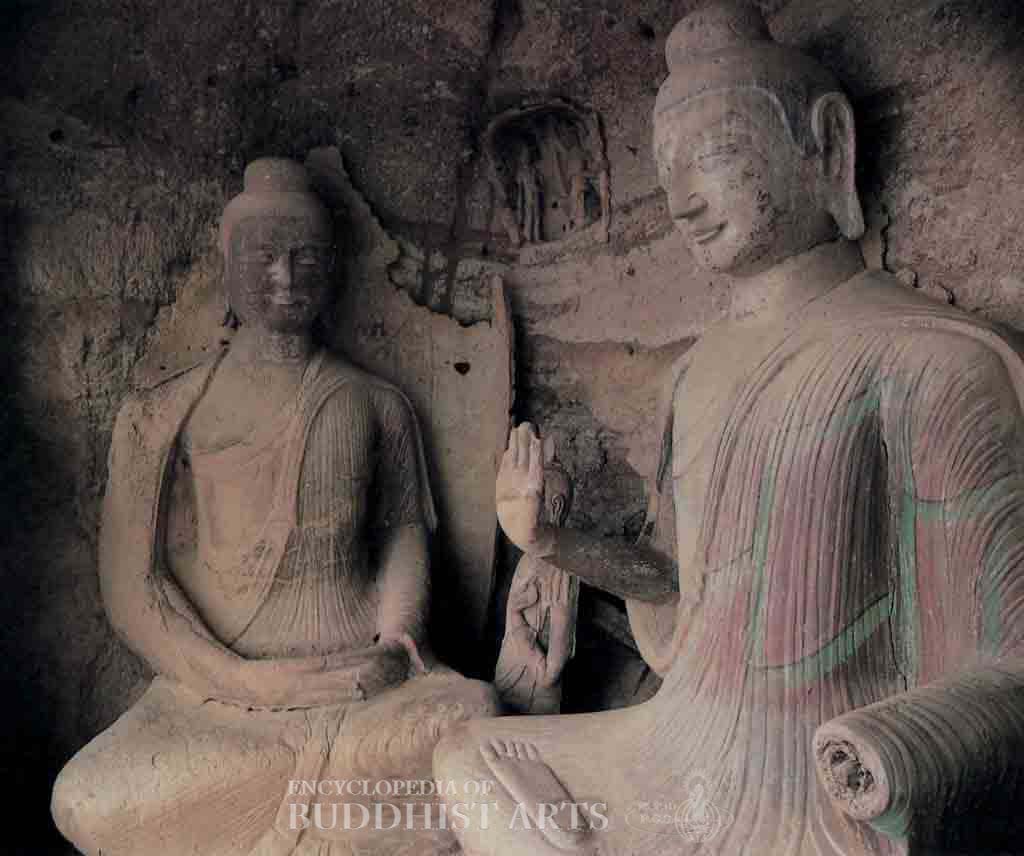
Maijishan Niche 78: Seated Buddhas (detail) (back and left walls)
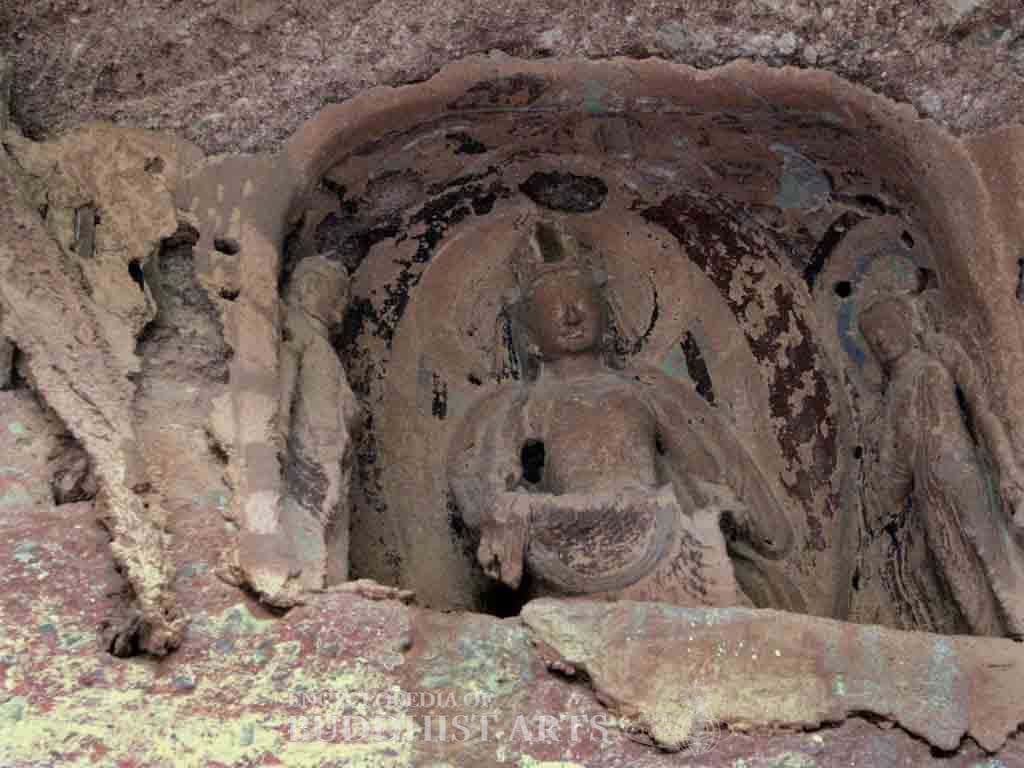
Maijishan Niche 78: Small Niche (back wall, upper right corner)

Maijishan Niche 78: Apsara (fragment)
Maijishan Niche 78
CHINA, Gansu, Tianshui
Located on the lower section of the west cliff, this grotto is 4.7 m in length and 4.5 m in height. The figures date to the Northern Wei dynasty (386–534) but some were restored in the Northern Zhou (557–581) and the Sui (581–618) dynasties. The mural is one of the earliest in the Maijishan Grottoes.
The interior of the niche has a large opening and an elaborate arched ceiling. A U-shaped altar, 90 cm in height, which extends around the perimeter of the three internal walls, supports statues of the Buddhas of the Past, Present, and Future, although the statue on the right is no longer present. The left hand of the Buddha at the center of the back wall is missing. An original attendant Bodhisattva stands on the left side of the back wall, while a Sui dynasty replacement Bodhisattva stands on the right side. A few faded murals, with a red ocher hue, remain on the walls.
The upper corners of the back wall have two small, circular arch niches approximately 60 cm in height and 70 cm in width. The left niche features a Bodhisattva seated with legs crossed at the ankles. The right niche features a Bodhisattva in contemplation, with the left leg pendent. The top left of the back wall and the ceiling of the niche on the left are decorated with the Thousand Buddhas.
Two painting fragments from the damaged altar were found in 1978. One of these is 40 cm in height and 60 cm in width, and depicts a Wisdom King, a Heavenly King, monks, and laypeople. The other fragment, 48 cm in height and 40 cm in width, depicts apsaras. The paintings date to the Northern Zhou and Sui dynasties.
For more details, go to the Encyclopedia of Buddhist Arts: Caves M-Mo, page 802.
Cite this article:
author = Hsingyun and Youheng and Johnson, Peter and Mankuang and Huntington, Susan and Edson, Gary and Neather, Robert,
booktitle = {Encyclopedia of Buddhist Arts: Caves M-Mo},
pages = 802,
title = {{Maijishan Niche 78}},
volume = 7,
year = {2016}}