
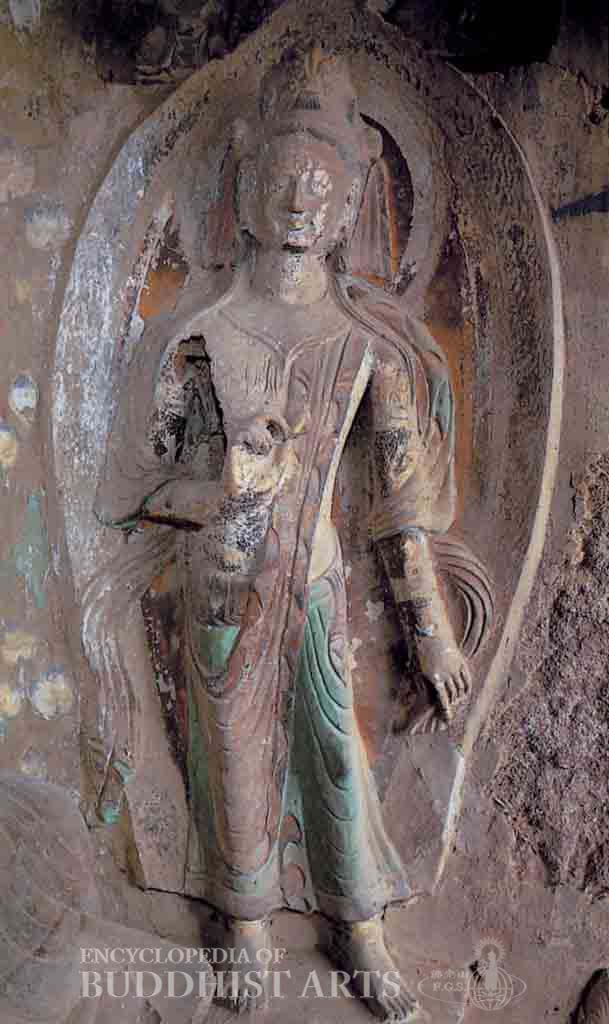
Maijishan Grotto 76: Attendant Bodhisattvas (right wall)
Clay
Maijishan Grotto 76: Attendant Bodhisattvas
CHINA, Gansu, Tianshui; Northern Wei dynasty
Both the left and right walls portray an attendant Bodhisattva who stands on a round pedestal. The heads are adorned with headdresses, and the long hair falls onto the shoulders. The slim Bodhisattvas are portrayed with a flat and square face, which contrasts with the solemn and serious main statue. Embellished with necklaces and armlets, the Bodhisattvas’ mouths turn up into gentle smiles. The Bodhisattvas wear lower garments and their stoles, which drape from the shoulders, entwine the arms. They are attached to the walls and encircled by a flame pattern mandorla with an ogee arch shape.
The style and posture of the Bodhisattvas evolved from the early Northern Wei dynasty (386–534). At that time, a typical posture had one hand placed on the chest while the other hung naturally downward. The slight alteration of their posture, with a slight swaying of the hips, produced a more dynamic and rich contour.
For more details, go to the Encyclopedia of Buddhist Arts: Caves M-Mo, page 756.
Cite this article:
author = Hsingyun and Youheng and Johnson, Peter and Mankuang and Huntington, Susan and Edson, Gary and Neather, Robert,
booktitle = {Encyclopedia of Buddhist Arts: Caves M-Mo},
pages = 756,
title = {{Maijishan Grotto 76: Attendant Bodhisattvas}},
volume = 7,
year = {2016}}