
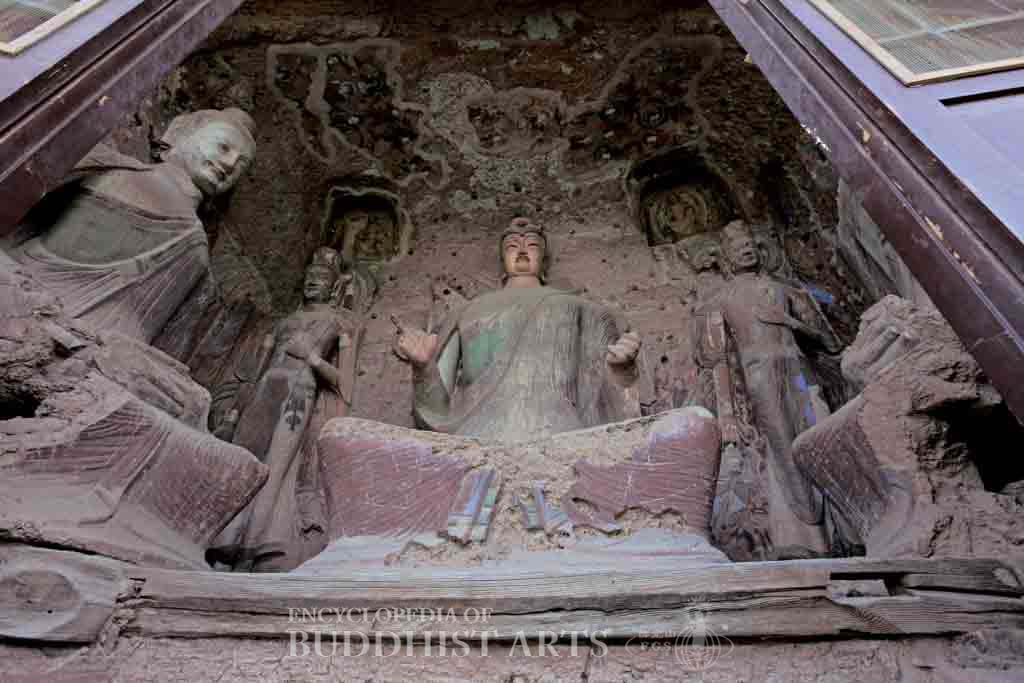
Maijishan Niche 74
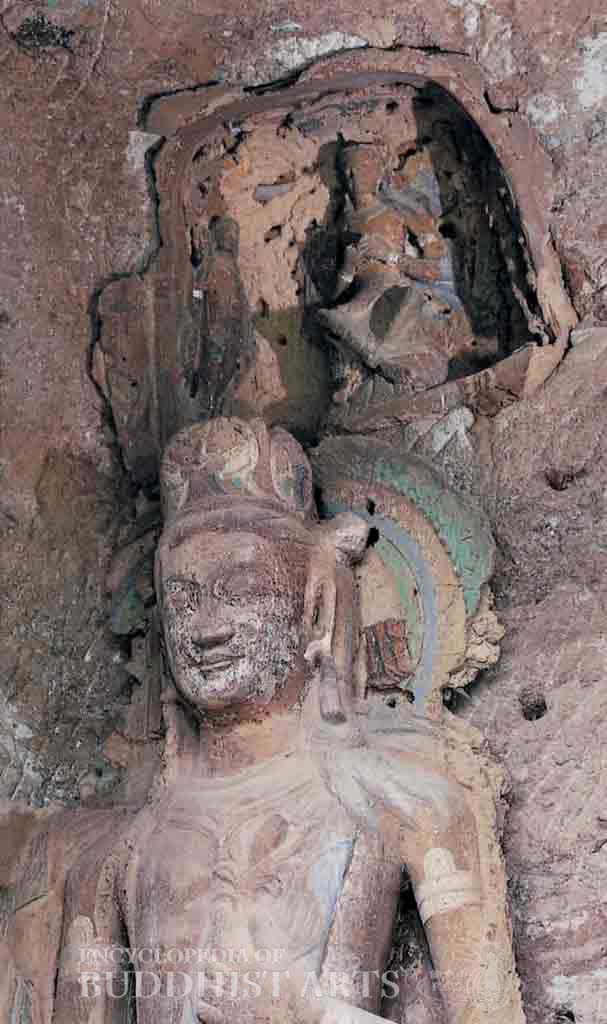
Maijishan Niche 74: Small Niche and Attendant Bodhisattva (back wall, left side)
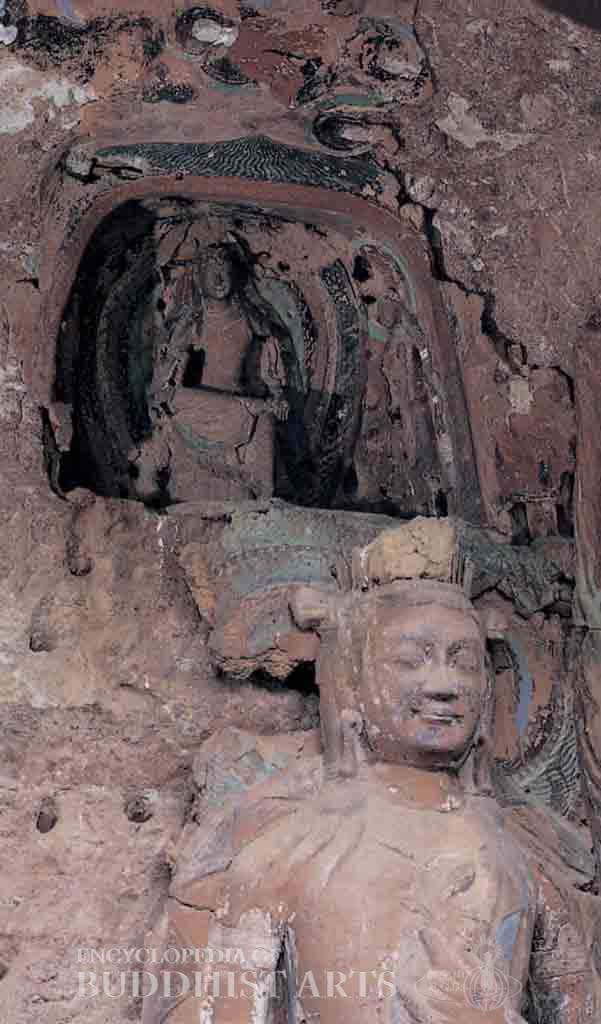
Maijishan Niche 74: Small Niche and Attendant Bodhisattva (back wall, right side)
Maijishan Niche 74
CHINA, Gansu, Tianshui
Located on the lower section of the west cliff, this large niche, with a highly ornamented ceiling, is believed to have been excavated before the Northern Wei dynasty (386–534). It is one of the earlier Maijishan grottoes, measuring 4.5 m in height and 4.7 m in width. The current figures are thought to be restored during the rule of Emperor Wencheng (reigned 452–465) after the persecution of Buddhism by Emperor Taiwu (reigned 423–452).
At the back wall, there is a seated Buddha that has been restored a number of times. The mandorla behind the statue is decorated with flame and honeysuckle patterns. The 1.64 m high attendant Bodhisattvas, which are in better condition, have long hair and headdresses, and are adorned with necklaces and armlets. Their bare torsos, which are secured to the wall, are draped in stoles with fine smooth folds. One Bodhisattva grasps a flower, while the other holds a vase. The style of the statues is very similar to the Western Qin Kingdom (384-431) sculptures at Bingling Temple Caves.
There is a small niche above each of the two attendant Bodhisattvas. The right niche, 80 cm in width and 62 cm in height, houses a Bodhisattva in contemplation, while the left niche, 71 cm in length and 65 cm in height, houses a Bodhisattva seated with legs crossed at the ankles. Both are similar to those found in Niche 78. Each side wall has a seated Buddha who forms the dhyana (meditation) mudra. The head of the seated Buddha on the right side is broken, while the one on the left is well preserved. The seated Buddha on the left is 2.8 m in height and is similar to the one in Niche 78, which has a high usnisa and wavy pattern hairstyle. The Buddha wears an inner robe underneath the outer monastic robe, which covers only the left shoulder. The simple niche is skillfully carved with lucid shaded lines, which creates a pleasing effect. There are remnants of the Thousand Buddhas depicted on the lintel as well as on the left and right walls.
For more details, go to the Encyclopedia of Buddhist Arts: Caves M-Mo, page 801.
Cite this article:
author = Hsingyun and Youheng and Johnson, Peter and Mankuang and Huntington, Susan and Edson, Gary and Neather, Robert,
booktitle = {Encyclopedia of Buddhist Arts: Caves M-Mo},
pages = 801,
title = {{Maijishan Niche 74}},
volume = 7,
year = {2016}}