
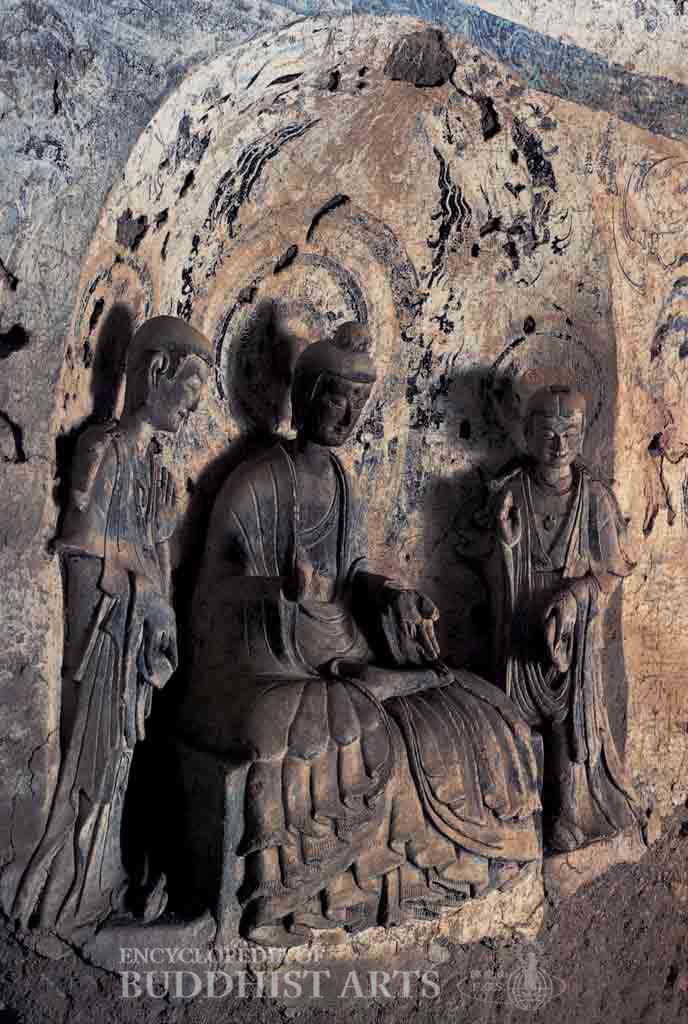
Maijishan Grotto 135: Buddha Triad (right wall)
Clay
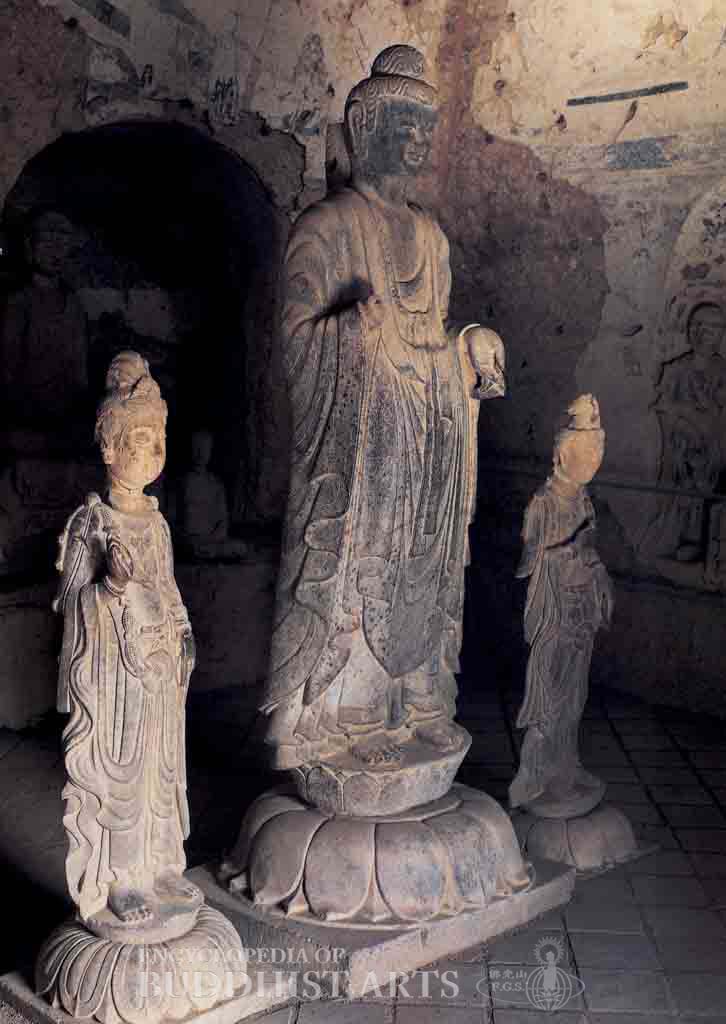
Maijishan Grotto 135: Buddha Triad (middle right of grotto)
Stone
Maijishan Grotto 135
CHINA, Gansu, Tianshui
This rectangular grotto, located in the upper tier of the west cliff, first underwent excavation during the Western Wei dynasty (535–556), with a niche in the back and side walls. During the Northern Zhou dynasty (557–581), the hewing of two extra niches took place on either side of the back wall, in addition to three windows at the top of the front wall for lighting and ventilation.
The original central niche on the back wall, which dates to the Western Wei dynasty, was restored during the Song dynasty (960–1279) and contains a seated Buddha flanked by two attendant Bodhisattvas. The right niche houses three seated Buddhas, while the left niche has a seated Buddha with two attendant Bodhisattvas.
The niche on the right wall contains a Buddha triad. The 1.37 m high Buddha sits in full lotus position on a rectangular throne. The Buddha’s left hand forms the varada (wish-granting) mudra, albeit with damaged fingers. His robe hangs down and covers the throne before him. The two attendant Bodhisattvas flanking the Buddha each measures 1.2 m in height. The Bodhisattvas, with similar postures and adornments, wear long robes. Nimbuses are painted on the wall behind their heads. The niche on the left wall contains a similar arrangement. In the middle right side of the grotto, there is a set of freestanding statues depicting a Buddha triad standing on lotus pedestals.
The grotto features many murals, of which 50 sq m are intact. The mural on the upper back wall contains an illustration of the Mahaparinirvana Sutra that primarily features the Distribution of Relics Among the Eight Kings, as well as the Buddha’s cremation. The upper sections of the side walls and on both sides of the central niche on the back wall feature murals of the Buddha teaching the Dharma. The mandorla behind the Buddha is decorated with apsaras images and flame pattern. The three walls and the statues contain many inscriptions dating from the Song to the Qing (1644–1911) dynasties.
For more details, go to the Encyclopedia of Buddhist Arts: Caves M-Mo, page 786.
Cite this article:
author = Hsingyun and Youheng and Johnson, Peter and Mankuang and Huntington, Susan and Edson, Gary and Neather, Robert,
booktitle = {Encyclopedia of Buddhist Arts: Caves M-Mo},
pages = 786,
title = {{Maijishan Grotto 135}},
volume = 7,
year = {2016}}