
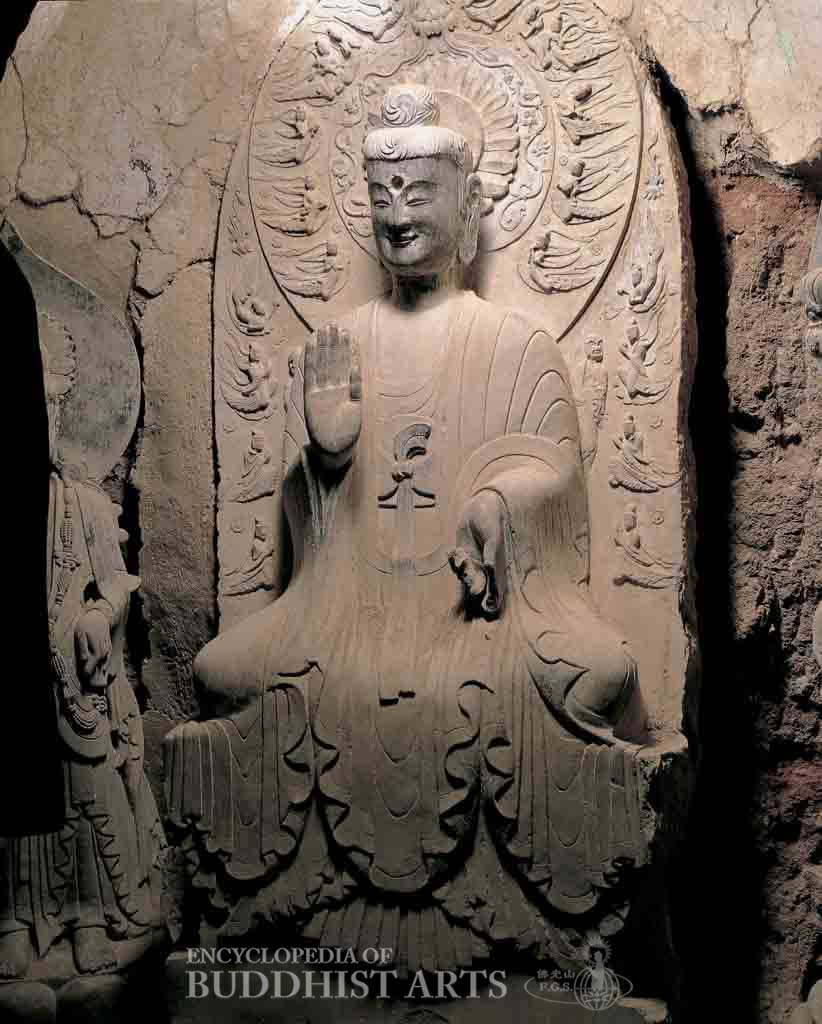
Maijishan Grotto 127: Buddha and Attendant Bodhisattva (back wall)
Maijishan Grotto 127
CHINA, Gansu, Tianshui
This grotto from the Western Wei dynasty (535–556), located in the upper tier of the west cliff, is rectangular with a truncated pyramidal ceiling and measures 8 m in width, 4 m in height, and 4 m in depth. There is an arched niche in each of the grotto’s three walls. The niche in the back wall houses a Buddha, 1.69 m in height, seated in full lotus position with two attendant Bodhisattvas. The Buddha’s outer monastic robe reveals an inner robe tied with a sash knotted in the middle. The right hand forms the abhaya (fearlessness) mudra and the left hand displays the varada (wish-granting) mudra. Behind the Buddha there are a circular, three-layered nimbus and a large mandorla. The nimbus has a lotus at the center, with winding vines in the middle layer and heavenly musicians in the outer layer. On the mandorla’s sides are apsaras, figures making offerings, and two disciples. All of these features are carved in bas-relief from a single stone block.
The two identical attendant Bodhisattvas, 1.2 m in height, stand barefooted on lotus pedestals. Each Bodhisattva has a nimbus with a lotus flower behind the head. Their tall topknots are highly ornamented and they wear long, soft robes. Each of the two shallow niches on the left and right walls has a Buddha with two attendant Bodhisattvas. The Buddhas are restored during the Song dynasty (960–1279), while the Bodhisattvas were originals from the Western Wei dynasty.
The murals preserved in the grotto cover 99 sq m and are mostly originals from the Western Wei dynasty, except for a few that were restored during the Ming dynasty (1368–1644). On the back wall is a mural depicting scenes from the Mahaparinirvana Sutra. The mural on top of the niche on the right wall contains an illustration of the Vimalakirti Sutra. The mural above the niche on the left wall illustrates scenes of the Western Pure Land, while the front wall has depictions of the Seven Buddhas and the Ten Wholesome and Unwholesome Deeds. The center of the ceiling portrays Sakra, and the left and right ceiling slopes contain scenes from the Prince Mahasattva Jataka. The back slope is painted with a Jataka, and the front slope illustrates the Syama Jataka.
Scattered throughout the walls and on the nimbuses of various figures are inscriptions from the Tang dynasty (618–907), the Five Dynasties (907–960), the Song dynasty, and the Yuan dynasty (1271–1368). The inscriptions suggest that the grotto was dedicated to Empress Yifu, who was the mother of Prince Wudu, Yuan Wu, from the Western Wei dynasty.
For more details, go to the Encyclopedia of Buddhist Arts: Caves M-Mo, page 768.
Cite this article:
author = Hsingyun and Youheng and Johnson, Peter and Mankuang and Huntington, Susan and Edson, Gary and Neather, Robert,
booktitle = {Encyclopedia of Buddhist Arts: Caves M-Mo},
pages = 768,
title = {{Maijishan Grotto 127}},
volume = 7,
year = {2016}}