
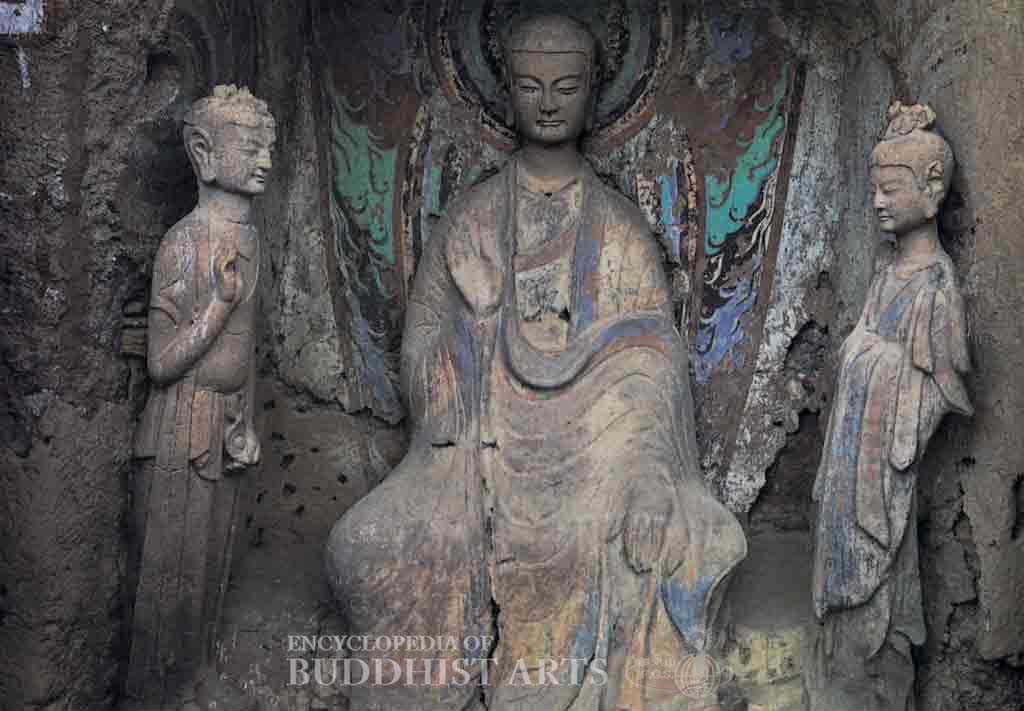
Maijishan Niche 60: Amitabha Buddha Triad (back wall)
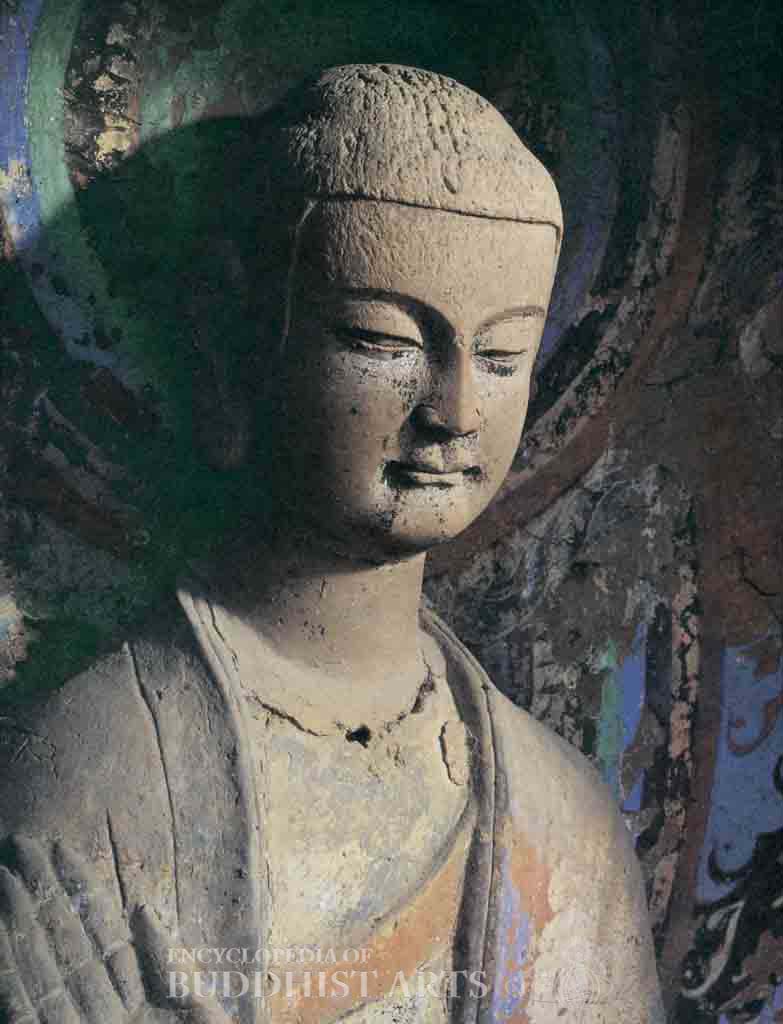
Maijishan Niche 60: Amitabha Buddha (detail) (back wall)
Maijishan Niche 60
CHINA, Gansu, Tianshui
This shallow, arch-shaped niche with a slanted ceiling is located on the west side of the west cliff. The grotto was excavated in the Western Wei dynasty (535–556) and was restored during the Sui dynasty (581–618). The back wall consists of a seated Amitabha Buddha statue that was restored throughout the Northern Zhou dynasty (557–581) and the Sui dynasty. The statue is flanked by two attendant Bodhisattvas, the left of which was restored during the Sui dynasty.
The 1.23 m high Amitabha Buddha is seated in full lotus position. An outer monastic robe worn over the inner robe covers both of the Buddha’s shoulders. The curvature of the outer robe creates a very distinct shading effect. Both of the arms are drawn in close to the body and the left hand extends down, while the right hand is raised to the chest with an open palm that faces the viewer. Painted in colors of azurite, mineral green, red, and black on the back wall, the mandorla is patterned with flames, honeysuckles, lotuses, and beads. However, parts of the mandorla have deteriorated. The Amitabha Buddha is flanked by Avalokitesvara Bodhisattva on the right and Mahasthamaprapta Bodhisattva on the left, forming an Amitabha Buddha Triad. The 1.06 m high Avalokitesvara is of the original Western Wei style. Mahasthamaprapta, 1.04 m in height, wears a necklace and has shoulders covered by a stole. A dhoti is folded at the waist. In Mahasthamaprapta’s left hand is a jewel held below the waist as the right hand is raised. Each Bodhisattva is preserved in their original colors of azurite, green, red, and white, which gives them a resplendent and exquisite appearance.
For more details, go to the Encyclopedia of Buddhist Arts: Caves M-Mo, page 798.
Cite this article:
author = Hsingyun and Youheng and Johnson, Peter and Mankuang and Huntington, Susan and Edson, Gary and Neather, Robert,
booktitle = {Encyclopedia of Buddhist Arts: Caves M-Mo},
pages = 798,
title = {{Maijishan Niche 60}},
volume = 7,
year = {2016}}