
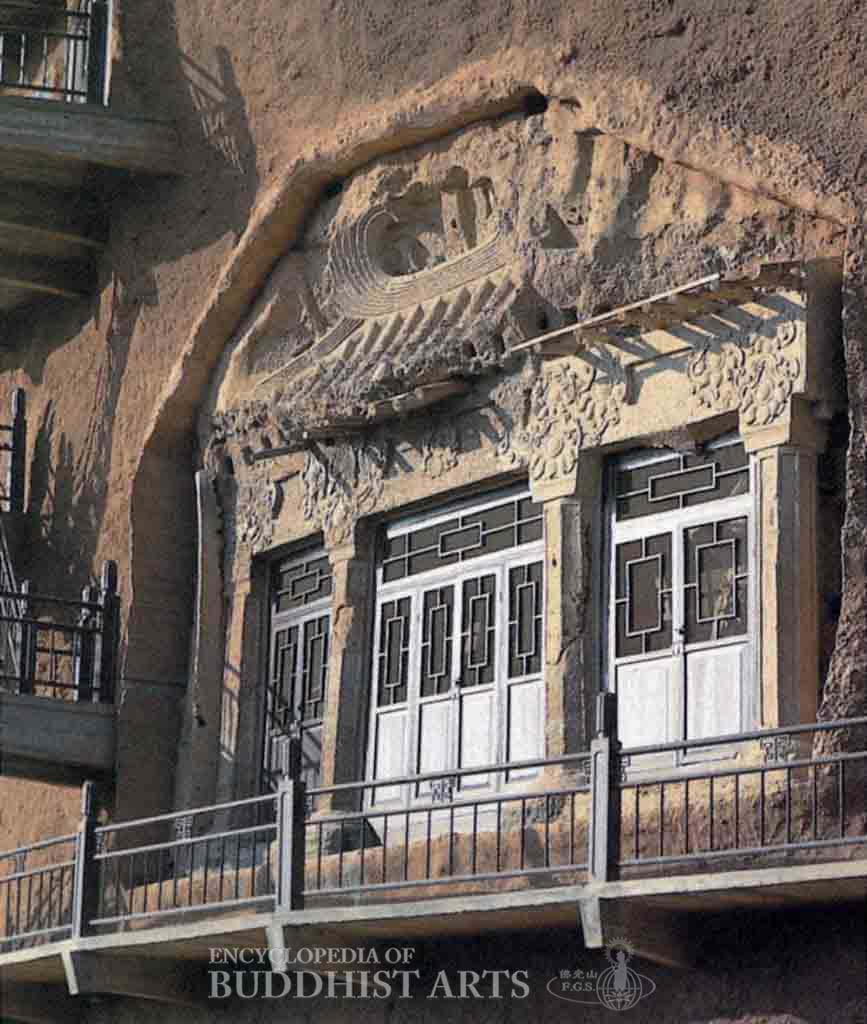
Maijishan Grotto 43
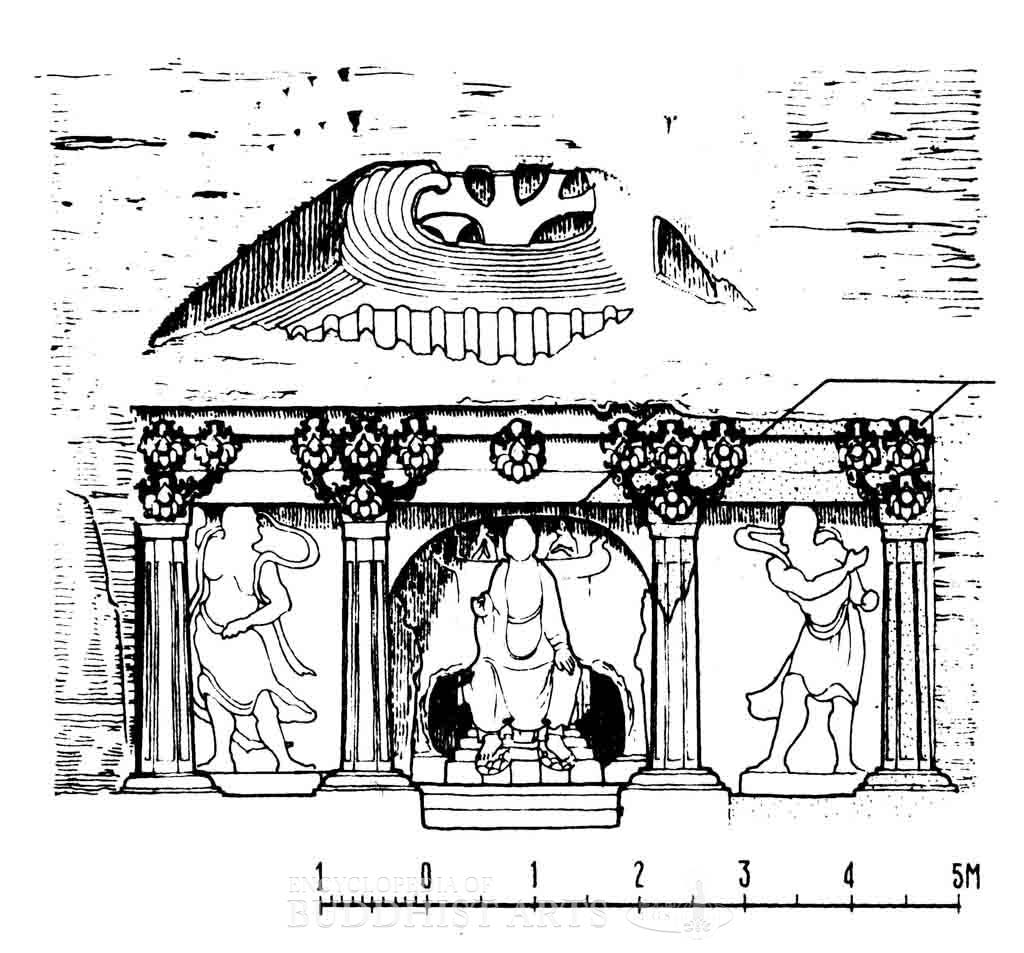
Maijishan Grotto 43 (elevation drawing)
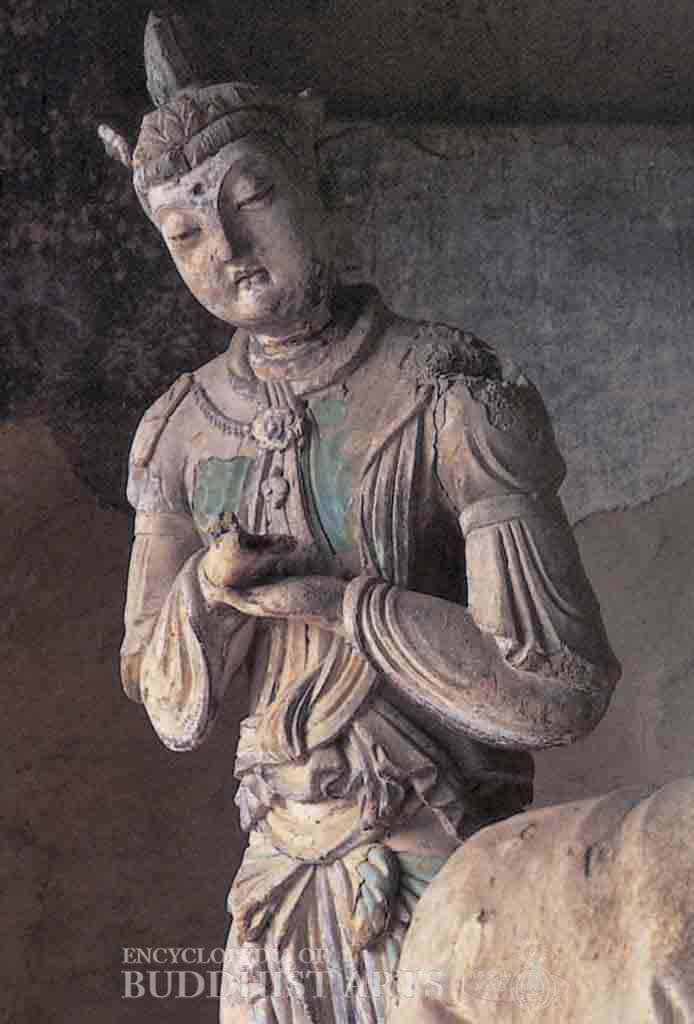
Maijishan Grotto 43: Bodhisattva (back wall, left side)
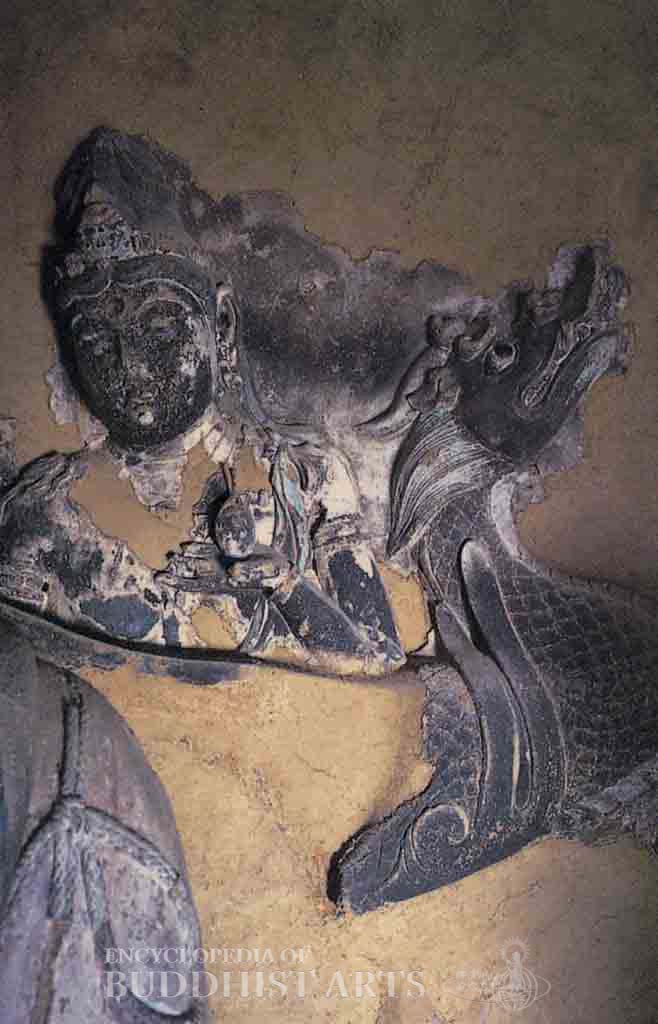
Maijishan Grotto 43: Bodhisattva Making an Offering (right niche, exterior)
Clay
Maijishan Grotto 43
CHINA, Gansu, Tianshui
Excavated during the Western Wei dynasty (535–556), the grotto is located in the lower section of the east cliff. It was restored in the Song (960–1279) and the Ming (1368–1644) dynasties. The grotto was constructed with a delicate carving style to have the appearance of a wooden structure. It consists of a portico, front chamber, and rear chamber. The rear chamber, with a truncated pyramidal ceiling, was the temporary burial grotto of Empress Yifu, the wife of Emperor Wen (reigned 535–551) who named the grotto Jiling (Silent Tomb).
The three bays of the facade, measuring 6.65 m in width and 2.7 m in height, are framed by four octagonal columns. The column plinths are shaped as overturned basins. Imitation bracket sets, decorated with lotuses, are carved above the column capitals. There are wooden architectural elements such as a beams, eaves, and rafters, and the hip roof is composed of round corrugated tiles. Each end of the ridge is decorated with an ornament. Many of the roof tiles have experienced serious erosion over the years. Under the eaves is the portico, 1.2 m in depth. A clay warrior from the Song dynasty stands on each side bay. The back wall of the central bay, with a flame pattern on the arched lintel, has a gateway that opens into the front chamber.
The oval front chamber, 3.4 m in width and 1.9 m in depth, has a vaulted ceiling and a large niche on the back wall. The niche houses a Song dynasty seated Buddha with legs pendent and attended by two Bodhisattvas. The back wall of the niche displays a Song dynasty relief of a dragon throne with a backrest and flanked by two Bodhisattvas making offerings. Inscriptions dated to the Southern Song (1127–1279) and Yuan (1271–1368) dynasties are found inside the niche. The entrance of a corridor that connects to the rear chamber is located on the lower section of the back wall, but it is blocked by the seated Buddha. In the upper corner on each side of the large niche, there is a smaller niche with traces of Western Wei dynasty mural, depicting apsaras, honeysuckle pattern, and lotus flowers. Remnants of a Bodhisattva making an offering from the Song dynasty are located outside the smaller niche on the right.
The trapezoidal rear chamber has a truncated pyramidal ceiling. It measures 3.2 m in depth, 1.73 m in height, and 2.5 m to 2.15 m in width. A stone statue with a mandorla is located in the front section of the rear chamber, with reliefs of two disciples carved within the mandorla.
For more details, go to the Encyclopedia of Buddhist Arts: Caves M-Mo, page 747.
Cite this article:
author = Hsingyun and Youheng and Johnson, Peter and Mankuang and Huntington, Susan and Edson, Gary and Neather, Robert,
booktitle = {Encyclopedia of Buddhist Arts: Caves M-Mo},
pages = 747,
title = {{Maijishan Grotto 43}},
volume = 7,
year = {2016}}