
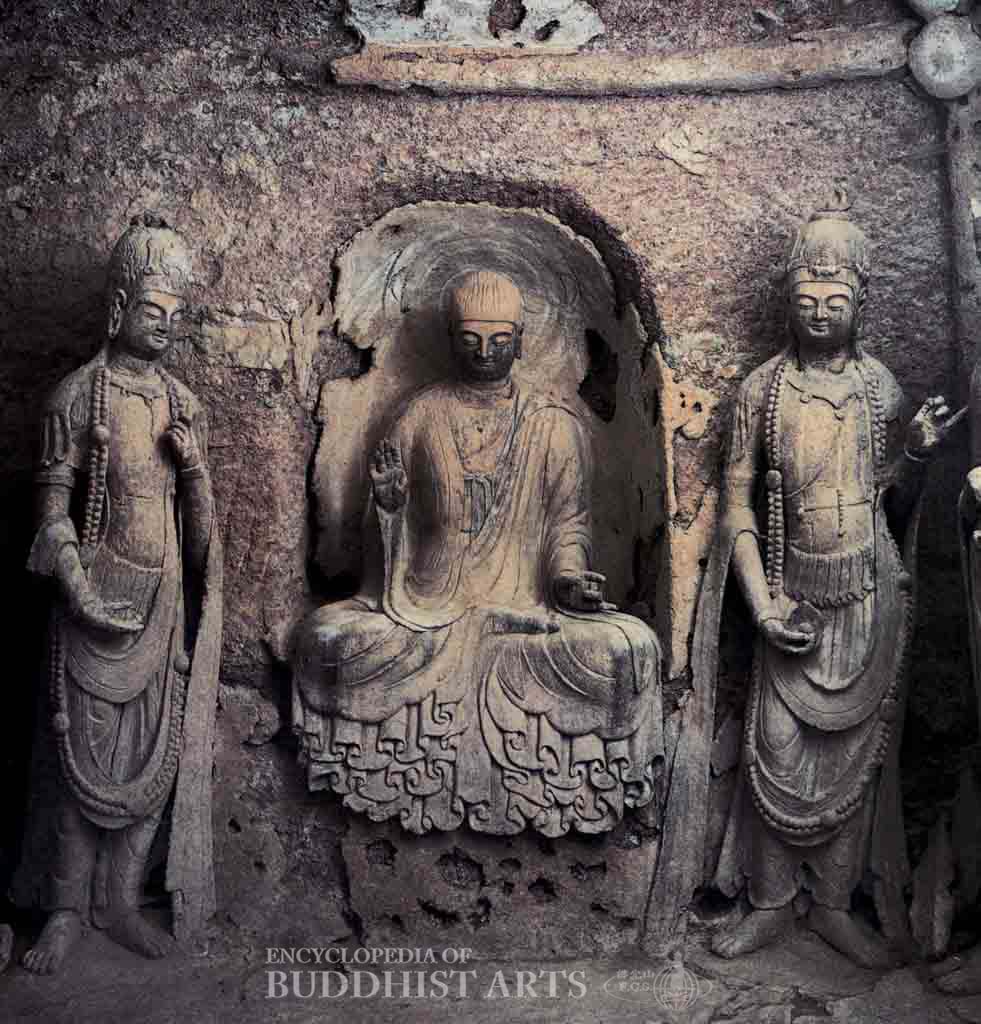
Maijishan Grotto 62: Buddha and Bodhisattvas (back wall)

Maijishan Grotto 62: Buddha and Bodhisattvas (left wall)
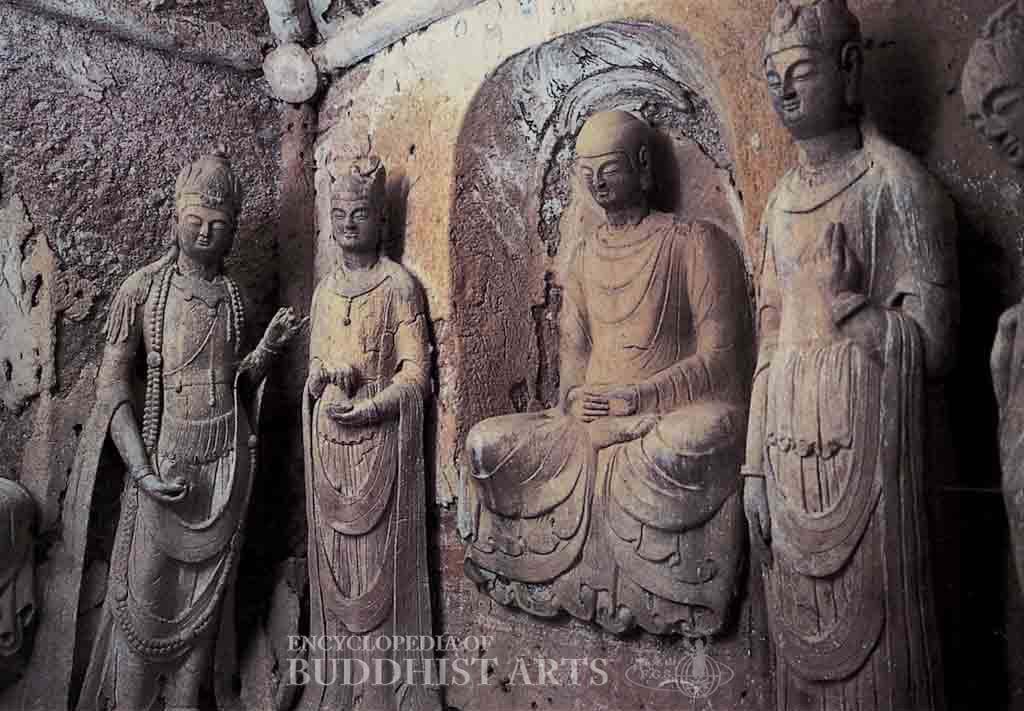
Maijishan Grotto 62: Buddha and Bodhisattvas (right wall)
Maijishan Grotto 62
CHINA, Gansu, Tianshui
First excavated in the Northern Zhou dynasty (557–581), this rectangular grotto with a pyramidal ceiling is located in the middle section of the west cliff. The grotto’s 12 statues are well preserved and have never been restored. A statue of a warrior stands on the right side of the grotto’s opening, which was once mirrored by a similar statue on the other side. A statue of a disciple, almost 1 m in height, stands within each side of the doorway. The door lintel is inscribed with the year 918, and the left side of the doorway is inscribed with 952. Two apsaras offering jewels are depicted on the back ceiling slope, while the Thousand Buddha images are depicted on the other three slopes.
In the arched niche at the back wall, a 92 cm high Buddha is seated in full lotus position and forms the abhaya (fearlessness) mudra with the right hand. The eyes of the Buddha are partially closed and the mouth, with slightly raised corners, expresses a gentle smile. The Buddha is portrayed with both an outer and inner robe. The outer monastic robe trails over the throne. The Buddha is flanked by two slender Bodhisattvas, the right of which is 115 cm in height and the left is 112 cm in height. With faces similar to the Buddha’s, each Bodhisattva is adorned with a headdress, a necklace, and ornaments that drape from the shoulders. The left and right walls of the grotto each feature a niche, which houses an 89 cm to 90 cm high seated Buddha whose hands form the dhyana (meditation) mudra. Similar in proportion, the Buddhas on the side walls are shorter than the main seated Buddha. The two slightly shorter Bodhisattvas outside the niches are also slightly shorter than those that flank the main Buddha.
For more details, go to the Encyclopedia of Buddhist Arts: Caves M-Mo, page 752.
Cite this article:
author = Hsingyun and Youheng and Johnson, Peter and Mankuang and Huntington, Susan and Edson, Gary and Neather, Robert,
booktitle = {Encyclopedia of Buddhist Arts: Caves M-Mo},
pages = 752,
title = {{Maijishan Grotto 62}},
volume = 7,
year = {2016}}