
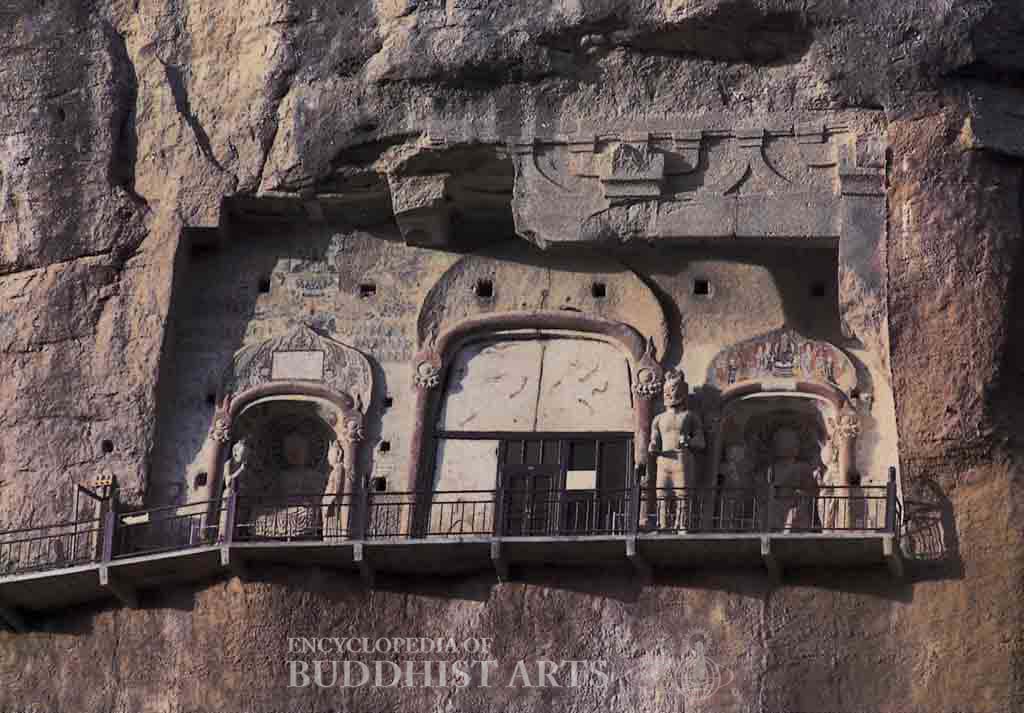
Maijishan Grotto 5: Facade
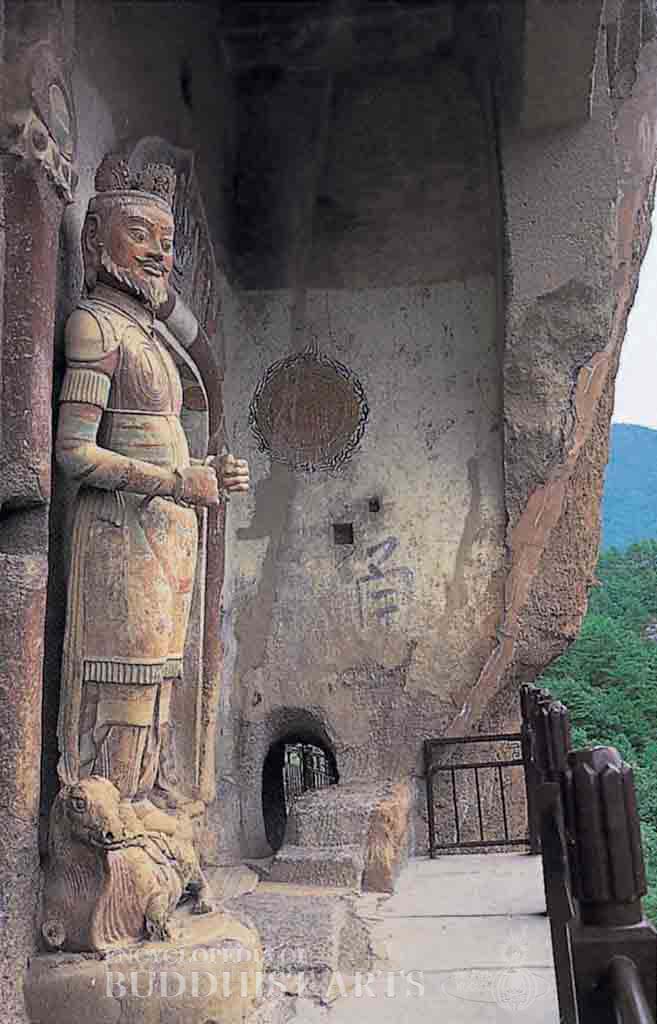
Maijishan Grotto 5: Mahesvara (right of entrance); Sui dynasty
Clay
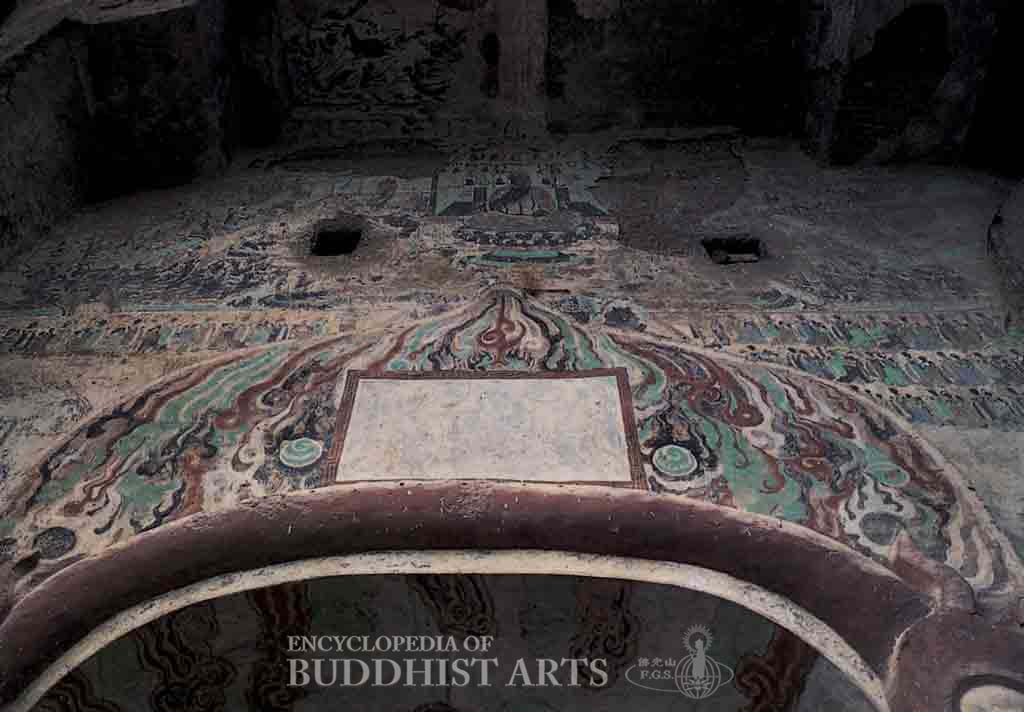
Maijishan Grotto 5: Lintel (left niche)
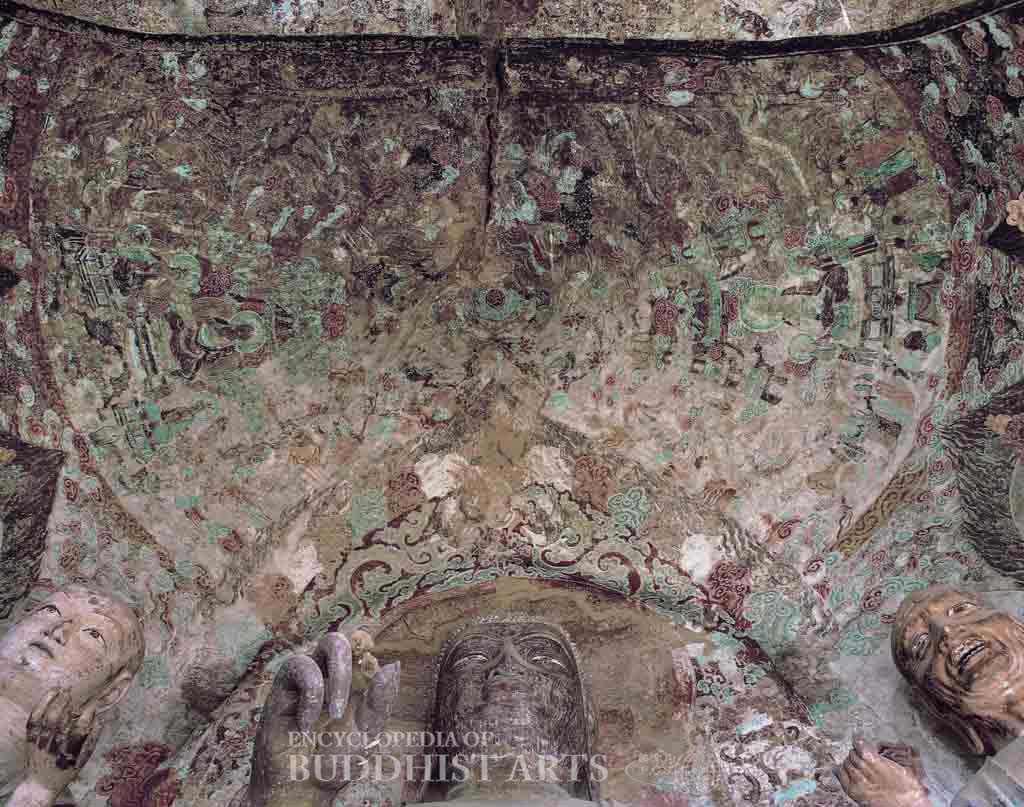
Maijishan Grotto 5: Ceiling (middle niche)
Maijishan Grotto 5
CHINA, Gansu, Tianshui
Also called Ox Hall, Grotto 5 is located west of Grotto 4 on the highest tier of the east cliff. Constructed to resemble wooden architecture, the grotto has three bays. The most significant part of the grotto is the portico, 15.9 m in length and 11 m in height. Most of the portico is damaged. On the left, a portion of the eave is missing and only one column on the right remains. Although the majority of Grotto 5’s sculptures are from the Tang dynasty (618–712), the earliest sculptures date to the Sui dynasty (581–618) and were restored during the Ming dynasty (1368–1644). There are well-preserved murals on the upper left section of the facade and the damaged left wall of the portico.
The facade consists of three horseshoe shaped niches. The larger middle niche, which has a vaulted arch, contains a seated Buddha flanked by Mahakasyapa and Ananda. The niche’s painted ceiling, decorated with a pagoda, lotus flowers, apsaras, and other figures depicts the Buddha teaching the Dharma. Most of the extant murals are from the Ming dynasty. Placed to the right of the niche is a statue of Mahesvara, 4.5 m in height, with headdress and armor. Mahesvara stands on the back of an ox, hence the name of the grotto. This Sui dynasty statue was restored in the Tang, Song, and Ming dynasties. Another statue once stood on the left side of the niche. Each of the left and right niches holds a seated Buddha with two flanking Bodhisattvas, which were restored in the Tang and Ming dynasties. The figures’ aureoles are painted on the niche’s wall. The lintel above the left niche depicts the Buddha teaching the Dharma and the lintel above the left niche displays a flaming jewel and two groups of figures making offerings. The top of the lintel has an illustration of the Western Pure Land. On the right side of the lintel, three rows of female figures making offerings are depicted, and there are similar male figures on the left side.
The portico’s ceiling is divided into 18 rows with six panels in each row. One preserved row depicts a galloping horse, a running elephant, an apsara scattering flowers, and a wish-fulfilling jewel. On the left, there are traces of a sutra illustration from the Tang dynasty, apsaras, and the Buddha teaching the Dharma. On the wall to the right of the middle niche, there are inscriptions from the Song and Ming dynasties. The left wall has one inscription that dates to the Song dynasty.
For more details, go to the Encyclopedia of Buddhist Arts: Caves M-Mo, page 737.
Cite this article:
author = Hsingyun and Youheng and Johnson, Peter and Mankuang and Huntington, Susan and Edson, Gary and Neather, Robert,
booktitle = {Encyclopedia of Buddhist Arts: Caves M-Mo},
pages = 737,
title = {{Maijishan Grotto 5}},
volume = 7,
year = {2016}}