
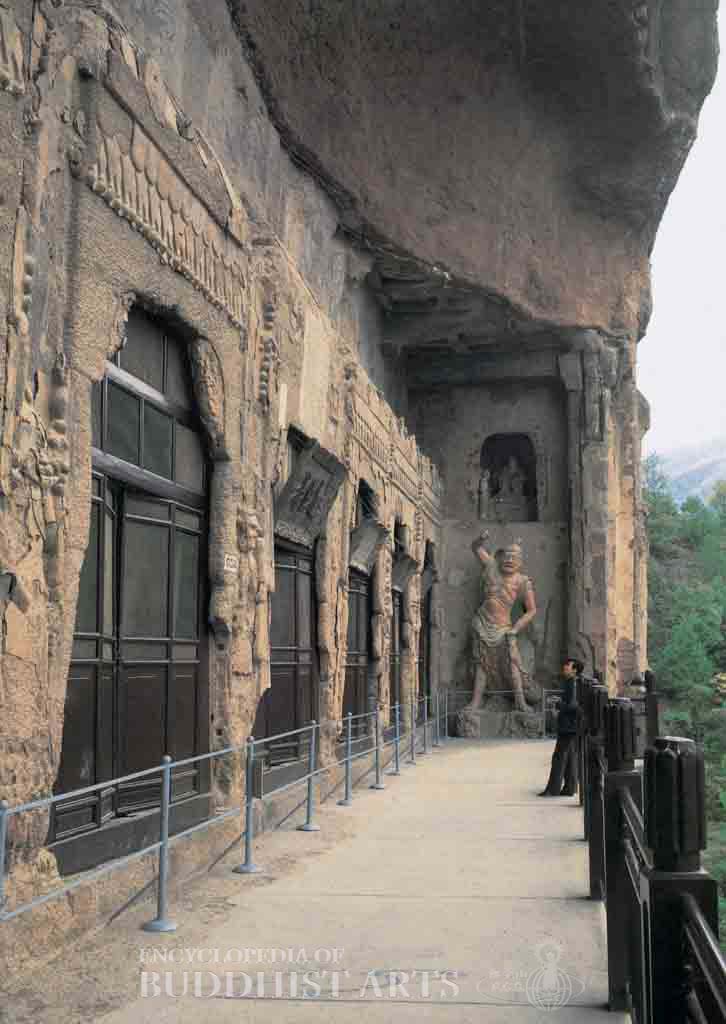
Maijishan Grotto 4: Portico
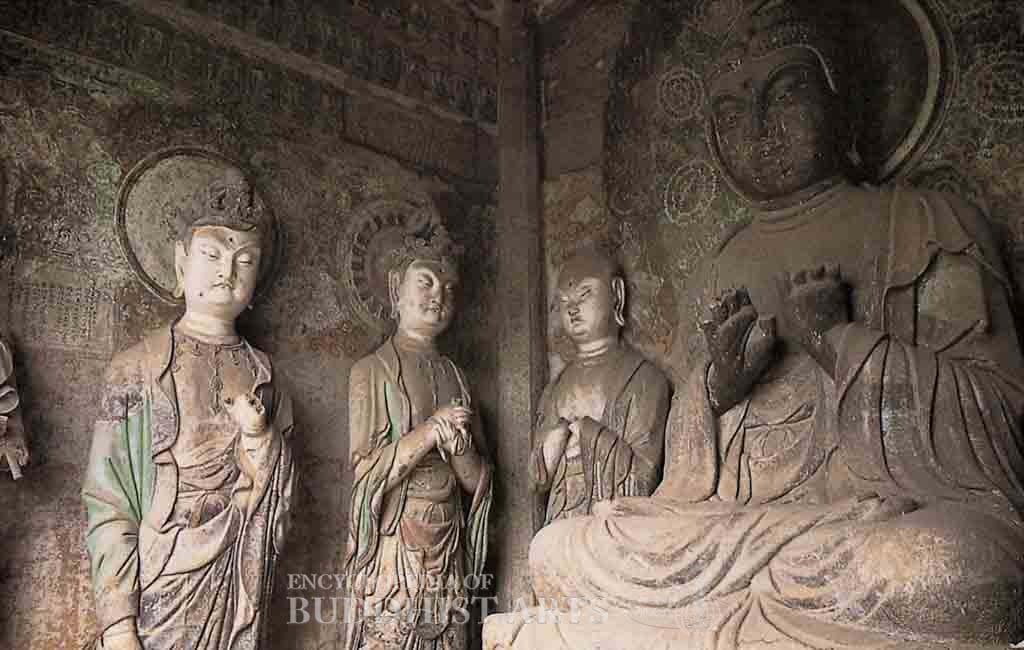
Maijishan Grotto 4: Niche 7 - Buddha, Disciple, and Bodhisattvas (back and left walls)
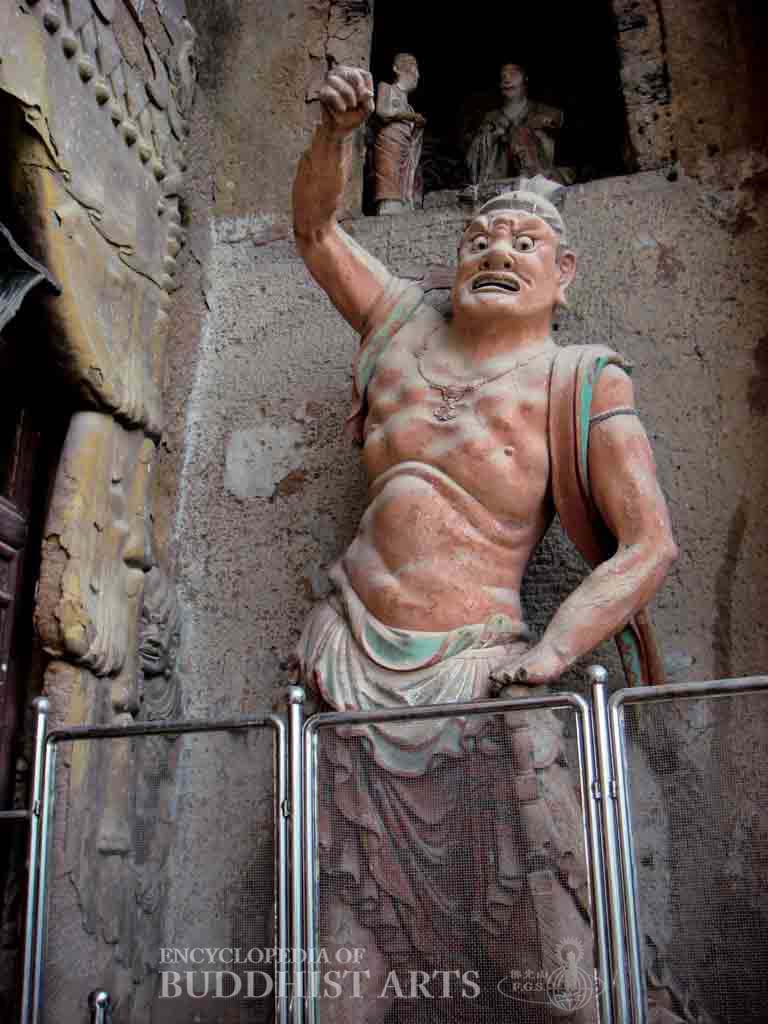
Maijishan Grotto 4: Warrior (portico, right wall)
Clay
Maijishan Grotto 4
CHINA, Gansu, Tianshui
Grotto 4, located 80 m above ground on the east cliff, is the highest and the largest grotto at Maijishan. Together with Grottoes 3 and 168, they form a complex. Grotto 4 was constructed during the Northern Zhou dynasty (557–581) and was renovated in the Sui (581–618), Tang (618–907), Song (960–1279), and Ming (1368–1644) dynasties. Constructed to imitate wooden architecture, the structure consists of seven niches sheltered by a portico. The façade was sculpted to appear as a seven bay structure covered by a hip roof. It is the largest grotto in China that imitates the traditional wooden architectural style.
The Collected Writings of Yu Zishan written in the Northern Zhou dynasty recorded that the Commander- in-Chief, Li Yunxin, erected a plank pathway across the face of the cliff and constructed seven Buddha niches on the south cliff in memory of his late father. Grotto 4 is also known as the Seven Buddha Pavilion, and the niches in this grotto may be the ones erected by Li Yunxin; however, Maijishan Grotto 9 is also known as the Seven Buddha Pavilion.
Originally, the portico was supported by eight columns, but presently only two corner columns 8 m in height are preserved. The portico measures 31.5 m in width, 8.75 m in height, and 3.5 m in depth. Although damaged, the column surface reveals an octagonal shape. The seven niches, with pyramidal ceilings and canopy patterns, are hewn behind the facade wall. The portico ceiling originally had many panels; however, only five panels remain.
At the back wall of each niche, there is a seated Buddha, sculpted in the Song dynasty and restored in the Ming dynasty. Mahakasyapa and Ananda flank the seated Buddha in each niche, except in Niches 3 and 5 where two Bodhisattvas flank the seated Buddha. Each side wall of every niche has three Bodhisattvas, and all three walls have the original reliefs of the Thousand Buddhas from the Northern Zhou dynasty. The left and right walls of Niche 1 preserve five original Bodhisattva statues and in the center there are two standing Buddha statues from the Song dynasty. The lintel of the Buddha niche is decorated with a stylized canopy and seven groups of apsaras. Beginning on the right, the first, third, fifth, and seventh groups consists of four heavenly musicians, while the second, fourth and sixth groups are have four heavenly beings making offerings. All of these images were created by combining bas-relief sculpture with wall painting.
The wall space between niches is decorated with reliefs that depict the Eight Classes of Dharma Protectors garbed as ancient Chinese warriors. The reliefs between Niche 1 and the right corner wall, as well as between Niches 1 and 2, are well preserved. Although the reliefs have been restored many times, the carving technique of the Northern Zhou dynasty is still evident. A Bodhisattva is painted above the Eight Classes of Dharma Protectors, while the upper sections of Niches 6 and 7 are adorned with illustrations from the Life of the Buddha and a few apsaras. A hole in the lower section of the left wall connects to Grotto 5.
Both side walls of the portico consist of a Song dynasty warrior that is 4.5 m in height. The warriors, half-clothed, with the lower body draped in a garment fastened at the waist, stand in a menacing posture and stare fiercely with wide-open eyes. The upper section of each side wall of the portico has a large niche. These niches were carved in the Song dynasty and restored during the Ming dynasty. The upper niche of the right wall consists of the seated Vimalakirti, one disciple, and three female heavenly beings. The upper niche on the left wall contains the seated Manjusri Bodhisattva, a Bodhisattva, and three disciples. The combined figures of these niches represent the Vimalakirti Sutra.
Throughout the grotto, there are numerous inscriptions either engraved or written in ink. One inscription can be seen on the face of the cliff next to the plank walkway of Grotto 3. Except for Niche 3, every niche contains at least one inscription. In addition, there are inscriptions on the left wall of the portico and on the portico’s columns.
For more details, go to the Encyclopedia of Buddhist Arts: Caves M-Mo, page 732.
Cite this article:
author = Hsingyun and Youheng and Johnson, Peter and Mankuang and Huntington, Susan and Edson, Gary and Neather, Robert,
booktitle = {Encyclopedia of Buddhist Arts: Caves M-Mo},
pages = 732,
title = {{Maijishan Grotto 4}},
volume = 7,
year = {2016}}