
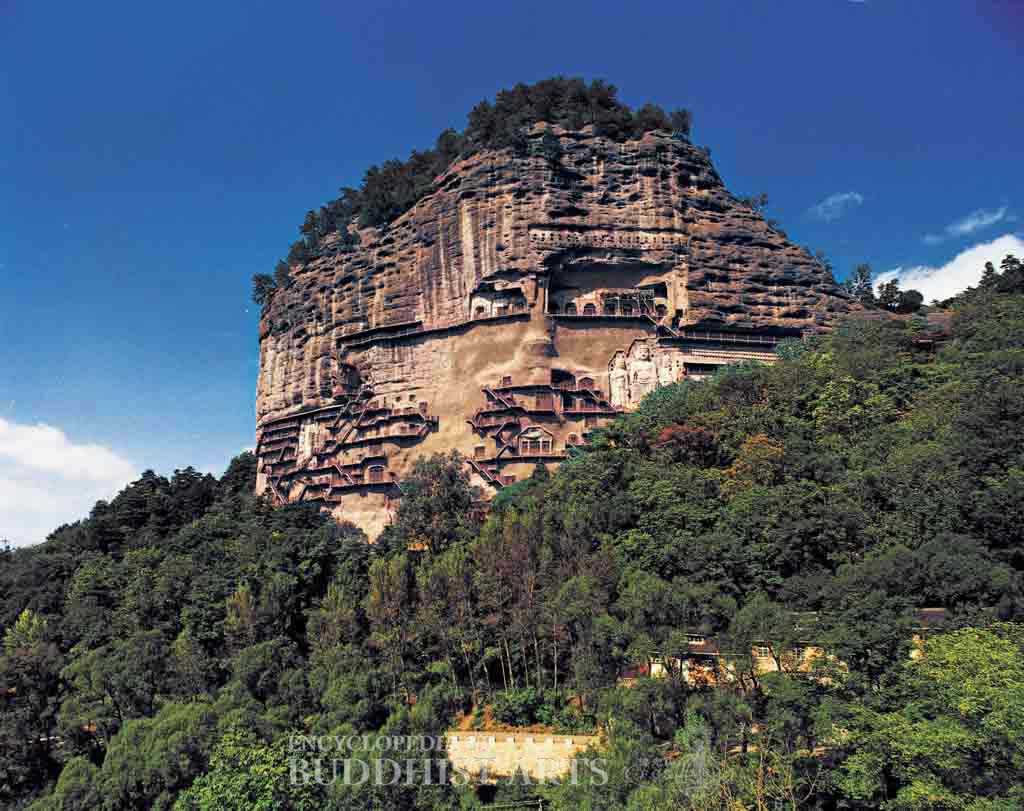
Maijishan Grottoes
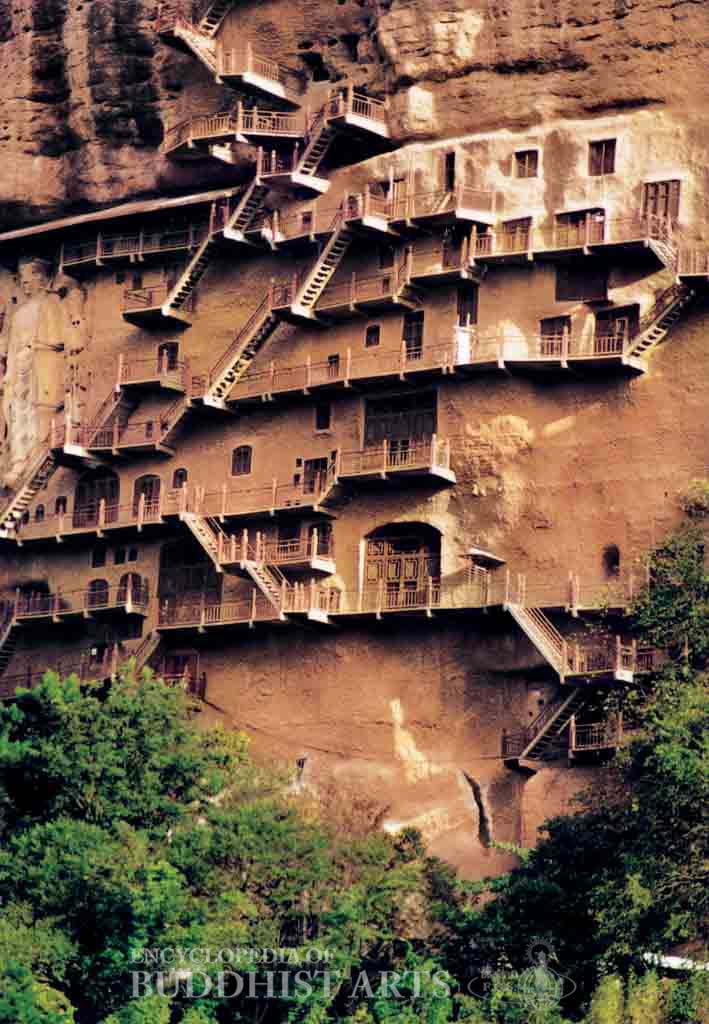
Maijishan Grottoes
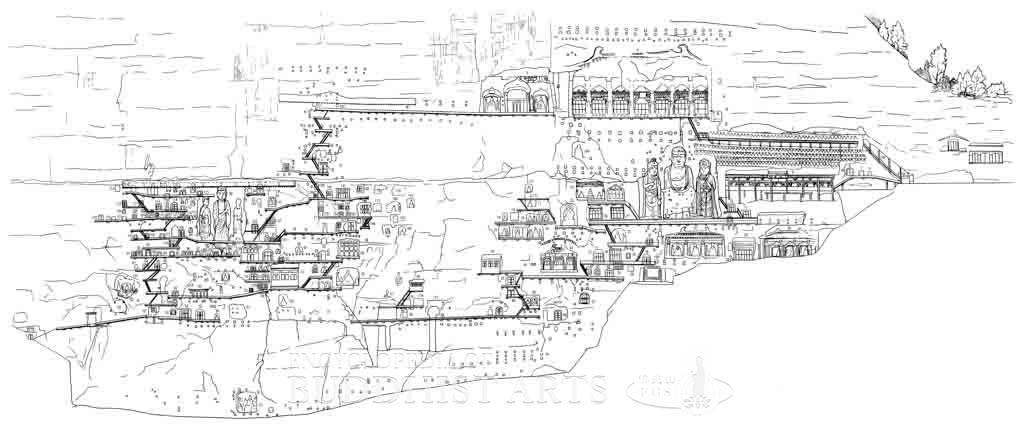
Maijishan Grottoes (elevation drawing)
Maijishan Grottoes
CHINA, Gansu, Tianshui
The grottoes cut into on a hillside of Maijishan (Wheat Stack Mountain) are located 45 km southeast of Tianshui in the south of Gansu, China. The mount was named Maijishan, because the mountain resembles the form of regional wheat stacks. The Maijishan Grottoes were located on the main road for north-south transit in medieval China. Located close to a former capital, Chang’an (present day Xi’an), the grottoes were sponsored by the imperial families of the Northern Wei (386–581), Western Wei (535–556), and Northern Zhou (557–581) dynasties. The earliest grottoes at Maijishan date from 394 of the Northern Wei dynasty. The grottoes were intermittently restored until the Qing dynasty (1644–1911). The hewing of the grottoes took place by piling hundreds of logs on top of each other, by which workers would ascend to the highest levels, hew them, and then, layer by layer, remove the logs and work their way to the bottom. In total, there are 194 grottoes and 7,200 figures. Among the figures, there are 3,513 sculptures, 25 rock carvings, and 3,662 images depicting the Thousand Buddhas. The grottoes’ murals total 900 sq m. The Maijishan Grottoes were listed as a National Cultural Heritage Site in 1961.
Presently narrow planks connect the grottoes across the cliff face. Archaeologists divide the mountain into east and west cliffs. The earliest grottoes are in the middle of the west cliff and include Grottoes 69, 74, 76, 78, and 169. Most of the later grottoes are on the east cliff and are usually larger. Many grottoes are not dated, but of those that are: 99 dated to the Northern Wei dynasty, 18 dated to the Western Wei dynasty, 32 dated to the Northern Zhou dynasty, 10 dated to the Sui (581–618) and Tang (618–907) dynasties, and 4 dated to the Song dynasty (960–1279). A few grotto restorations occurred in the Ming (1368–1644) and Qing dynasties.
The Northern Wei dynasty was the most prosperous period of rock carvings at Maijishan. There are two phases in classifying the grottoes from this dynasty. The sculpture, with an emphasis on size and solemnity and featuring broad shoulders and thick chests, was prominent in the earlier grottoes. The major subjects are the Buddhas of the Past, Present, and Future, each flanked by attendant Bodhisattvas. Niches commonly housed the Sakyamuni and Prabhutaratna Buddhas. The earlier grottoes also contain the Thousand Buddhas and seated Bodhisattvas. The tall and slender style of statues in the later grottoes was influenced by the artwork of the Southern Dynasties.
The grottoes of the Western Wei dynasty primarily have flat, square ceilings and feature the Buddhas of the Past, Present, and Future. Some grottoes have no niches, others contain niches on two or three walls. The statues usually portray figures dressed in loose and wide gowns. The figures’ faces are also more slender. The grottoes of the Northern Zhou dynasty tend to be smaller, and feature trapezoidal ceilings with elaborate columns in the corners connected by beams with lotuses at the joining sections. Most of the grottoes have niches on three sides and the Seven Buddhas was the most common subject of this period. The statues, moreover, are more full and rounder than the slim statues from the Western Wei dynasty. The grottoes of the Sui dynasty are mostly continuations of the Northern Zhou dynasty in style, but are heavily influenced by the designs of the Northern Qi dynasty (550–577). The statues are generally larger and have a more solid and heavy appearance. The sculptures that date to the Song dynasty had a greater emphasis on symmetry.
The major subjects for murals are the Jatakas, the Life of the Buddha, sutra illustrations, the Buddha, Bodhisattvas, disciples, apsaras, figures making offerings, and various decorative designs. Some of the most noteworthy examples are the rendering of the Life of the Buddha across three walls in Grotto 115, and the largest mural, found in Grotto 127, depicting Prince Mahasattva sacrificing himself to a hungry tigress.
For more details, go to the Encyclopedia of Buddhist Arts: Caves M-Mo, page 728.
Cite this article:
author = Hsingyun and Youheng and Johnson, Peter and Mankuang and Huntington, Susan and Edson, Gary and Neather, Robert,
booktitle = {Encyclopedia of Buddhist Arts: Caves M-Mo},
pages = 728,
title = {{Maijishan Grottoes}},
volume = 7,
year = {2016}}