
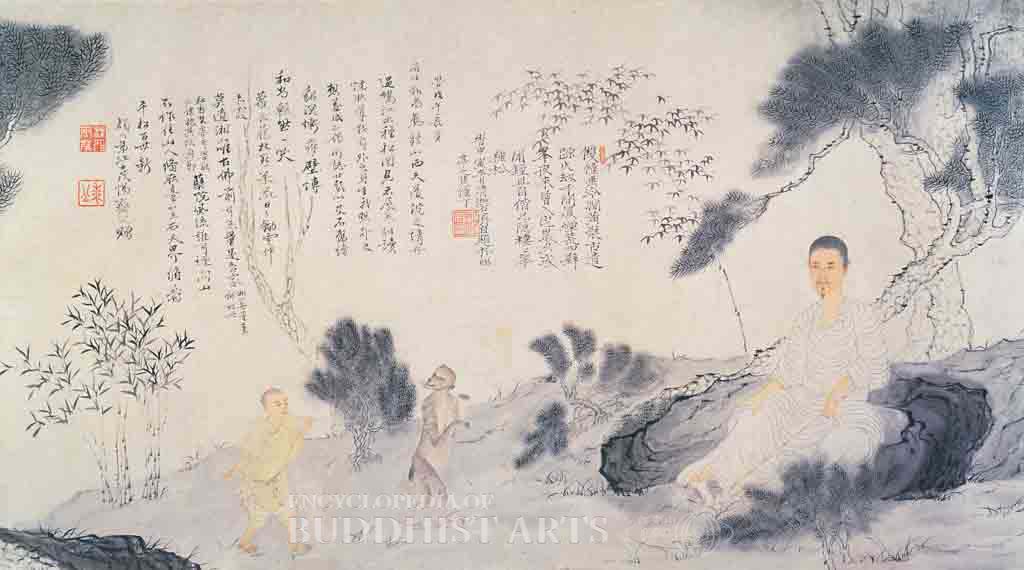
Planting Pine Trees by Shitao; Qing dynasty, dated 1674
Ink and color on paper
Shitao
CHINA, Guangxi, Quanzhou; Qing dynasty
Shitao had an original name of Zhu Ruoji and was also known by his Dharma name, Yuanji. He was a calligrapher and painter, as well as a descendant of Prince Jingjiang from the Ming dynasty (1368–1644). Shitao renounced at a young age and studied the Dharma and art under Master Lu’an Benyue. He later became the abbot of Yizhi Temple in Jiangsu and was referred to as “Old Man Yizhi.” In his old age, he resided in Yangzhou where alongside Shixi, another renowned monk, he was known as one of the “Two Shis.” Shitao was also considered to be one of the Four Eminent Monks of the late Ming and early Qing (1644–1912) dynasties. His vivid depiction of Huangshan invoked a new style of painting, and was the catalyst for the formation of the Huangshan school of painting.
Influenced by Mei Qing, a prominent artist of the Qing dynasty, Shitao was adept in drawing figures and nature, particularly landscapes because of his ability to closely observe and depict natural scenery. Given that he did not like to copy ancient paintings, his compositions were original and exemplified his superb painting skills, which were highly adaptable. As for calligraphy, he worked from several ancient copybooks, primarily that of Yan Zhenqing’s. Shitao was well-versed in Buddhist, Daoist, and Confucian philosophy, in addition to painting theory. He often wrote postscripts on his paintings, many of which were later compiled in his Art of Painting. He also authored Painting Manual, an influential text in the field of painting.
Shitao’s calligraphic works include Letter from Shitao to Tuiweng, which is kept at Ho’s Calligraphy Foundation in Taipei, Taiwan. His paintings include Avalokitesvara Bodhisattva, kept at the Shanghai Museum; Planting Pine Trees, kept at the National Palace Museum in Taipei, Taiwan; Sixteen Arhats, kept at the Metropolitan Museum of Art in New York, USA; and Shitao Producing a Painting, kept at Beijing Fine Art Academy in China.
For more details, go to the Encyclopedia of Buddhist Arts: People, page 236.
Cite this article:
author = Hsingyun and Youheng and Youlu and Pokorski, Stefanie and Yichao and Mankuang and Miaohsi,
booktitle = {Encyclopedia of Buddhist Arts: People },
pages = 236,
title = {{Shitao}},
volume = 19,
year = {2016}}