
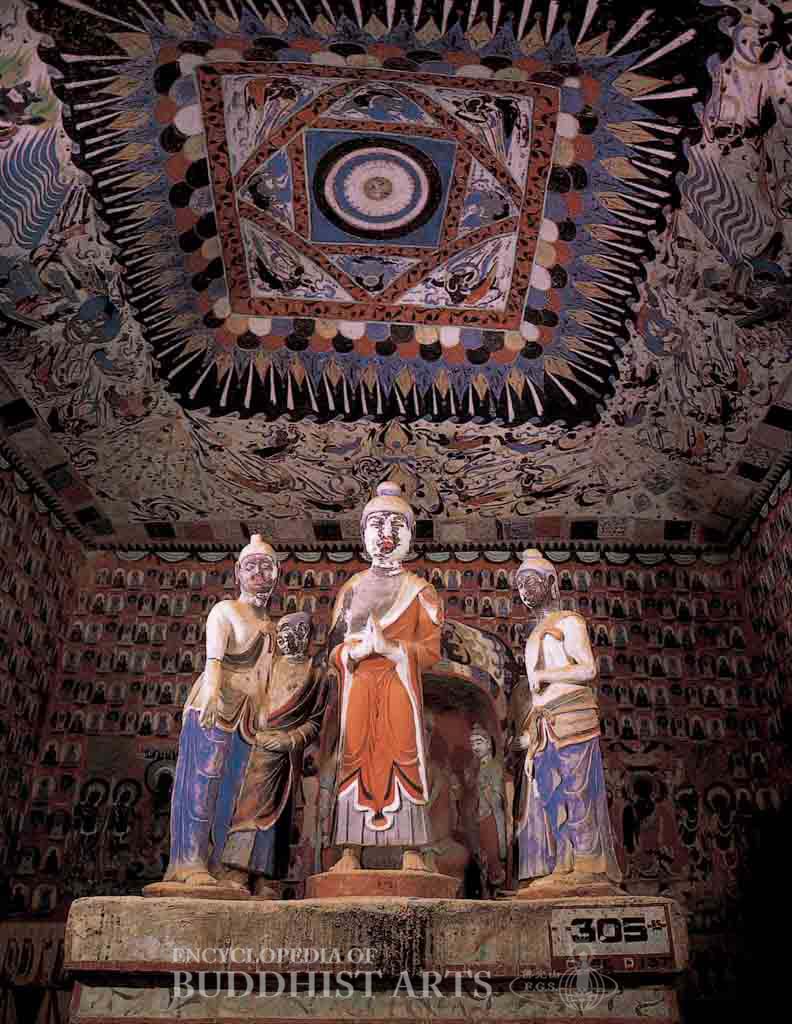
Mogao Cave 305: Main Chamber - Central Platform - Sculptures
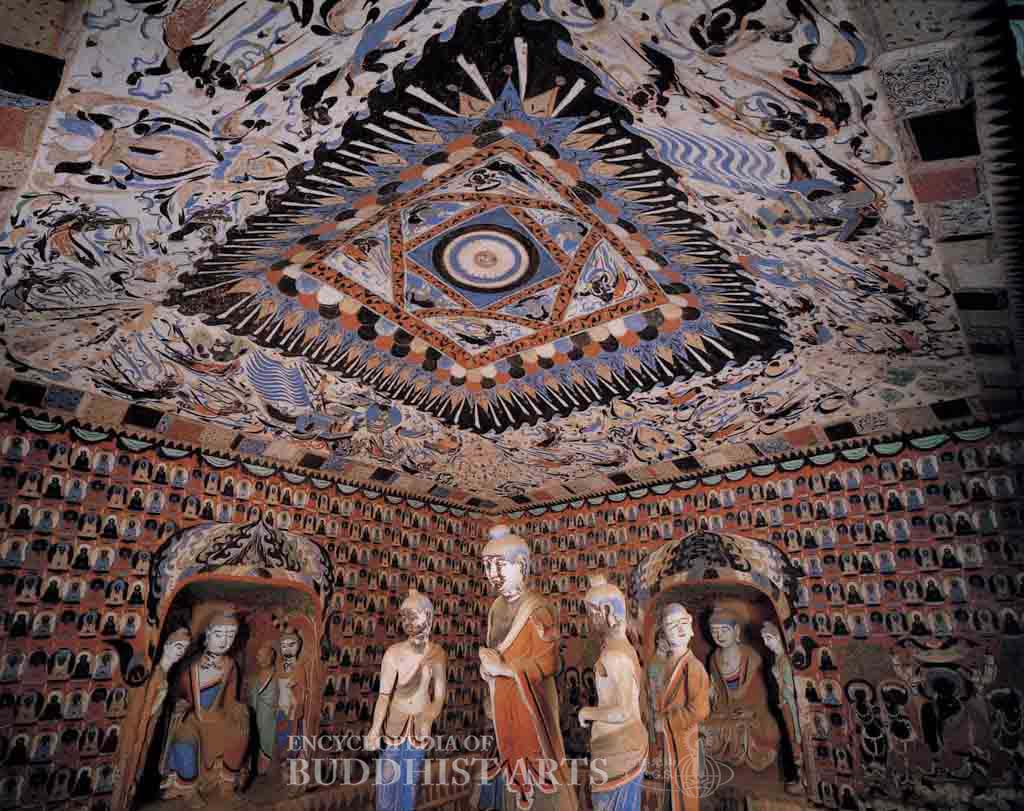
Mogao Cave 305: Main Chamber
Mogao Cave 305
CHINA, Gansu, Dunhuang
This altar cave is located in the south area and was constructed in the year 585 of the Sui dynasty, according to an inscription on the north wall of the main chamber. The cave consists of both a main chamber and an antechamber. The walls of the antechamber have mostly collapsed. The main chamber is 3.8 m in width, 3.35 m in height, and 3.65 m in depth. It has a truncated pyramidal ceiling and a platform in the center intended for circumambulation. Standing on the platform are statues of a Buddha, two Bodhisattvas, and two disciples, all of which were replaced during the Qing dynasty (1644–1911). The center of the ceiling is embellished with a diamond-in-square motif, and the slopes have images of celestial flowers, sweeping clouds, and flying apsaras with fluttering stoles. In the center of the east and west slopes are wish-fulfilling jewels flanked by apsaras, while on the north and south slopes are a male and female deity, each riding a carriage through the clouds.
Thousand Buddhas fill the four walls of the main chamber, and in the center of the back (west) and side walls are arched niches, each containing a Buddha from the Sui dynasty (581–618), as well as two Bodhisattvas and two disciples from the Qing dynasty. Dharma teaching scenes are painted on both sides of the niches on the three walls, as well as on both sides of the entrance on the front (east) wall. At the bottom of each wall are images of figures making offerings and pennant patterns.
For more details, go to the Encyclopedia of Buddhist Arts: Caves Mo-S, page 1136.
Cite this article:
author = Hsingyun and Youheng and Johnson, Peter and Mankuang and Huntington, Susan and Edson, Gary and Neather, Robert,
booktitle = {Encyclopedia of Buddhist Arts: Caves Mo-S},
pages = 1136,
title = {{Mogao Cave 305}},
volume = 8,
year = {2016}}