
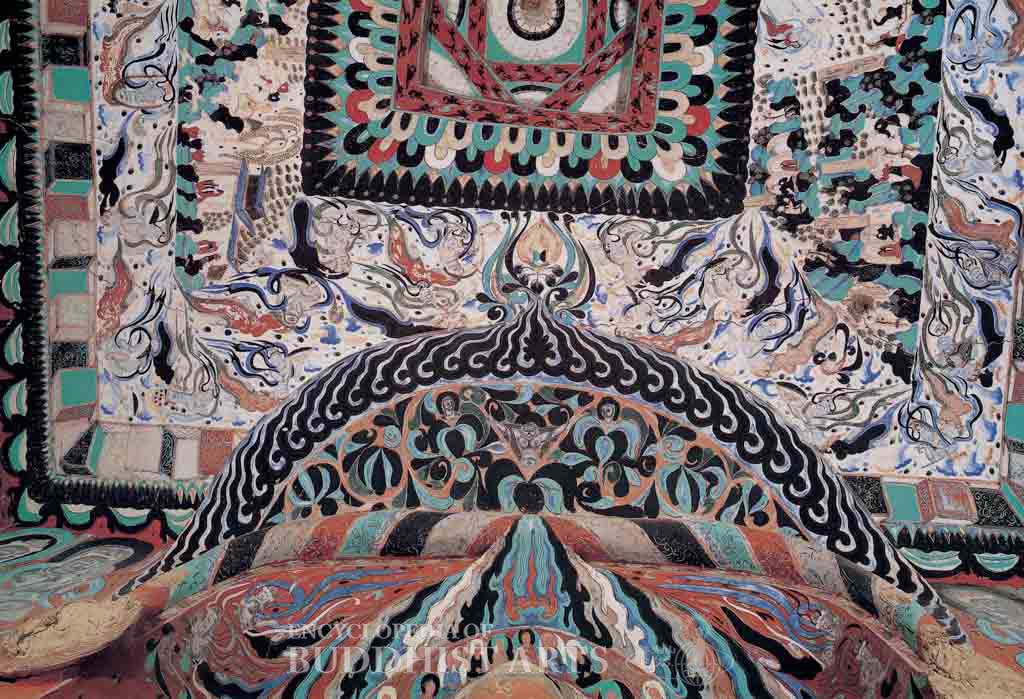
Mogao Cave 301: Main Chamber - Ceiling (west slope)
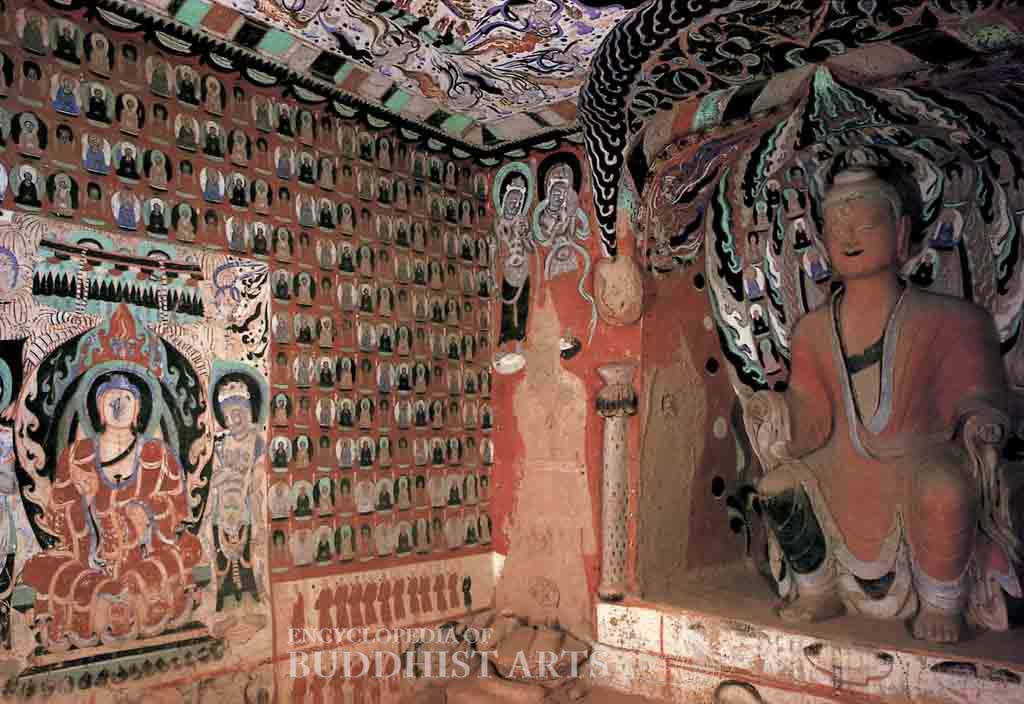
Mogao Cave 301: Main Chamber
Mogao Cave 301
CHINA, Gansu, Dunhuang
Situated in the south area of the site, this shrine cave was constructed between the late Northern Zhou dynasty (557–581) and the early Sui dynasty (581–618), and was renovated during the Five Dynasties (907–960). The main chamber is rectangular with a truncated pyramidal ceiling. In the center of the ceiling are four inverted lotus flowers framed by various decorative patterns. On the south and east slopes of the ceiling is an illustration of the Prince Mahasattva Jataka, and on the north slope is the Syama Jataka. On the west slope are images of wish-fulfilling jewels and lotuses flanked by apsaras.
The west slope connects to the large, petal-shaped lintel of the Buddha niche on the back (west) wall. The lintel is decorated with multi-colored flames and lotus-born children. The head of a dragon is in the center of the lintel, and the columns on either side are decorated with lotus flowers. The niche contains a single statue of the Buddha and on the back wall is a large mandorla with two heavenly musicians on each side. The attendant Bodhisattva statues which at one time stood outside the niche have since disappeared and only their lotus pedestals remain. The north, south, and front (east) walls of the cave are covered in Thousand Buddha images, with an illustration of the Buddha teaching the Dharma in the center of each, and images of donors and yaksas at the bottom.
For more details, go to the Encyclopedia of Buddhist Arts: Caves Mo-S, page 1127.
Cite this article:
author = Hsingyun and Youheng and Johnson, Peter and Mankuang and Huntington, Susan and Edson, Gary and Neather, Robert,
booktitle = {Encyclopedia of Buddhist Arts: Caves Mo-S},
pages = 1127,
title = {{Mogao Cave 301}},
volume = 8,
year = {2016}}