
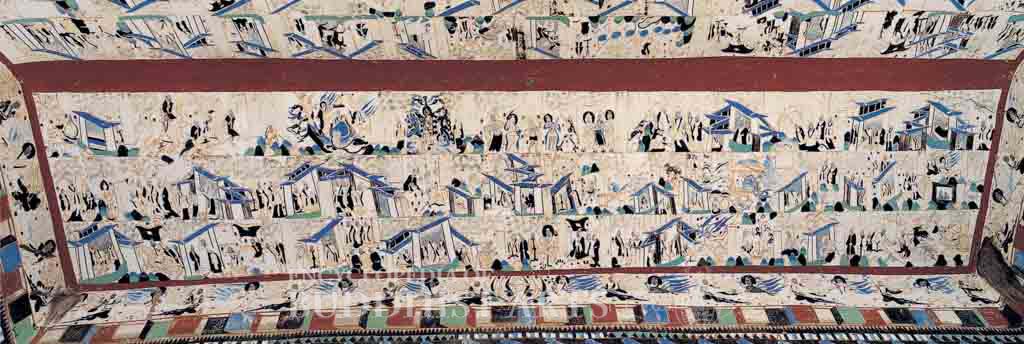
Mogao Cave 290: Life of the Buddha (ceiling, east slope)
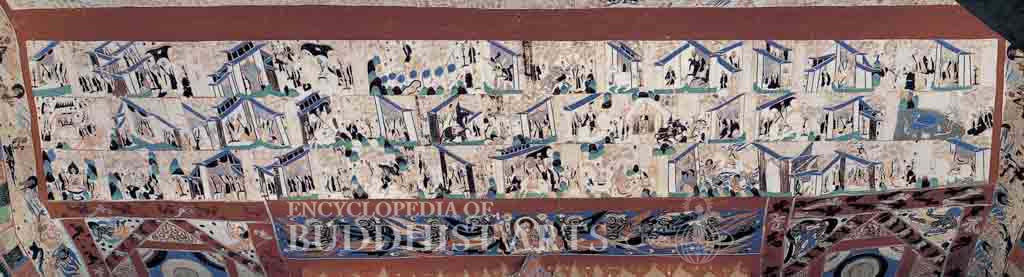
Mogao Cave 290: Life of the Buddha (ceiling, west slope)
Mogao Cave 290: Life of the Buddha
CHINA, Gansu, Dunhuang; Northern Zhou dynasty
Located on the two slopes of the gabled ceiling, this illustration is based on the Caryanidana Sutra and portrays events in the life of Sakyamuni Buddha. The mural consists of 87 scenes distributed in three rows on each slope, together totaling 27.5 m in length. The narrative begins on the upper right side of the east slope and ends on the lower left side of the west slope, progressing in an “S” formation on each slope. The scenes from the Life of the Buddha are depicted as follows: Queen Maya’s Dream, Birth of Prince Siddhartha, Seven Steps at Birth, Bathing by the Nine Nagas, Asita’s Prophecy, Palace Life, Education of the Prince, Skills Contest, Marriage, Four Encounters, Reflections on the Farming Process, the Great Departure, Renunciation, Defeat of Mara and Enlightenment, and the First Turning of the Dharma Wheel. The last scene is on a narrow strip just above the main Buddha niche on the east side of the central pillar.
The figures, clothing, architecture, and the painting style are characteristic of the Central Plain region. The work also reflects the unique development of Buddhist art and mythology within Chinese culture.
For more details, go to the Encyclopedia of Buddhist Arts: Caves Mo-S, page 1117.
Cite this article:
author = Hsingyun and Youheng and Johnson, Peter and Mankuang and Huntington, Susan and Edson, Gary and Neather, Robert,
booktitle = {Encyclopedia of Buddhist Arts: Caves Mo-S},
pages = 1117,
title = {{Mogao Cave 290: Life of the Buddha}},
volume = 8,
year = {2016}}