
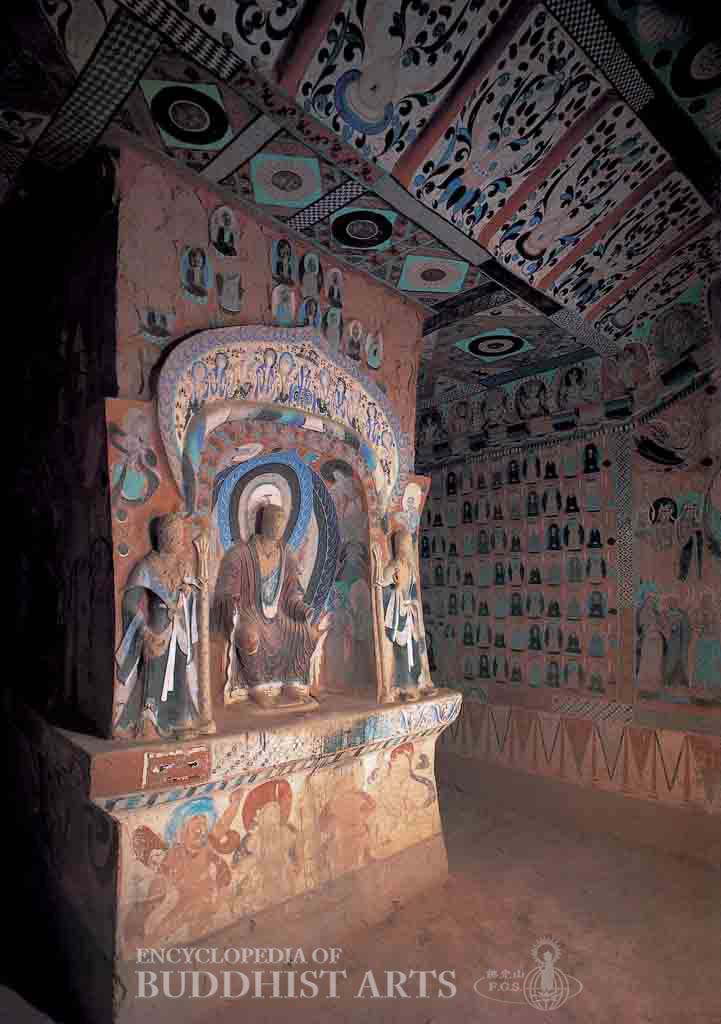
Mogao Cave 288: Main Chamber - Central Pillar (east side)

Mogao Cave 288: Rear Ceiling (detail)
Mogao Cave 288
CHINA, Gansu, Dunhuang
This central pillar cave is situated on the second level in the northern section of the south area of the site. The cave was constructed during the Western Wei dynasty (535–556) and renovated during the Five Dynasties (907–960) and the Qing dynasty (1644–1911). It consists of an antechamber and a main chamber. The antechamber is rectangular and has a gabled ceiling. The main chamber contains a square central pillar and is also rectangular, with a gabled ceiling at the front and a flat ceiling at the rear. The gabled ceiling of the main chamber has reliefs of beams. Between the raised beams are images of lotuses, wish-fulfilling jewels, apsaras, warriors, and various birds, including doves, phoenixes, and peacocks. The flat ceiling is painted with square lattices, with four-lotus emblems at the center of each square surrounded by flame patterns and apsaras. On the lattice borders are honeysuckle, cloud, and geometric patterns.
On the east side of the central pillar is a niche containing a Buddha seated with legs pendent. Attendant Bodhisattvas stand outside the niche along a narrow ledge that extends around all four sides of the pillar. Upper and lower niches are cut into each of the north, south, and west sides of the pillar; each contains a Buddha and two Bodhisattvas. The Buddhas are all depicted either in meditation or with legs crossed at the ankles. Outside the niches, the Thousand Buddhas are in low relief, but most of these figures are now missing. The base of the pillar is painted with yaksas.
The four walls of the main chamber all have similar layouts: heavenly musicians within heavenly palaces are painted along the top, Thousand Buddha images fill the middle, and pennant patterns line the base. In the center of the back (west) wall is a white-robed Buddha teaching the Dharma. Scenes of the Buddha teaching the Dharma are painted below the gabled ceiling on both the north and south walls. On the front (east) wall are images of monks and donors below the Thousand Buddhas.
For more details, go to the Encyclopedia of Buddhist Arts: Caves Mo-S, page 1113.
Cite this article:
author = Hsingyun and Youheng and Johnson, Peter and Mankuang and Huntington, Susan and Edson, Gary and Neather, Robert,
booktitle = {Encyclopedia of Buddhist Arts: Caves Mo-S},
pages = 1113,
title = {{Mogao Cave 288}},
volume = 8,
year = {2016}}