
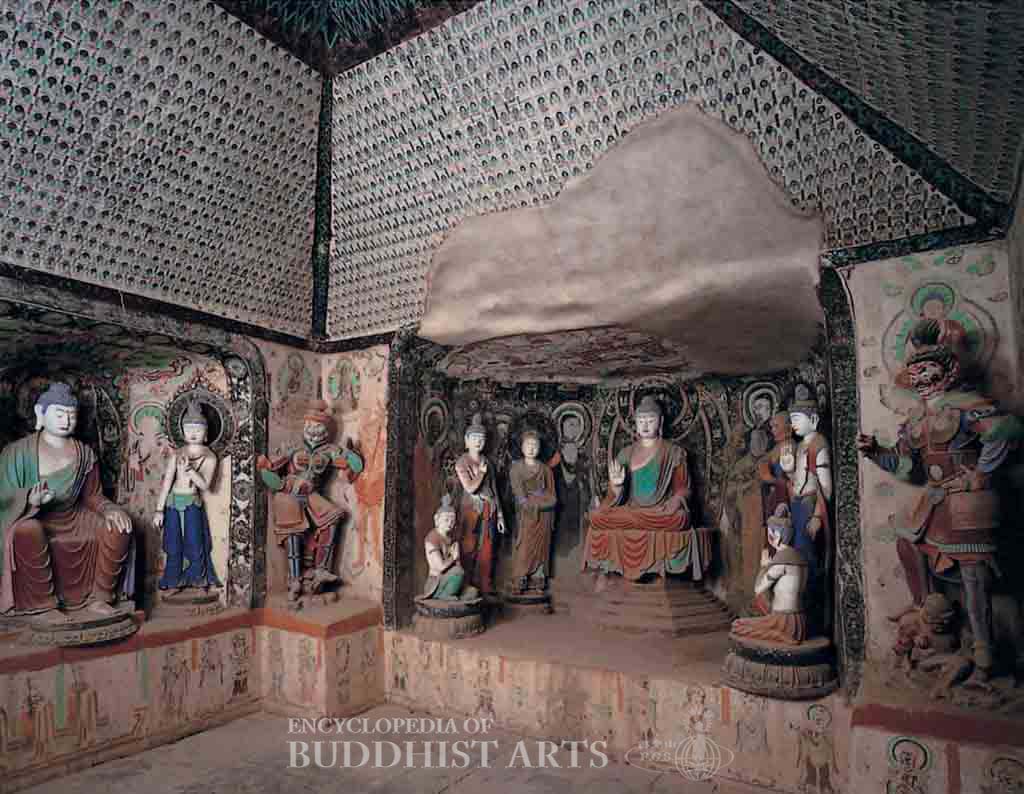
Mogao Cave 384: Main Chamber
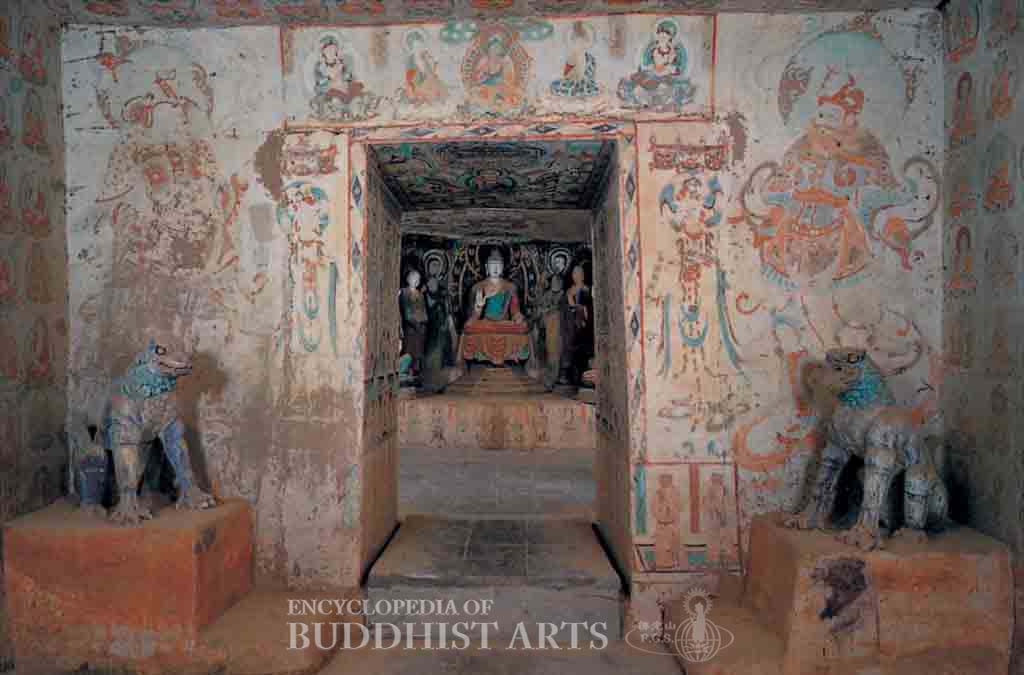
Mogao Cave 384: Antechamber
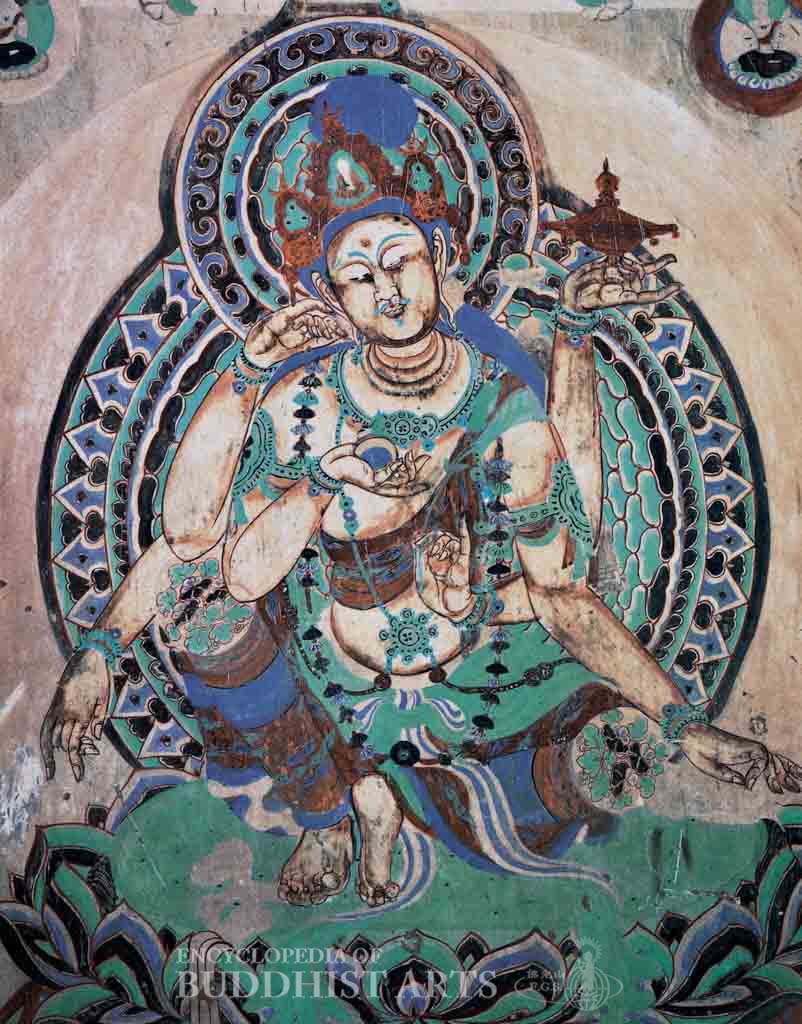
Mogao Cave 384: Illustration of the Cintamanicakra Avalokiteshvara (north wall)
Mogao Cave 384
CHINA, Gansu, Dunhuang
This shrine cave is in the northern section of the south area and dates to the High Tang period (712–756), though some murals were painted in the Mid-Tang period (756–846). It was renovated during the Five Dynasties (907–960) and Qing dynasty (1644–1911). The cave has an antechamber and a main chamber connected by a corridor. The murals in the antechamber and corridor were painted in the Mid-Tang and Five Dynasties periods. The back (west) wall of the antechamber has a Mid-Tang painting of the Buddha teaching the Dharma, and flanking the entrance are portraits of the Heavenly Kings Virudhaka and Dhrtarsastra. The Heavenly King of the East, Dhrtarsastra, has red hair and prominent muscles. Two sculptures of lions on platforms also flank the entrance. The north and south walls are covered in Thousand Buddha images from the Mid-Tang period. Images of Ksitigarbha and the Ten Kings of Hell are on the ceiling of the corridor, and on the walls are illustrations of the Maitreya Sutras, the Medicine Buddha Sutra, and donors from the Five Dynasties.
The main chamber has a truncated pyramidal ceiling and niches along three walls. The caisson ceiling has circular floral patterns and valances surrounded by Thousand Buddhas on the four slopes. The niche in the back wall houses a Buddha, two disciples, two attendant Bodhisattvas, and two Bodhisattvas making offerings. Images of Buddhas and Bodhisattvas are on the flat ceiling of the niche, and on the walls are eight disciples and two Bodhisattvas. Images of Buddhas seated in full lotus position from the Mid-Tang flank the niche on the back wall, and the lower wall displays images of Bodhisattvas making offerings from the Five Dynasties. Statues of Heavenly Kings stand on platforms at the two corners bordering the back wall.
The niche on the north wall houses statues of a Buddha seated in full lotus position and two Bodhisattvas. To the right of the niche is an illustration of Cintamanicakra Avalokitesvara from the Mid-Tang period. Cintamanicakra Avalokitesvara wears a crown with a Buddha image and has a round face, elongated earlobes, and a slightly tilted head. The six-armed Bodhisattva holds a wish-fulfilling wheel and lotus flower in two of the left hands while the third rests on Mount Potalaka. One of the right hands supports the chin while another holds a jewel and the third hangs relaxed beside the body. The Bodhisattva is seated on a lotus throne which emerges from a pond. The figure is surrounded by Suryaprabha Bodhisattva, Candraprabha Bodhisattva, two naga kings, two wrathful deities, Ganesa, and Virudhaka. Below the niche are Bodhisattvas making offerings and female donors painted during the Five Dynasties. The niche on the south wall houses a Buddha seated with legs pendent and two Bodhisattvas. The statues were repaired during the Qing dynasty. To the left of the niche is an illustration of Amoghapasa Avalokitesvara from the Mid-Tang period. Amoghapasa Avalokitesvara wears a crown with a Buddha image and has a round face with curved eyebrows. The Bodhisattva is seated on a lotus throne in full lotus position. The six arms hold a vase, lotus, and another vase on the left, and a halberd, willow branch, and lasso on the right. Surrounding Amoghapasa are Four Heavenly Kings, two nagas, two apsaras, two wrathful deities, Suryaprabha Bodhisattva, Candraprabha Bodhisattva, Vasu, Mahadevi, Ganesa, and Virudhaka. Bodhisattvas making offerings and female donors from the Five Dynasties are on the lower wall.
Seven Buddhas are painted above the entrance on the front (east) wall. On the right of the entrance there are two Bodhisattvas from the Five Dynasties, and on the left is an image of Vaisravana.
For more details, go to the Encyclopedia of Buddhist Arts: Caves Mo-S, page 1180.
Cite this article:
author = Hsingyun and Youheng and Johnson, Peter and Mankuang and Huntington, Susan and Edson, Gary and Neather, Robert,
booktitle = {Encyclopedia of Buddhist Arts: Caves Mo-S},
pages = 1180,
title = {{Mogao Cave 384}},
volume = 8,
year = {2016}}