
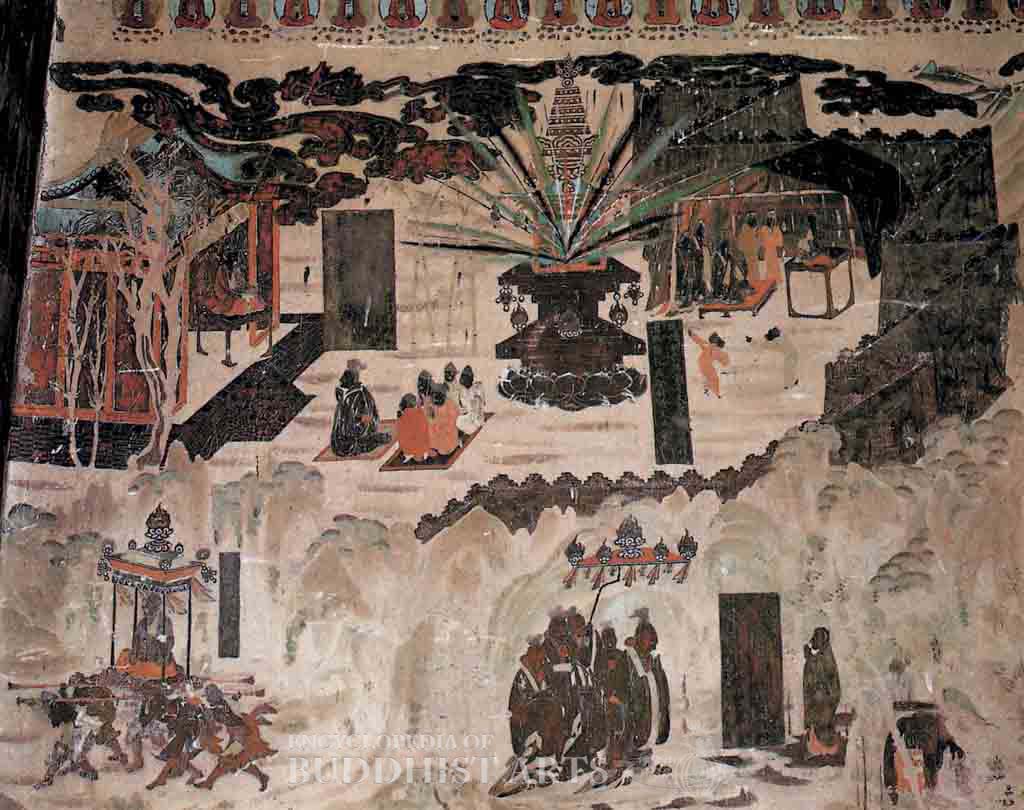
Mogao Cave 323: Spread of Buddhism - Story of Master Tanyan
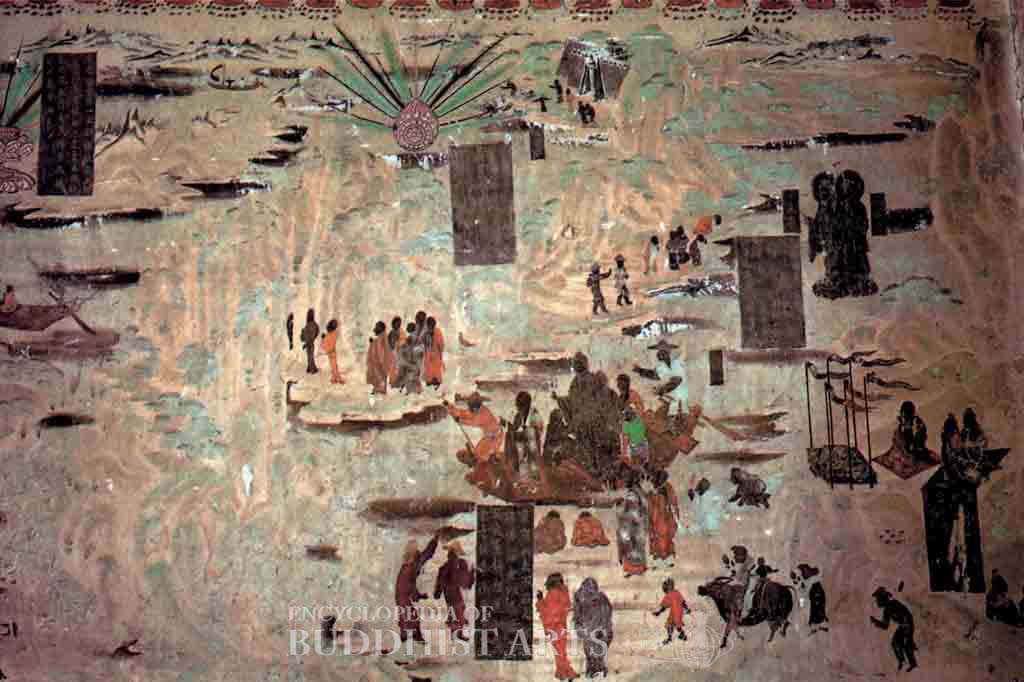
Mogao Cave 323: Spread of Buddhism - Stone Buddha Floating on a Lake in Wujun
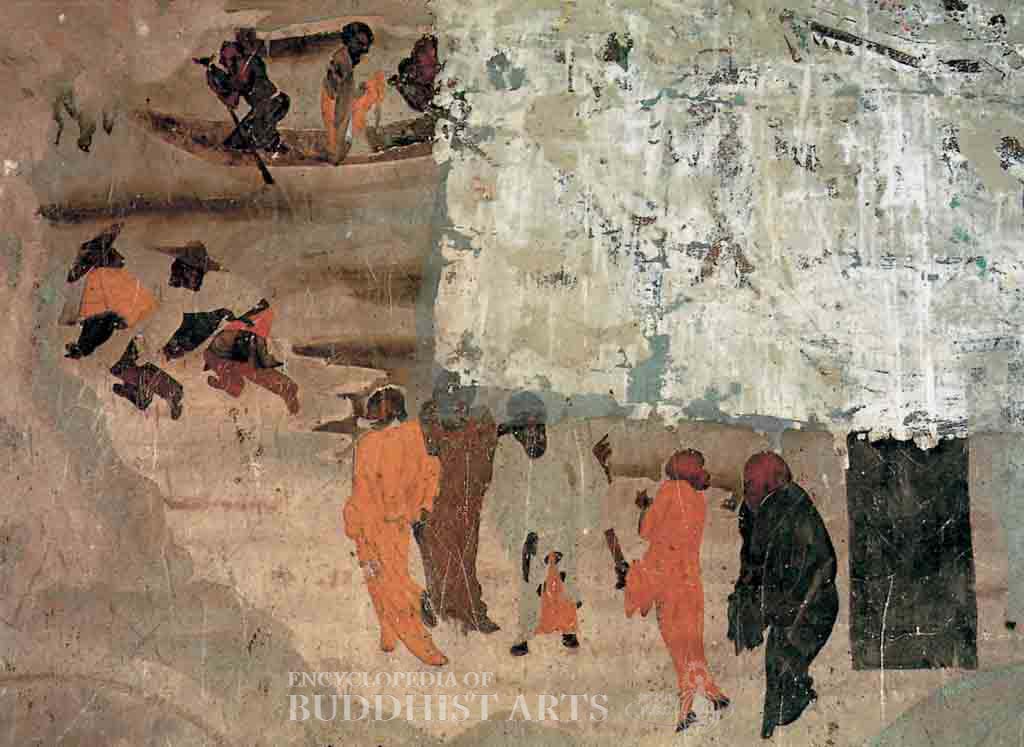
Mogao Cave 323: Spread of Buddhism - Gao Kui Obtaining the Golden Statue (detail)
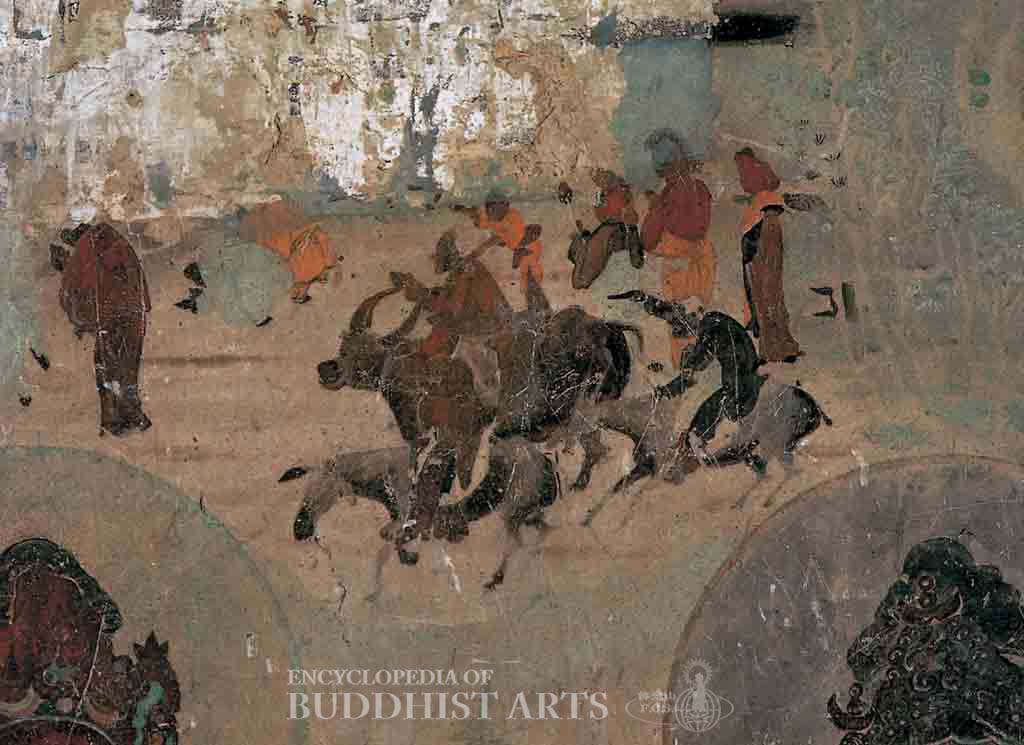
Mogao Cave 323: Spread of Buddhism - Gao Kui Obtaining the Golden Statue (detail)
Mogao Cave 323: Spread of Buddhism
CHINA, Gansu, Dunhuang; Tang dynasty
Located on the upper north and south walls within the main chamber, this Early Tang period (618–712) mural illustrates legends formed during the spread of Buddhism in China, including stories of auspicious Buddha images, eminent monks, and Buddhist sutras. Beginning from the left of the north wall are depictions of five stories, including: Zhang Qian’s Expedition to Central Asia, the Lake Where Sakyamuni Buddha Washed His Clothes, the Story of Buddhacinga, King Asoka Constructing Stupas, and the Story of Kang Senghui. On the south wall are three more, including: the Story of Master Tanyan, Gao Kui Obtaining the Golden Statue, and the Stone Buddha Floating on a Lake in Wujun. There are no obvious boundaries between the illustrations, and each is composed of several scenes accompanied by a cartouche with descriptions.
In the illustration of Zhang Qian’s Expedition to Central Asia is a scene of Emperor Wu (reigned 141–87 BCE) of the Han dynasty, making a trip to Ganquan Palace to pay a formal visit to two Jin prisoners captured during an expedition against the Xiongnu people. Scenes of Zhang Qian bidding farewell to the emperor and traveling west to Daxia (also known as Bactria) are also illustrated.
The illustration of Gao Kui Obtaining the Golden Statue is centered on a scene of people welcoming the auspicious Buddha statue with open arms. The image of the ship which carries the statue was removed by Langdon Warner, however, monks on the shoreline and boatmen pulling the ship ashore are still visible.
The Story of Master Tanyan tells of how the eminent monk propagated Buddhist teachings, particularly by converting Emperor Wen (reigned 581–604) of the Sui dynasty. The scenes include the emperor welcoming Master Tanyan into the palace, a relic stupa radiating colored light, the emperor inquiring about the Dharma, and Master Tanyan imparting the precepts to the emperor.
For more details, go to the Encyclopedia of Buddhist Arts: Caves Mo-S, page 1150.
Cite this article:
author = Hsingyun and Youheng and Johnson, Peter and Mankuang and Huntington, Susan and Edson, Gary and Neather, Robert,
booktitle = {Encyclopedia of Buddhist Arts: Caves Mo-S},
pages = 1150,
title = {{Mogao Cave 323: Spread of Buddhism}},
volume = 8,
year = {2016}}