
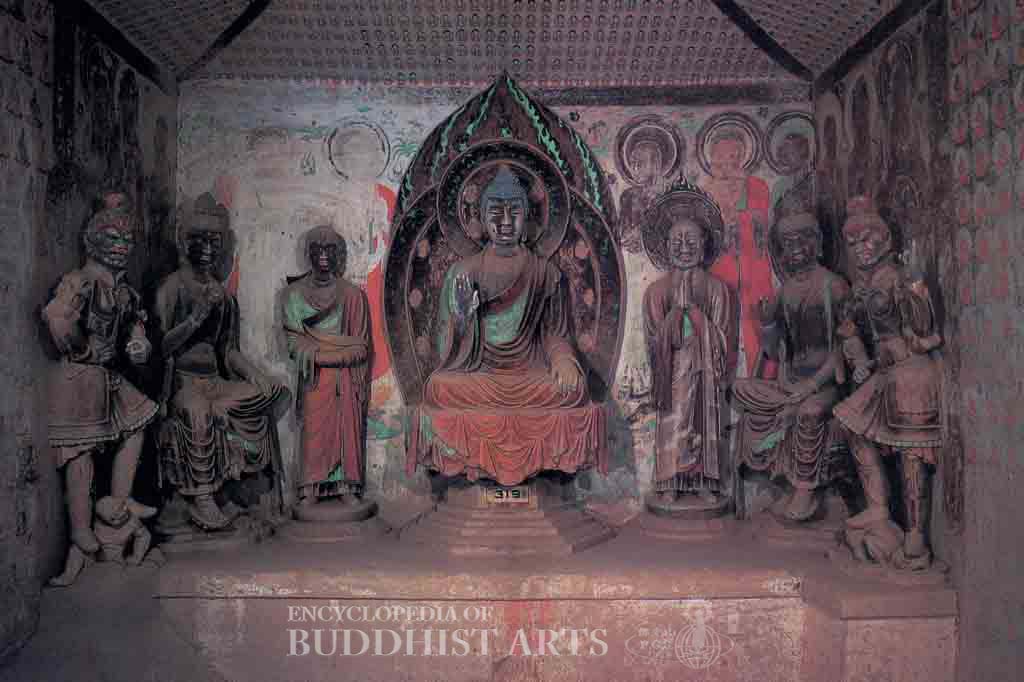
Mogao Cave 319: Sculptures (back wall)

Mogao Cave 319: Bodhisattva (detail) (back wall, left side)
Mogao Cave 319
CHINA, Gansu, Dunhuang
This altar cave is situated in the northern section of the south area and was built in the High Tang period (712–756). The main chamber has a truncated pyramidal ceiling and a Buddha altar is installed along the back (west) wall. The front (east) wall and east slope of the ceiling have collapsed. The center of the ceiling features three floral medallions surrounded by decorative patterns, and Thousand Buddha images cover the four slopes.
On the altar at the back wall are statues of a Buddha, two disciples, two Bodhisattvas, and two Heavenly Kings. The Buddha wears an ocher red robe and is seated in full lotus position on a Sumeru throne. The disciple Mahakasyapa stands on the right with palms joined, and on the left is the disciple Ananda, who stands with hands clasped inside his sleeves. The Bodhisattvas are seated in a variation of the relaxation posture and have high topknots, round faces, and narrow waists. The armor-clad Heavenly Kings appear fierce and stand on demons. Although the colors on the sculptures have faded, they remain in good condition. On both sides of the Buddha’s mandorla on the back wall are painted images of three disciples, while two Bodhisattvas and one disciple are painted on the west side of both the north and south walls, and Thousand Buddha images cover the remaining space.
For more details, go to the Encyclopedia of Buddhist Arts: Caves Mo-S, page 1139.
Cite this article:
author = Hsingyun and Youheng and Johnson, Peter and Mankuang and Huntington, Susan and Edson, Gary and Neather, Robert,
booktitle = {Encyclopedia of Buddhist Arts: Caves Mo-S},
pages = 1139,
title = {{Mogao Cave 319}},
volume = 8,
year = {2016}}