
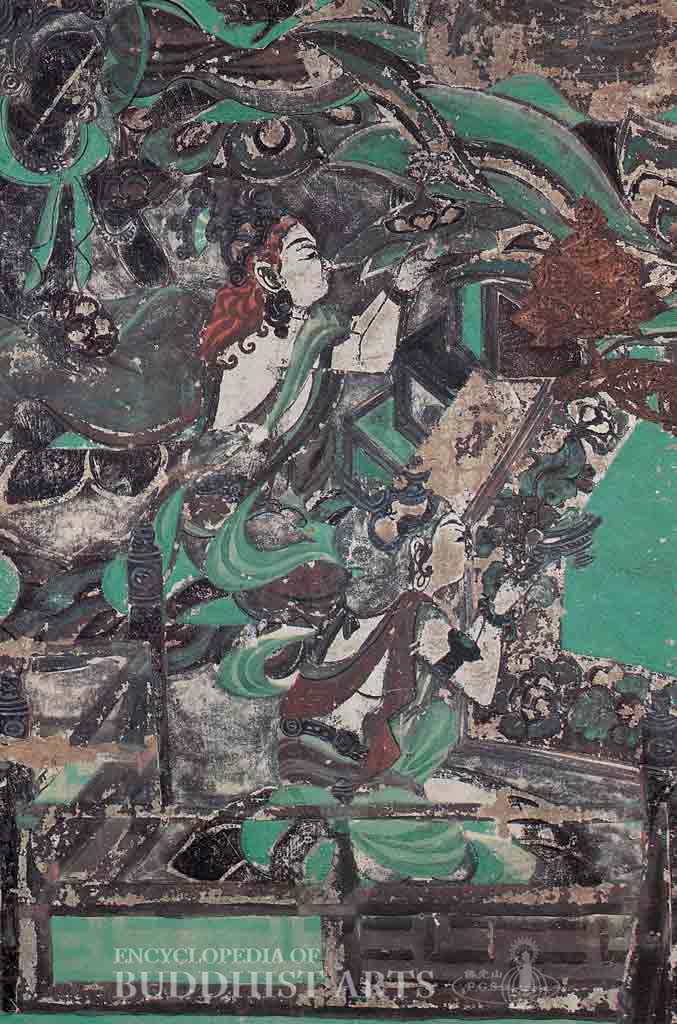
Mogao Cave 172: Figures Making Offerings (north wall)
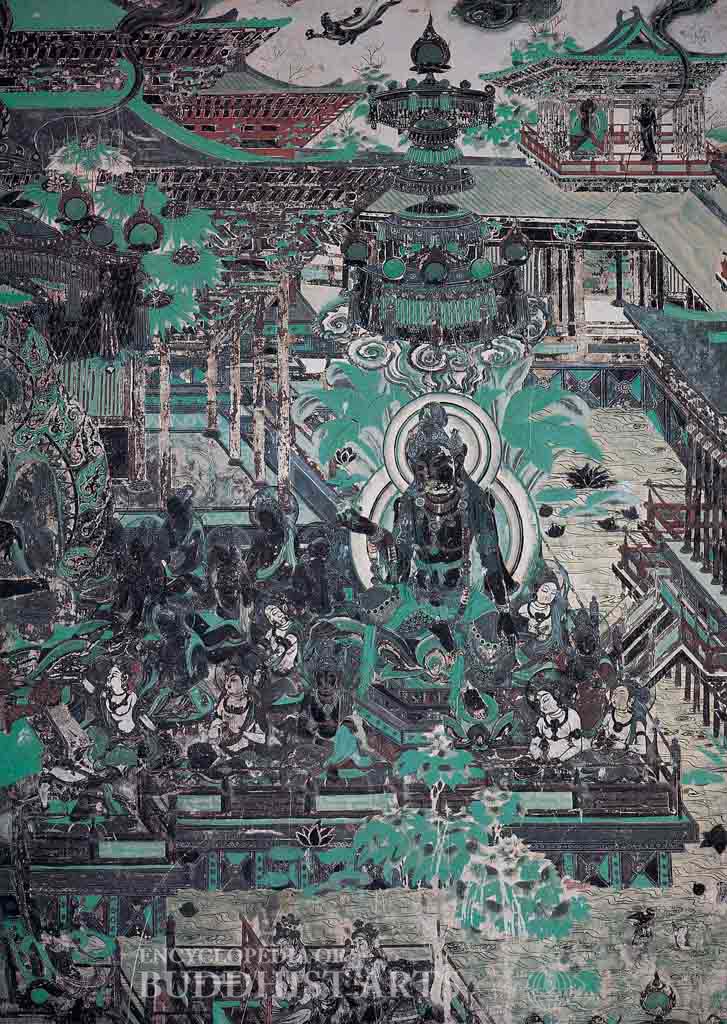
Mogao Cave 172: Illustration of the Amitayurdhyana Sutra (detail) (north wall)
Mogao Cave 172
CHINA, Gansu, Dunhuang
This shrine cave, situated in the southern section of the south area of the site, was constructed during the High Tang period (712–756). The cave consists of an antechamber and a main chamber connected by a corridor. The antechamber and corridor were renovated during the Song dynasty, and the majority of the murals that remain were painted during that time. On either side of the entrance on the back (west) wall of the antechamber is the illustration of the Vimalakirti Sutra, with Manjusri on one side and Vimalakirti on the other. The south wall displays a Thousand-Armed Avalokitesvara, and the north wall shows a Thousand-Armed Manjusri; both have suffered extensive damage. The ceiling of the corridor is painted with circular floral designs, and both walls display Avalokitesvara images. There is an entrance to Cave 173 on the south wall.
The main chamber has a truncated pyramidal ceiling and a niche in the back wall. The ceiling is decorated with a round floral motif in the center, surrounded by a valance pattern. There is an apsara in each corner of the ceiling, and the Thousand Buddhas are painted on the four slopes. The niche in the back wall houses sculptures of a Buddha, two disciples, and four Bodhisattvas. The Buddha is seated in full lotus position, two of the Bodhisattvas are seated in half lotus position, and the other four figures stand. On the flat ceiling of the niche are images of the Buddha teaching the Dharma, and on the niche walls are eight portraits of disciples. Outside the niche are two statues of Heavenly Kings, which were repaired during the Qing dynasty (1644–1911), and paintings of two heavenly beings holding banners. Below the niche is a painting of an ogee arched door surrounded by offerings and heavnely musicians playing instruments.
The north and south walls both display illustrations of the Amitayurdhyana Sutra. In the center of each are Amitabha Buddha and two attendant Bodhisattvas surrounded by dancers, musicians, and lotus-born children. To each side are panel illustrations of the story of Ajatasatru and the Sixteen Contemplations. On the right side of the south wall are images of Avalokitesvara and two figures making offerings, and on the left side of the north wall are three Avalokitesvara images. On the lower walls are figures making offerings from the Song dynasty (960–1279), which were painted over donor portraits from the High Tang period (712–756).
On the front (east) wall above the cave entrance are illustrations of the Pure Land. To the right are images of four Bodhisattvas, including Avalokitesvara and Ksitigarbha, and below these is an illustration of Samantabhadra Bodhisattva riding an elephant. To the upper left of the cave entrance are images of four Bodhisattvas, and below these figures is an illustration of Manjusri Bodhisattva riding a lion. On the lower wall to the left of the entrance are Song dynasty donor portraits.
For more details, go to the Encyclopedia of Buddhist Arts: Caves M-Mo, page 1001.
Cite this article:
author = Hsingyun and Youheng and Johnson, Peter and Mankuang and Huntington, Susan and Edson, Gary and Neather, Robert,
booktitle = {Encyclopedia of Buddhist Arts: Caves M-Mo},
pages = 1001,
title = {{Mogao Cave 172}},
volume = 7,
year = {2016}}