
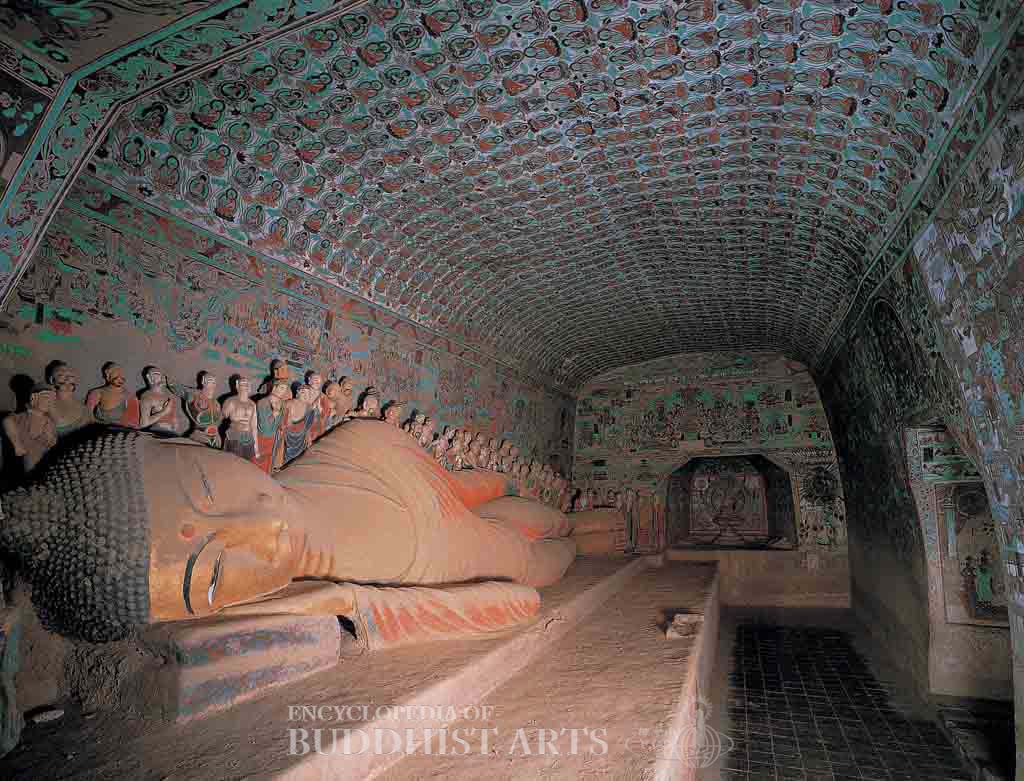
Mogao Cave 148
Mogao Cave 148
CHINA, Gansu, Dunhuang
This parinirvana cave also known as the Dali Cave or the Li Family Cave, is located on the southern end of the Mogao Cave site. It was constructed during the High Tang period (712–756). According to a stele erected in the south wing of the antechamber, the sponsor of the cave was Li Dabin. The cave consists of an antechamber and a main chamber connected by a corridor.
Within the antechamber, Mid-Tang (756–846) statues of a warrior, a Heavenly King, three attendants, and a lion are sculpted on either side of the doorway on the back (west) wall. These statues were restored during the Qing dynasty. On the west slope of the antechamber’s ceiling are fragments of a Tang dynasty illustration of the Buddha teaching the Dharma. In the corridor, there are remnants of an illustration of the Returning Favors Sutra on the gabled ceiling, the oldest depiction of this sutra in the Mogao Caves. Portraits of several Western Xia benefactors are partially visible on the north wall of the corridor.
The main chamber is rectangular and has a barrel-vaulted ceiling. A 14.4 m long reclining Sakyamuni Buddha statue rests on a two-tier stone platform along the back wall. This giant stucco statue was originally sculpted during the High Tang period, but was subsequently altered. The Buddha faces east, with the head resting on the right hand. Eighty-three small sculptures of mourning disciples and heavenly beings are installed behind the Buddha. These underwent restoration during the Qing dynasty (1644–1911). A large illustration of the Mahaparinirvana Sutra covers the back wall above the figures and extends onto the side walls. Late Tang period (846–907) images of the donors are found beneath the illustration. The Thousand Buddhas are painted on the ceiling.
There are niches with trapezoidal ceilings in the north and south walls. A statue of Amoghapasa Avalokitesvara once stood within the north wall niche, but it is now missing. The niche ceiling has an image of Ratnaketu Buddha, and on the north slope of the ceiling are a Buddha and four Bodhisattvas. The east and west slopes both display Bhaisajyaraja Bodhisattva flanked by eight Bodhisattvas and two Heavenly Kings. The eight panels on the walls of the niche display images from the Amoghapasa Dharani Sutra. Above the niche is an illustration of the Devata Sutra, and below it are depictions of Western Xia period (1032–1227) donors, which were painted over images of Tang dynasty (618–907) donors. On the wall to the right of the niche is an illustration of Samantabhadra Bodhisattva.
The niche in the south wall once housed a statue of Cintamanicakra Avalokitesvara. Eight-Armed Avalokitesvara, Four-Armed Avalokitesvara, and Three-Headed, Six-Armed Avalokitesvara are painted on the slopes of the niche ceiling. As in the north wall niche, the murals on the walls are arranged in eight panels. There are illustrations from the Cintamanicakra Dharani Sutra, including depictions of Candraprabha Bodhisattva and Suryaprabha Bodhisattva on the north and south walls respectively. A large illustration of the Maitreya Sutras is painted above the niche, and to the left is an illustration of Manjusri Bodhisattva.
Above the entrance on the front (east) wall is an image of a Thousand-Armed, Thousand-Eyed Avalokitesvara, while to the right and left of the entrance are illustrations of the Amitayurdhyana Sutra and the Medicine Buddha Sutra, respectively. Below these are paintings of donors from the Western Xia period.
For more details, go to the Encyclopedia of Buddhist Arts: Caves M-Mo, page 954.
Cite this article:
author = Hsingyun and Youheng and Johnson, Peter and Mankuang and Huntington, Susan and Edson, Gary and Neather, Robert,
booktitle = {Encyclopedia of Buddhist Arts: Caves M-Mo},
pages = 954,
title = {{Mogao Cave 148}},
volume = 7,
year = {2016}}