
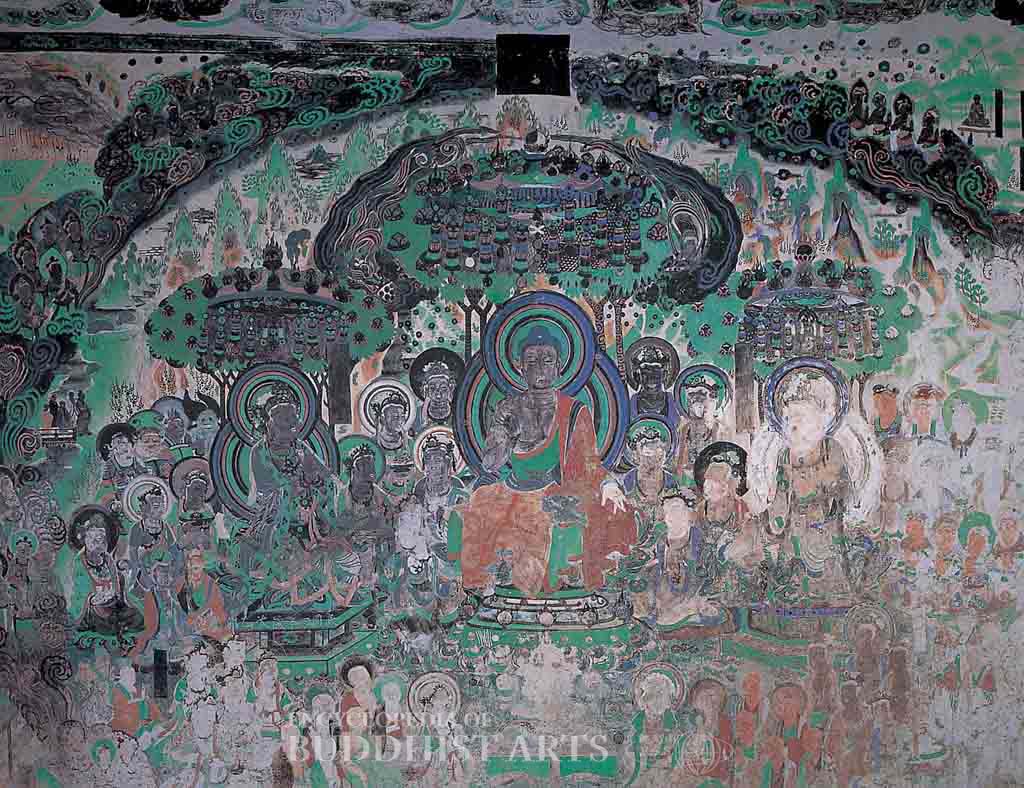
Mogao Cave 23: Illustration of the Lotus Sutra - Introductory Chapter
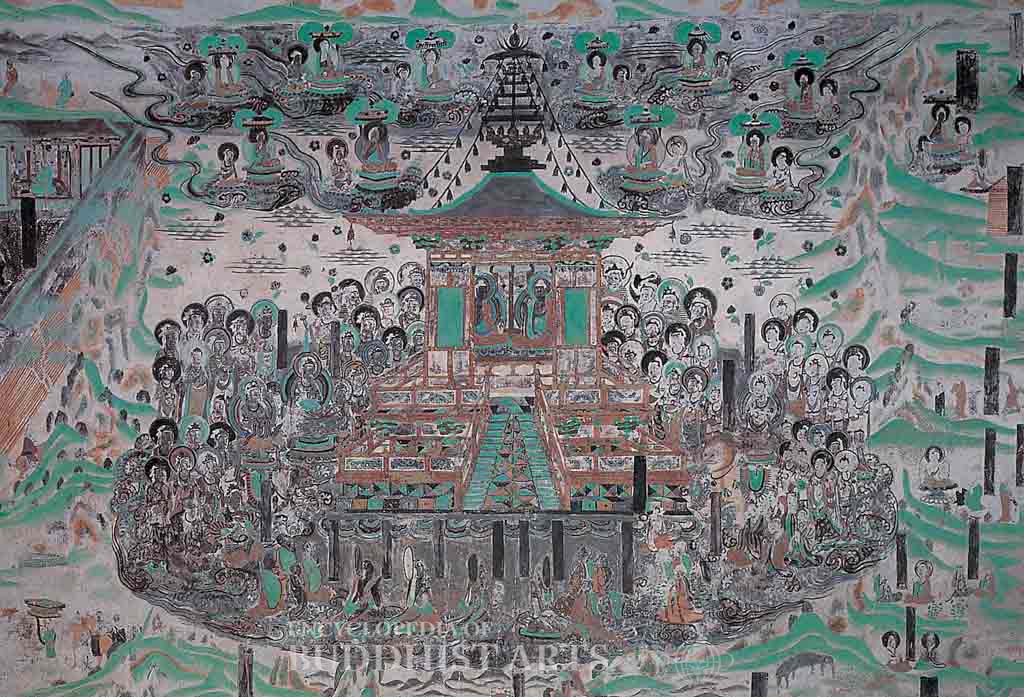
Mogao Cave 23: Illustration of the Lotus Sutra - Chapter on the Emergence of the Prabhutaratna Pagoda
Mogao Cave 23: Illustration of the Lotus Sutra
CHINA, Gansu, Dunhuang; Tang dynasty
The illustration of the Lotus Sutra is located on the north, south, and front (east) walls of the main chamber, as well as on the east and south slopes of the ceiling. They date from the High Tang period (712–756).
The mural located in the center of the north wall depicts the Assembly at Vulture Peak as described in the “Introductory Chapter” of the Lotus Sutra. Sakyamuni Buddha is seated at the center and teaches the Lotus Sutra to an audience of disciples and Bodhisattvas. At the top of the painting are the tree-covered foothills of Vulture Peak; Bodhisattvas ride on clouds above the mountain. Scenes from the “Chapter on the Parable of Medicinal Herbs,” the “Chapter on Skillful Means,” and the “Chapter on Similes and Parables” surround figures in the center.
In the center of the south wall is a depiction of the “Chapter on the Emergence of the Prabhutaratna Pagoda,” with Sakyamuni and Prabhutaratna Buddhas seated side-by-side within the Prabhutaratna Pagoda. They are surrounded by Bodhisattvas, disciples, and the Eight Classes of Dharma Protectors. Mountains and illustrations of the “Universal Gateway Chapter,” and the “Chapter on the Parable of the Phantom City” are painted on the sides of the south wall. Above the doorway on the front (east) wall is an illustration of the “Chapter on Sadaparibhuta Bodhisattva.” Other chapters are illustrated on either side of the doorway. The east and south slopes of the ceiling contains the Assembly at Vulture Peak and Avalokitesvara Teaching the Dharma, surrounded by scenes from the “Universal Gateway Chapter.”
For more details, go to the Encyclopedia of Buddhist Arts: Caves M-Mo, page 853.
Cite this article:
author = Hsingyun and Youheng and Johnson, Peter and Mankuang and Huntington, Susan and Edson, Gary and Neather, Robert,
booktitle = {Encyclopedia of Buddhist Arts: Caves M-Mo},
pages = 853,
title = {{Mogao Cave 23: Illustration of the Lotus Sutra}},
volume = 7,
year = {2016}}