
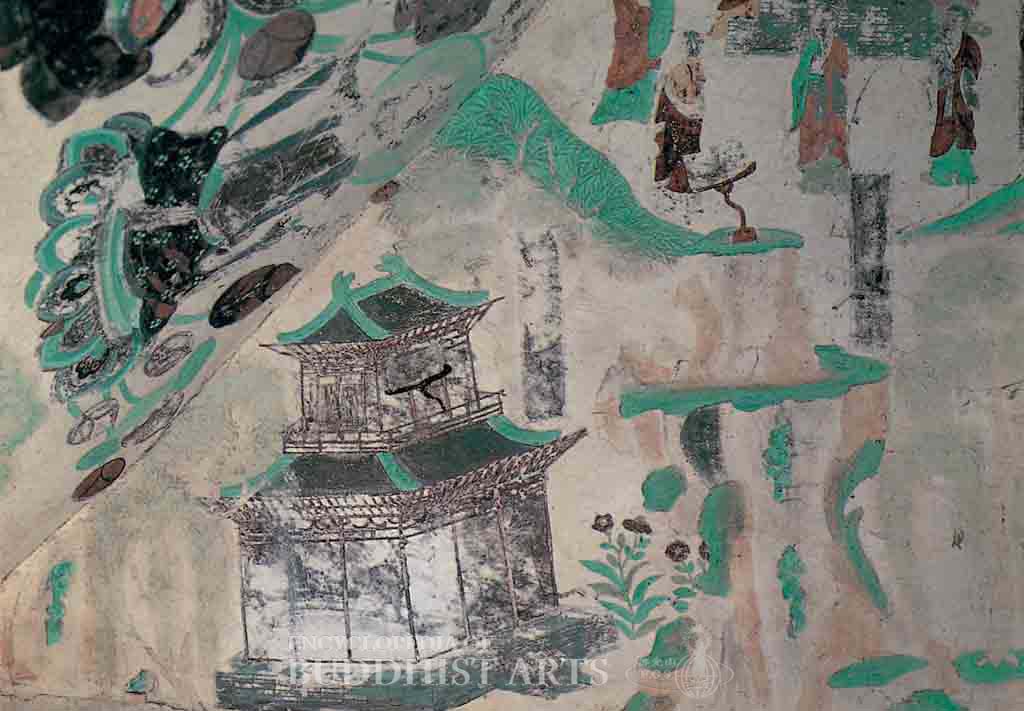
Mogao Cave 23: Illustration of the Lotus Sutra - Universal Gateway Chapter (detail)
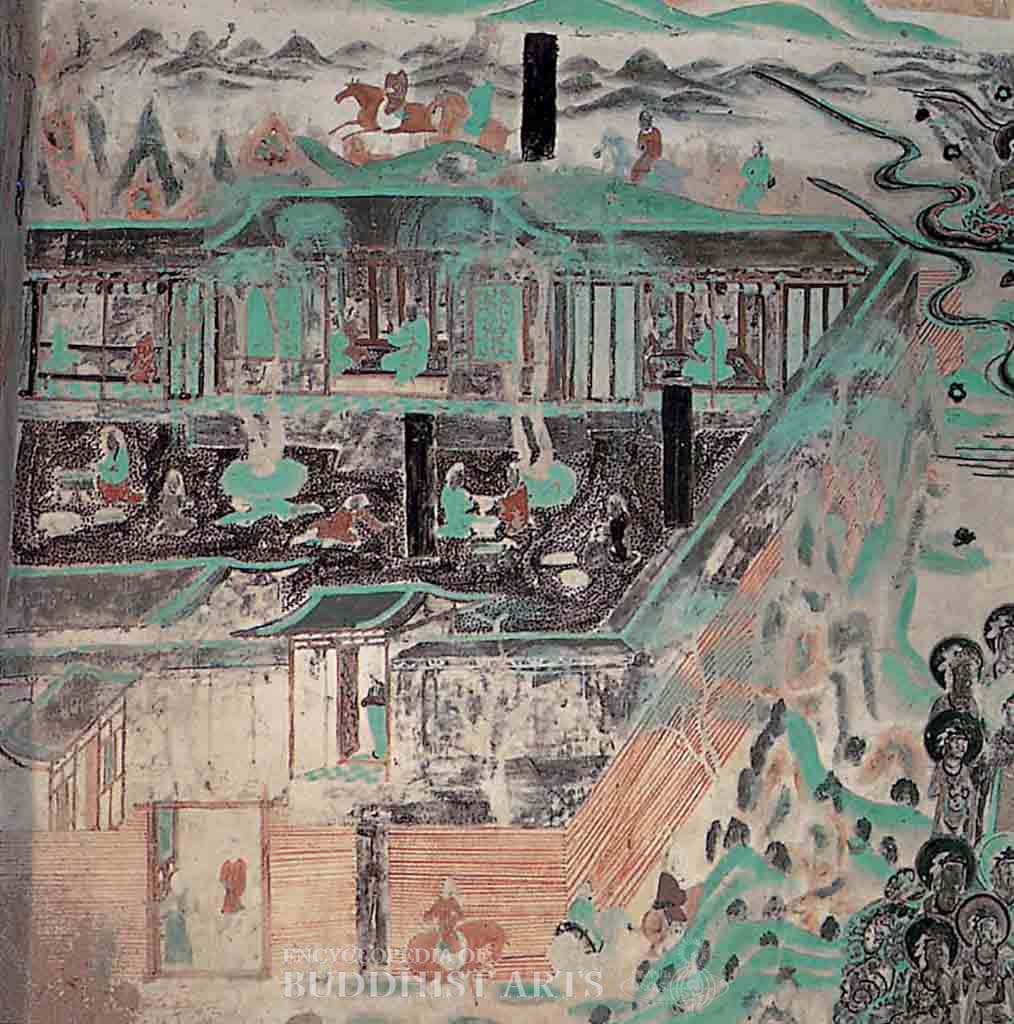
Mogao Cave 23: Illustration of the Lotus Sutra - Chapter on the Parable of Phantom City (detail)
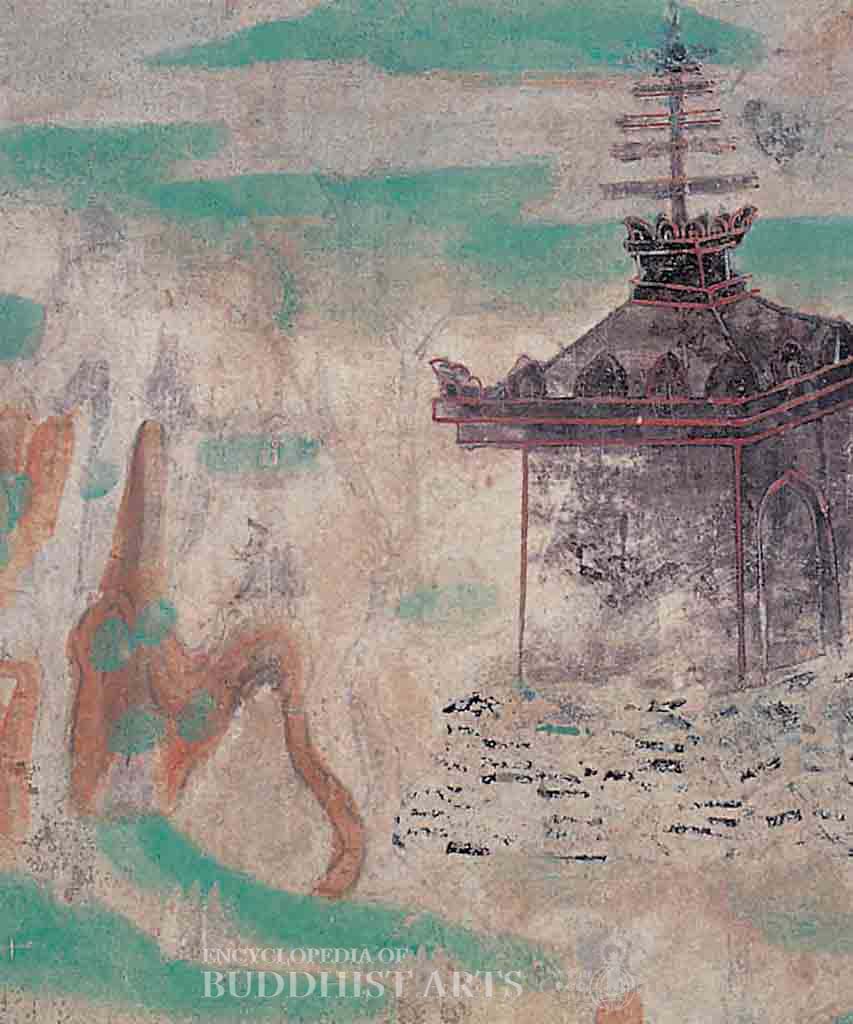
Mogao Cave 23: Illustration of the Lotus Sutra - Chapter on the Past Deeds of Bhaisajyaraja Bodhisattva (detail)
Mogao Cave 23
CHINA, Gansu, Dunhuang
This shrine cave is located in the northern section of the south area. It was built during the High Tang period (712–756) and consists of an antechamber and a main chamber connected by a corridor. The main chamber has a truncated pyramidal ceiling and a niche in the back (west) wall. The ceiling in the main chamber has a lotus medallion in the center, with additional scenes from the Lotus Sutra on the east and south slopes, including the Assembly at Vulture Peak and Avalokitesvara Teaching the Dharma. An illustration of the Maitreya Sutras is on the west slope, and a depiction of the Amitabha Sutra adorns the north slope.
The niche in the back wall houses a Buddha with two disciples and four Bodhisattvas, all of which were repaired during the Qing dynasty. The center of the niche ceiling is painted with a checker-patterned floral motif. There are images of 13 standing Medicine Buddhas and 5 Bodhisattvas on the walls within the niche, all painted during the Mid-Tang (756–846) and Five Dynasties (907–960) periods. Parts of the back wall and the ceilings of the corridor and antechamber were also painted over during this time period.
Illustrations of the Lotus Sutra abound in this cave. The Lotus Sutra was a nascent theme within the Mogao Caves during the Sui dynasty (581–618), with scenes from the sutra often appearing on ceilings. By the High Tang period, illustrations of the sutra had gained significance, occupying prominent positions on the walls of the caves.
Detailed murals of the Lotus Sutra within the main chamber include scenes from the following chapters: “Introductory Chapter,” “Chapter on the Parable of Medicinal Herbs,” “Chapter on Similes and Parables,” “Chapter on the Emergence of the Prabhutaratna Pagoda,” “Universal Gateway Chapter,” “Chapter on the Parable of the Phantom City,” “Chapter on Sadaparibhuta Bodhisattva,” “Chapter on Skillful Means,” “Chapter on Emerging from the Earth,” “Chapter on the Past Deeds of Bhaisajuaraja Bodhisattva,” “Chapter on Belief and Understanding,” “Chapter on Devadatta,” “Chapter on Supernatural Powers of the Tathagata,” and “Chapter on the Past Deeds of King Subhavyaha.”
For more details, go to the Encyclopedia of Buddhist Arts: Caves M-Mo, page 852.
Cite this article:
author = Hsingyun and Youheng and Johnson, Peter and Mankuang and Huntington, Susan and Edson, Gary and Neather, Robert,
booktitle = {Encyclopedia of Buddhist Arts: Caves M-Mo},
pages = 852,
title = {{Mogao Cave 23}},
volume = 7,
year = {2016}}