
Mogao Cave 254

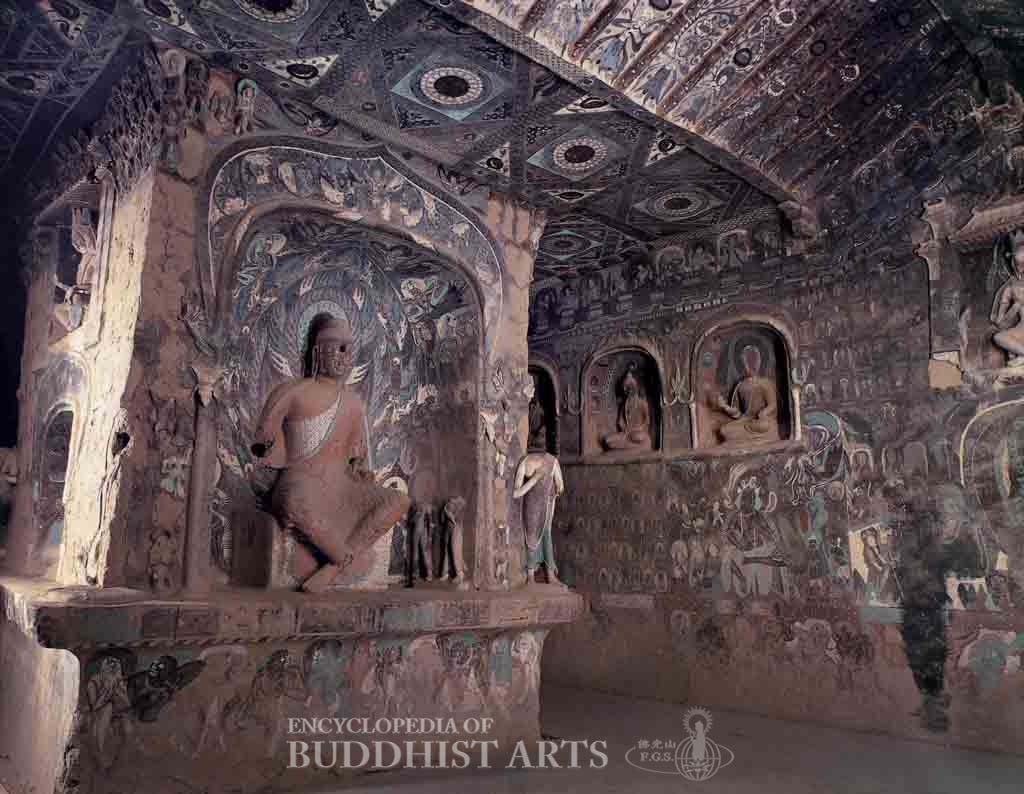
Mogao Cave 254: Seated Buddha (central pillar, east side)
Mogao Cave 254
CHINA, Gansu, Dunhuang
Situated in the central section of the south area of the site, this cave is among the oldest central pillar caves at Mogao. It was constructed during the Northern Wei dynasty (386–534) after the imperial army assumed control of the Hexi Corridor region. The cave was later renovated during the Sui dynasty (581–618). The front of the cave has a gabled ceiling decorated with figures holding lotus flowers in offering. The rear ceiling is coffered, with diamond-in-square motifs on each panel embellished with lotuses, flames, and flying apsaras. On the north and south walls at the front of the cave, there are niches containing statues of cross-ankled Bodhisattvas.
The central pillar near the rear of the cave has niches in all four sides. The arched niche on the east side houses the main Buddha statue, and has a honeysuckle pattern painted on the lintel as well as a dragon head carved on each side. The seated Buddha is 1.9 m in height, has curly hair, and wears a monastic robe draped over the left shoulder. Behind the Buddha is a flaming mandorla decorated with flying apsaras and lotus-born children. Two attendant Bodhisattvas are sculpted within the niche on each side of the Buddha, but some of them are damaged. Vasu and Mrgasirsa are painted beside the Buddha. Above them are images of 4 apsaras and 12 Bodhisattvas making offerings. Originally, there were two Bodhisattva sculptures outside the niche, but at present only one remains and is heavily damaged. Remnants of 16 Bodhisattva reliefs can be seen on the pillar wall outside the niche. There are ten yaksas painted on the base of the pillar below the niche.
The north, south, and west sides of the central pillar each have two niches. The upper niches on the north and south sides contain statues of Bodhisattvas with legs crossed at the ankles, and the lower niches contain statues of Buddha in meditation. Outside each lower niche are two sculpted attendant Bodhisattvas. The niches on the west side both contain Buddhas in meditation, the upper niche with images of two heavenly beings making offerings and six lotus-born children, and the lower niche with 22 Bodhisattva reliefs outside.
In the center of the back (west) wall is a painting of a niche containing a Buddha in a white robe, with 17 yaksas painted below it. A row of heavenly musicians in various postures inside the arched gateways of their heavenly palaces covers the upper register of the four walls. Below this on the north and south walls are five arched niches opposite the central pillar. Inside each niche is a statue of either a Buddha in meditation or a Buddha teaching the Dharma. All the statues on the south wall are damaged, and only two on the north wall remain intact. Below the niches on the south wall, there are depictions of the Defeat of Mara, the Prince Mahasattva Jataka, and a Dharma teaching scene. Below the niches on the north wall are illustrations of the King Sibi Jataka, the Renunciation of Nanda, and a Dharma teaching scene. Along the bottom of both the north and south walls are 25 yaksas. On the front (east) wall is a window surrounded by heavenly musicians, with yaksas are painted below it along the base of the wall. The remaining space on all four walls is filled with Thousand Buddha images.
For more details, go to the Encyclopedia of Buddhist Arts: Caves M-Mo, page 1063.
Cite this article:
author = Hsingyun and Youheng and Johnson, Peter and Mankuang and Huntington, Susan and Edson, Gary and Neather, Robert,
booktitle = {Encyclopedia of Buddhist Arts: Caves M-Mo},
pages = 1063,
title = {{Mogao Cave 254}},
volume = 7,
year = {2016}}