
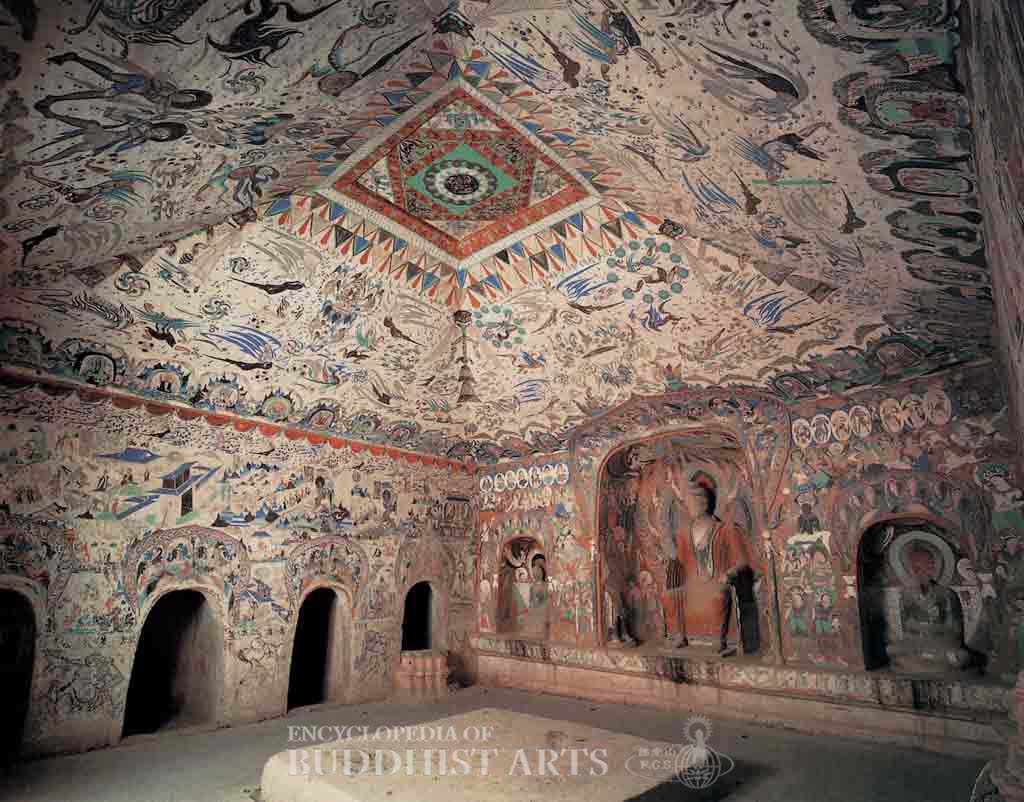
Mogao Cave 285: Main Chamber
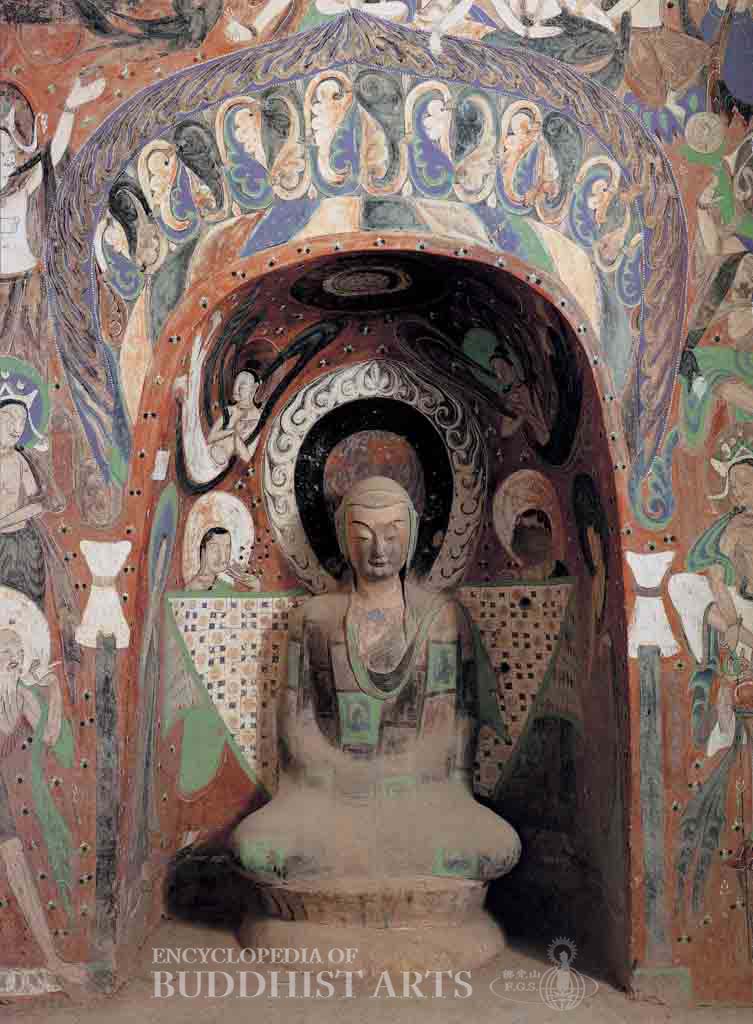
Mogao Cave 285: Main Chamber - Seated Monk (back wall, left side)
Mogao Cave 285
CHINA, Gansu, Dunhuang
This modified vihara cave is situated on the second level in the central section of the south area. It was constructed during the Western Wei dynasty (535–556). An inscription dated to 538 was found on the north wall, making this the earliest dated cave at Mogao. Researchers believed that Yuan Rong of Luoyang, then governor of Guazhou, most likely sponsored the construction of the cave. It is composed of a rectangular antechamber and a square main chamber with a truncated pyramidal ceiling. There is a low square platform in the center of the cave. Four meditation cells are built into the side walls. Stupas were constructed outside the meditation cells during the Yuan dynasty (1271–1368) but were subsequently removed; at present only four of the bases remain.
On the back (west) wall of the main chamber, there is a large niche in the center and a smaller niche on each side. The large niche contains a statue of a Buddha seated with legs pendent, flanked by two Bodhisattvas, and the two smaller niches contain statues of seated monks.. Outside the niches, the back wall is covered with paintings of Bodhisattvas, heavenly beings, and warriors. On the north wall are seven images of Buddha teaching the Dharma to disciples and Bodhisattvas, as well as one depiction of Sakyamuni and Prabhutaratna Buddhas with attendant Bodhisattvas. Between the meditation cells are images of Bodhisattvas making offerings and the Thousand Buddhas. At the top of the south wall are 12 apsaras, with a large illustration of the Conversion of Five Hundred Bandits below them, and to the far right is an image of Sakyamuni and Prabhutaratna Buddhas. Between the entrances to the meditation cells is an illustration of the Novice Monk Committing Suicide to Uphold the Precepts from the Sutra of the Wise and the Foolish. Above the doorway on the front (east) wall are three Buddha images, and on both sides are images of Amitabha Buddha teaching the Dharma. Below these are cartouches and donor images. Yaksas are painted along the bottom of the north, south, and front walls, and draperies line the very top of the walls.
For more details, go to the Encyclopedia of Buddhist Arts: Caves Mo-S, page 1100.
Cite this article:
author = Hsingyun and Youheng and Johnson, Peter and Mankuang and Huntington, Susan and Edson, Gary and Neather, Robert,
booktitle = {Encyclopedia of Buddhist Arts: Caves Mo-S},
pages = 1100,
title = {{Mogao Cave 285}},
volume = 8,
year = {2016}}