
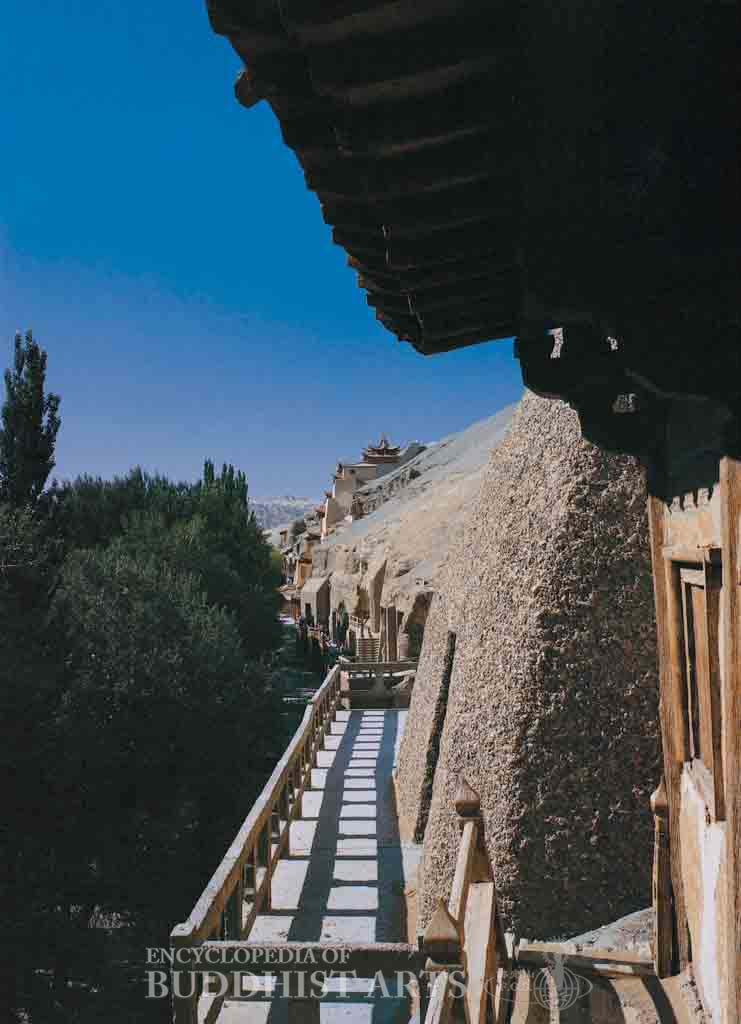
Dunhuang Caves: Mogao Caves (south section)

Dunhuang Caves: Mogao Caves

Dunhuang Caves: Mogao Caves
Dunhuang Caves
CHINA, Gansu, Dunhuang
The Dunhuang Caves are comprised of a number of distinct cave sites located near the city of Dunhuang in Gansu province, at the western end of the Hexi Corridor. These sites include the Mogao Caves, the Eastern and Western Thousand Buddha Caves, the Yulin Caves, and the Five Temple Caves. The Mogao Caves and Western Thousand Buddha Caves were listed as National Cultural Heritage Sites in 1961, and the Eastern Thousand Buddha Caves and Yulin Caves were given the same designation in 1996. The Mogao Caves were also listed as a UNESCO World Heritage Site in 1987.
The Mogao Caves are located 25 km southeast of Dunhuang, at the foothills of Mingshashan (Singing Sand Mountain). According to a stele dating to the year 698, the first caves at the site were created in 366 during the Sixteen Kingdoms period (303–439). The caves were expanded continuously between the Northern Liang dynasty (397–439) and the Yuan dynasty (1271–1368). After the fall of the Yuan dynasty, work on the caves stopped and the area was gradually abandoned. In 1900, the Daoist priest Wang Yuanlu discovered a priceless collection of several thousand sutras, paintings, and ancient records in what is now known as Mogao Cave 17.
The caves are cut into the west cliff face at a height of 15 m to 20 m above ground level. They are unevenly aligned along approximately four levels, and span nearly 1.7 km in total. The caves have been numbered up to 735, and together contain approximately 45,000 sq m of murals and more than 2,400 sculptures. The cave site can be separated into north and south areas, with 487 caves in the south area, and just over 250 in the north. In the north area, except for Caves 461 to 465, the others do not contain painted sculptures or murals.
The majority of the caves are meditation caves, shrine caves, and central pillar caves. Other less common types of caves at the site include great Buddha caves and parinirvana caves. The cliffs at Mingshashan are made of fine sand and gravel, resulting in a surface which is not suitable for direct carving. Thus, sculptures and carvings were created out of other materials and then attached to the walls. The subjects of the artwork at Mogao include Buddhist figures, sutra illustrations, images from Chinese mythology, depictions of donors, illustrations of Buddhist historical sites, decorative patterns, and various other illustrations of Buddhist concepts, stories, and figures.
The Western Thousand Buddha Caves are located 30 km southwest of Dunhuang. Although the exact date of the first construction at the site is unknown, the surviving caves were created over a period spanning from the late Northern Wei (386–534) to the Yuan dynasty. The site consists of a total of 22 caves similar to those at the Mogao Caves site. One particularly notable work in the Western Thousand Buddha Caves is the mural in Cave 12 depicting the battle between Sariputra and Raudraksa. It is the oldest known mural of this story in China, and the only one from the Northern Dynasties (386–581).
The Yulin Caves are located along the cliff face on the east and west banks of Yulin River, 75 km southwest of Guazhou. There are currently 42 caves at the site, with 31 located on the east cliff and 11 on the west. They were created during the Tang dynasty (618–907), period of Uighur (1030–1036) ruling over Shazhou, Song dynasty (960–1279), Western Xia period (1032–1227), Yuan dynasty (1271–1368), and Qing dynasty (1644–1911). The majority of the caves at Yulin have a layout consisting of a long front passageway, an antechamber, and a main chamber. The caves created during the Western Xia period and Yuan dynasty are considered to be of particular importance. Specifically, the Tibetan Buddhist art at the site has been a valuable resource for historical and cultural research.
The Eastern Thousand Buddha Caves are located on the east and west cliff faces of a riverbed 35 km southeast of Qiaozi village in Guazhou. Work at the site began during the Western Xia period, resulting in 23 caves arranged in two levels. Caves 2, 4, 5, and 7 are the most important, with a vast amount of subjects from Vajrayana Buddhism.
The Five Temple Caves are located on banks of the Danghe River, 20 km northwest of Subei, Jiuquan. There are four caves remaining at this site, dating from between the Northern Wei and the Northern Song (960–1127) dynasties. Unfortunately, these caves have suffered significant damage and none of the original statues remain. Among the surviving murals are sutra illustrations and paintings with Vajrayana themes; however, these images have been badly damaged by smoke and many are difficult to discern.
For more details, go to the Encyclopedia of Buddhist Arts: Caves A-E, page 317.
Cite this article:
author = Hsingyun and Youheng and Johnson, Peter and Mankuang and Huntington, Susan and Edson, Gary and Neather, Robert,
booktitle = {Encyclopedia of Buddhist Arts: Caves A-E},
pages = 317,
title = {{Dunhuang Caves}},
volume = 5,
year = {2016}}