
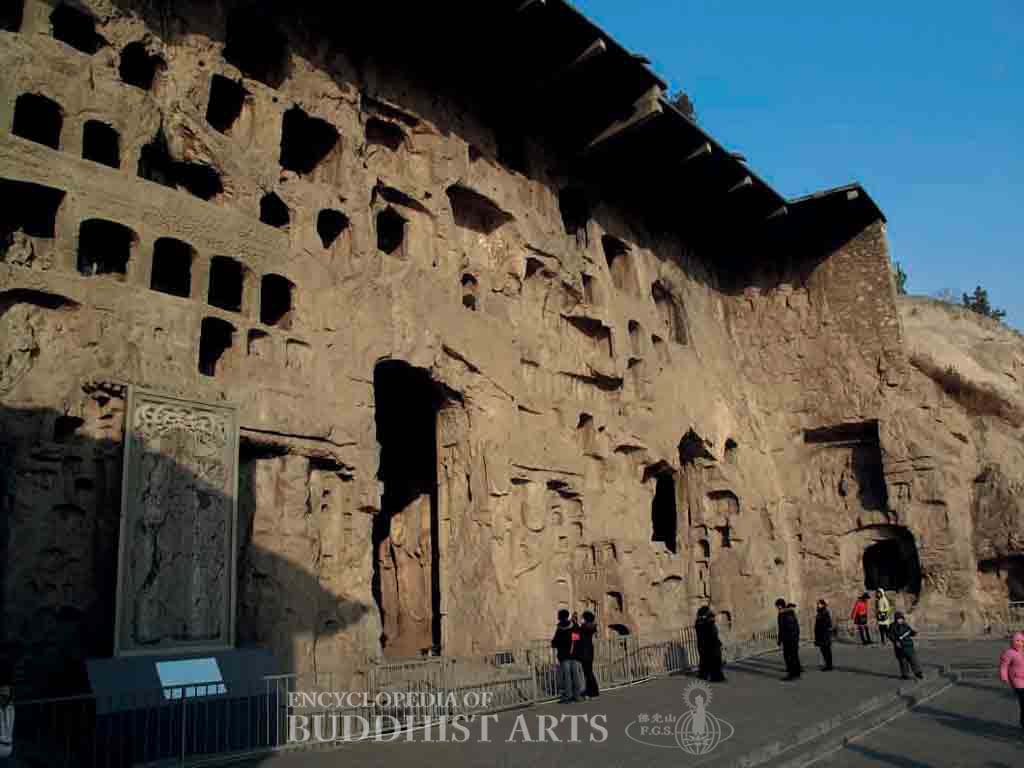
Longmen Grotto 140
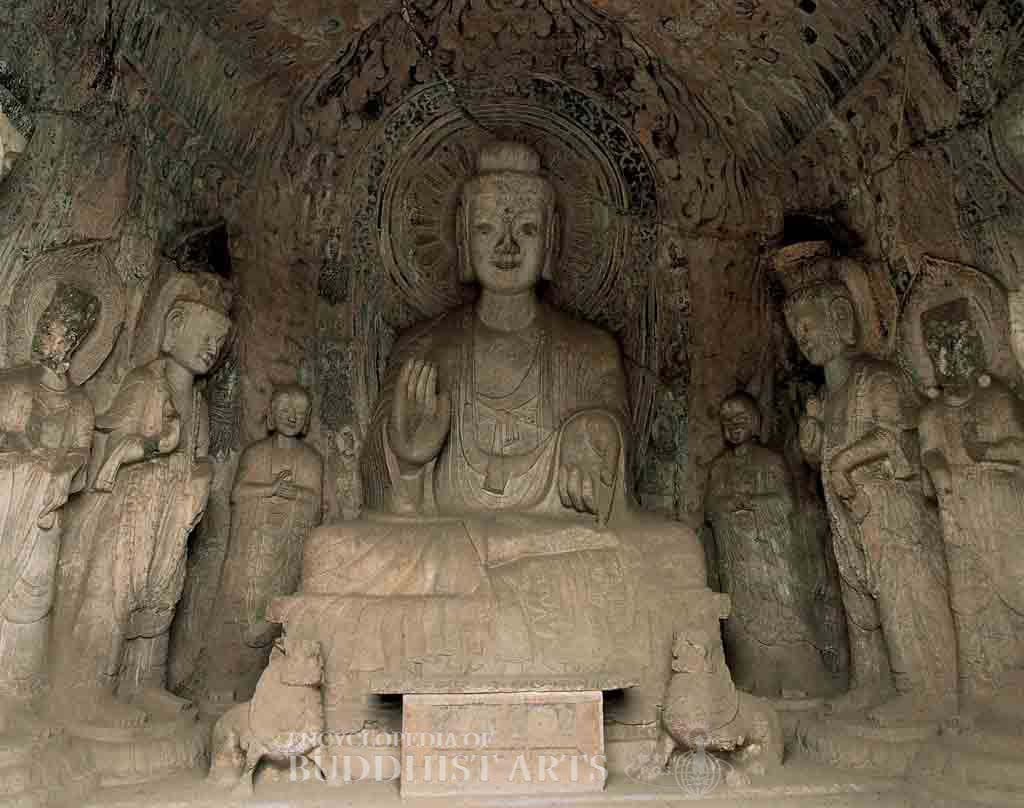
Longmen Grotto 140: Buddha Pentad (back wall)
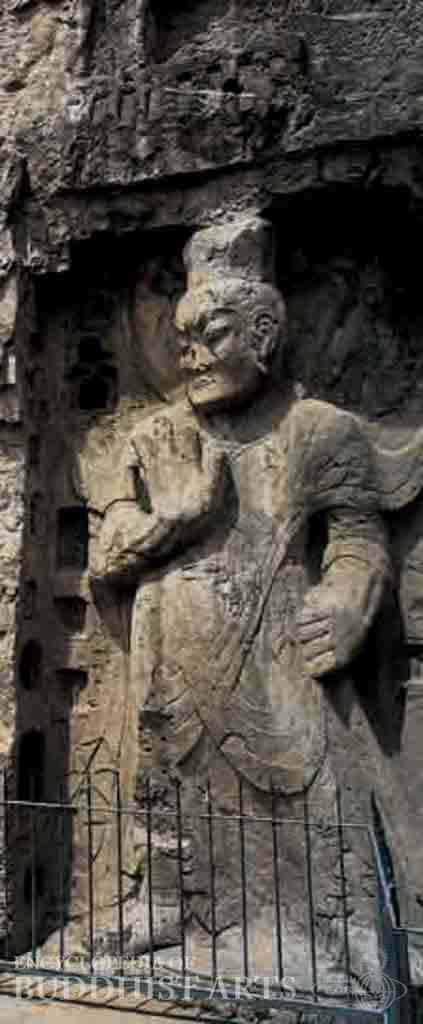
Longmen Grotto 140 : Warrior (right side of entrance); Northern Wei dynasty, dated 523
Longmen Grotto 140
CHINA, Henan, Luoyang
This grotto, known as Central Binyang Grotto, is located in the northern area of the Yi River’s west bank. The grotto was completed after 505 during the Northern Wei dynasty. With an apsidal layout and vaulted ceiling, Grotto 140 measures 11.4 m in width, 9.3 m in height, and 9.85 m in depth. The flame-patterned arched doorway is framed by a lintel carved with the dragon body and columns decorated with dragon heads on the sides. Niches to the left and right of the entrance house fierce-looking warriors who hold vajras.
The grotto has an ornate ceiling relief of two lotus flowers surrounded by eight apsaras and two Bodhisattvas making offerings, between which are clouds and foliage. Five freestanding statues are along the back (west) wall. The Buddha in the center is 6.45 m in height and is seated in full lotus position on a Sumeru throne. The figure has a high usnisa and gentle features. The right hand displays the abhaya (fearlessness) mudra, while the left forms the varada (wish-granting) mudra. The Buddha’s outer robe drapes over the front of the throne, which is flanked by two small lions. The Buddha’s nimbus and mandorla are highly decorative, with the latter bordered by a flame pattern. Disciples Mahakasyapa and Ananda flank the Buddha. Mahakasyapa clasps his hands at chest level and Ananda holds an object. Next to the disciples, two smiling Bodhisattvas with petal-shaped nimbuses wear tall cylindrical crowns. The Bodhisattvas wear necklaces, stoles and long garments, and both display mudras with the right hand, while standing barefoot upon round lotus pedestals. To each side of the central group of statues is a smaller Buddha triad. Relief illustrations of the Vimalakirti Sutra are depicted at the top of the front (east) wall on either side of the doorway within the grotto. Below these are illustrations of the Prince Sudana Jataka on the right and the Mahasattva Jataka on the left. At one time, there were portraits of Emperor Xiao Wendi (reigned 471–499) of the Northern Wei dynasty and his wife, Empress Wenzhao, below the Jataka illustrations; however, they were removed and are now kept in the USA. Ten deities are depicted on the lower wall, five on each side of the doorway. Wind Deity, Dragon Deity, Water Deity, Tree Deity, and Lion Deity are portrayed to the left, and on the right are Mountain Deity, Jewel Deity, Fire Deity, Elephant Deity, and Bird Deity. On the floor below the entry, there is a pond scene, where four large lotuses float on the water, surrounded by birds and people.
For more details, go to the Encyclopedia of Buddhist Arts: Caves R-L, page 664.
Cite this article:
author = Hsingyun and Youheng and Johnson, Peter and Mankuang and Huntington, Susan and Edson, Gary and Neather, Robert,
booktitle = {Encyclopedia of Buddhist Arts: Caves R-L},
pages = 664,
title = {{Longmen Grotto 140}},
volume = 6,
year = {2016}}