
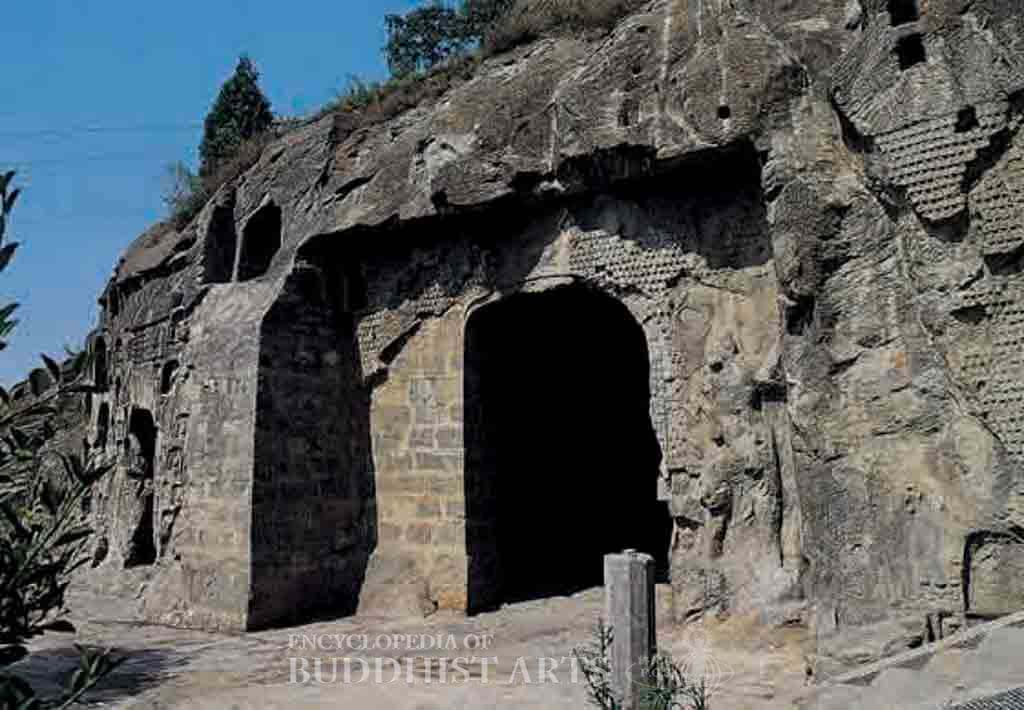
Longmen Grottoes 2050, 2055, and 2062: Grotto 2055
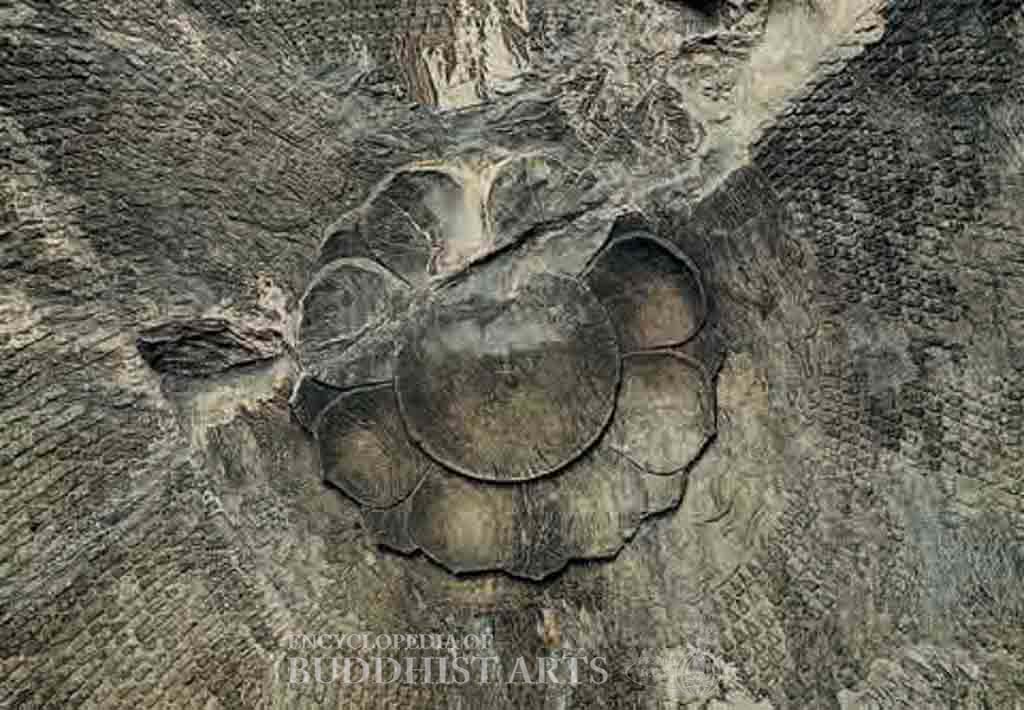
Longmen Grottoes 2050, 2055, and 2062: Grotto 2055 - Ceiling
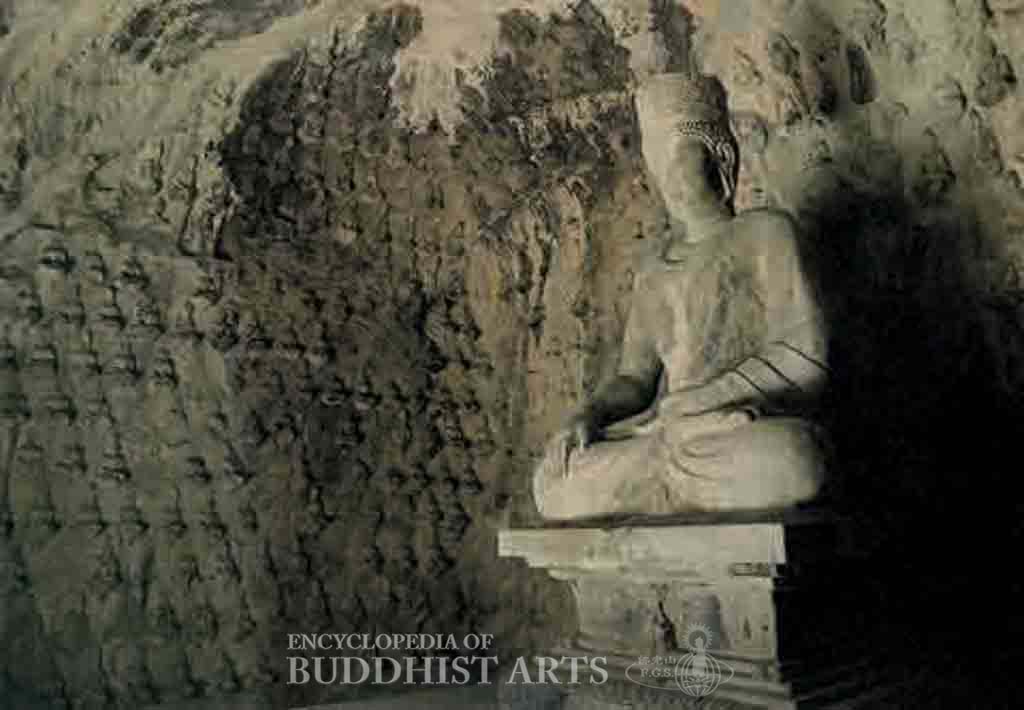
Longmen Grottoes 2050, 2055, and 2062: Grotto 2050 - Seated Buddha (back wall)
Longmen Grottoes 2050, 2055, and 2062
CHINA, Henan, Luoyang
These three grottoes, known as the Leigutai (Drum Beating Platform) Grottoes, are located on the Yi River’s east bank and face west. They were constructed during the Wu Zhou period (684–705). Grotto 2050, or South Leigutai Grotto, is 7.88 m in width, 6 m in height, and 7.9 m in depth. Traces of a lotus relief are visible on the vaulted ceiling. On the back (east) wall, a Buddha sits in full lotus position on a Sumeru throne. The Buddha wears a crown, a robe that bares the right shoulder, and is adorned with a necklace and bracelets. The right hand forms the bhumisparsa (earth-touching) mudra. The image is regarded as a Bodhi Figure, which illustrate the auspicious signs during Sakyamuni Buddha’s enlightenment as described in Master Xuanzang’s account of the Magadha region. The walls of the grotto have a total of 746 Thousand Buddha images, each seated in full lotus position.
Grotto 2055, or Central Leigutai Grotto, is 6.3 m in width, 5.78 m in height, 7.7 m in depth. It has an apsidal layout with a vaulted ceiling. There are 1039 Thousand Buddha images carved on the exterior of the grotto. Above the entrance, an inscription reads, “Fifteen Thousand Buddha Niches.” A warrior stands on the right side of the entrance. Inside the grotto, the lotus medallion on the ceiling is surrounded by apsaras who play musical instruments. A Buddha and two Bodhisattvas are placed on the crescent-shaped altar at the back (east) wall. All three statues are damaged. Four sutras carved above the shallow niche include the Heart Sutra and the Dharani Sutra of the Six Gates. Carved on the ceiling and four walls are 10,128 Thousand Buddha images seated in full lotus position and forming the dhyana (meditation) mudra with both hands. Twenty-five Arhats sculpted below the Thousand Buddhas include Mahakasyapa and Aryasimha. Beside each Arhat is an inscription with excerpts from the Account of the Causes and Conditions of the Dharma-Treasury Transmission.
With an arched entrance, Grotto 2062, the North Leigutai Grotto, also has an apsidal layout with a vaulted ceiling. The grotto measures 5.18 m in width, 4.3 m in height and 4.76 m in depth. A lotus medallion surrounded by four apsaras is depicted on the ceiling and there are altars along three walls. The main Buddha statue on the back (east) wall is 3.36 m in height, with a crown and a three-layered nimbus decorated with lotus petals and Buddha images. Seated on a lotus throne in full lotus position, the Buddha wears a robe which bares the right shoulder, as well as a necklace and bracelets. Facial features and parts of the body have deteriorated over time. The 3.3 m high Buddha statue on the north wall is seated on an octagonal lotus throne. The nimbus is identical to that of the main Buddha on the back wall. This statue has sustained substantial damage. The south wall has also deteriorated; only two Buddhas within the nimbus of the statue and the octagonal lotus throne are still discernible. On each side of the entrance on the front (west) wall, a niche housing a Bodhisattva statue is also damaged. The figures wear necklaces, bracelets, and long stoles which cross through a ring at the waist. At one time, high relief images of Bodhisattvas making offerings covered the four walls, but only 17 remain. There are also 25 small niches within the grotto; most of them are arched, and each of them houses a Buddha and two Bodhisattvas.
For more details, go to the Encyclopedia of Buddhist Arts: Caves R-L, page 714.
Cite this article:
author = Hsingyun and Youheng and Johnson, Peter and Mankuang and Huntington, Susan and Edson, Gary and Neather, Robert,
booktitle = {Encyclopedia of Buddhist Arts: Caves R-L},
pages = 714,
title = {{Longmen Grottoes 2050, 2055, and 2062}},
volume = 6,
year = {2016}}