
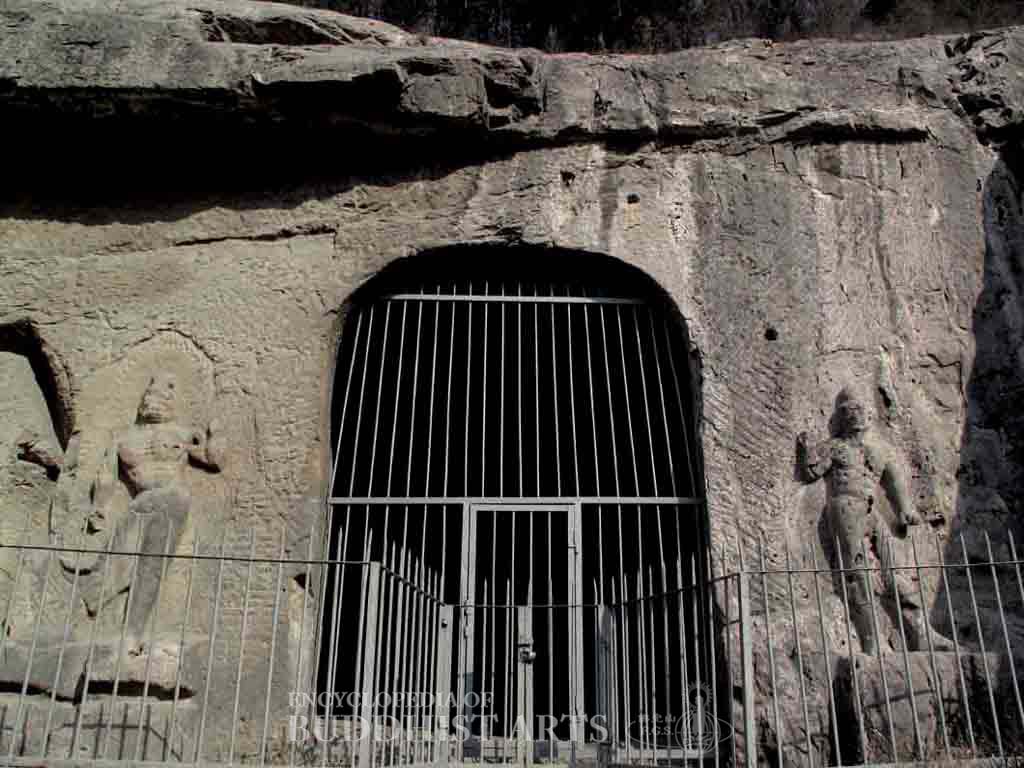
Longmen Grotto 2144: Entrance
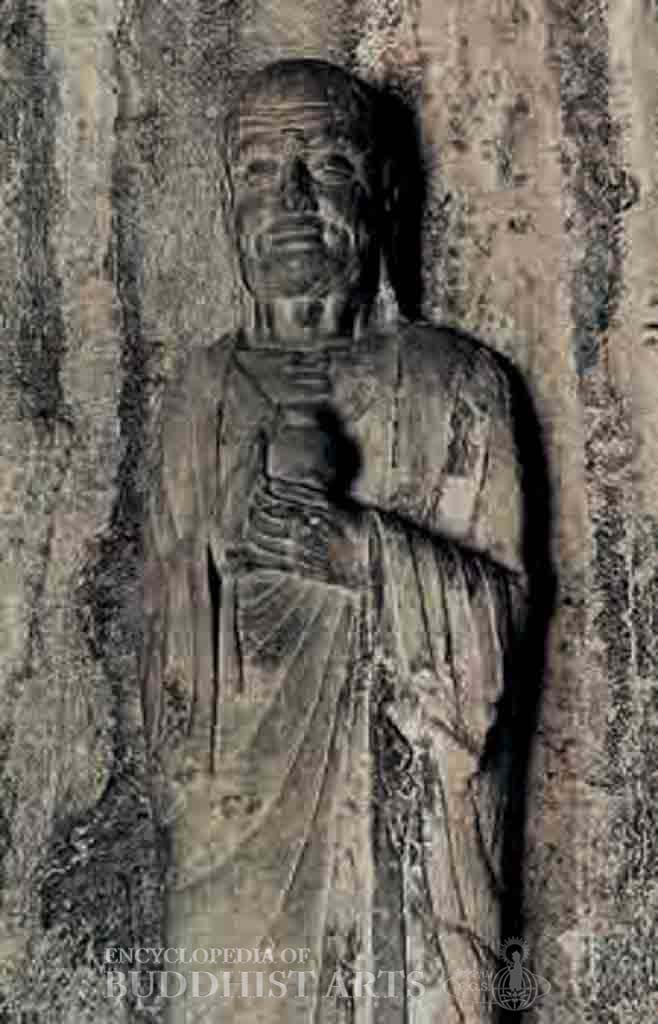
Longmen Grotto 2144: Main Chamber - Mahakasyapa (back wall)
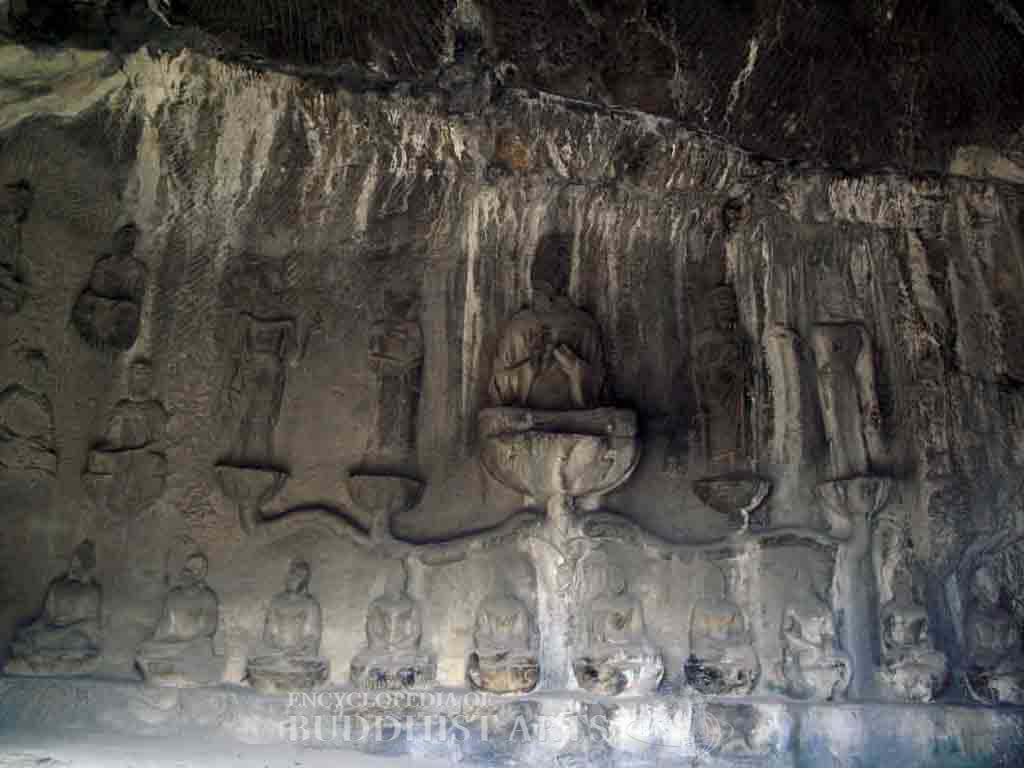
Longmen Grotto 2144: Main Chamber - Back Wall
Longmen Grotto 2144
CHINA, Henan, Luoyang
Grotto 2144 is also known as Prince of Gaoping Grotto. It is located on the Yi River’s east bank, on the north cliff of Wanfogou (Ten Thousand Buddha Gorge). Measuring 9.96 m in width, 6 m in height, and 7.6 m in depth, the south-facing grotto is rectangular and has a barrel-vaulted ceiling. The entrance to the antechamber is arched and guarded on each side by a warrior with a flame-patterned nimbus. Inside there are 24 movable statues with tenons attached to mortises on the floor of the grotto. Two inscriptions on two of the thrones indicate that the grotto was excavated between 684 and 705 by Wu Chonggui, the Prince of Gaoping, and later completed by the monk Huicheng.
On the back (north) wall of the main chamber, a relief depicts Amitabha Buddha seated on a large lotus flower, the stem of which rises from the bottom of the wall’s center. On both sides of the lotus, two additional blooms extend to support pairs of flanking disciples and Bodhisattvas. The Buddha’s monastic robe covers both shoulders while the flanking disciples have cross-collared robes. Ananda is to the left, and on the right is Mahakasyapa, who holds an incense burner with both hands. The two slender Bodhisattvas that stand on the outer lotuses are adorned with necklaces and long stoles. The Bodhisattva on the right holds a vase in one hand and a whisk in the other, while the Bodhisattva on the left holds a vase in the raised left hand and grasps the stole with the right hand. The heads of all but Mahakasyapa have been removed. Ten seated Buddha statues are depicted on a ledge along the bottom of the back wall.
Three rows of Buddhas sit in full lotus position on ledges along the west wall. There are seven Buddhas on the lower row, eight in the middle, and seven at the top. The east wall was not finished and is therefore unadorned. Nine Buddhas are preserved on the right side of the south wall; they sit in full lotus position, similar to those along the north wall.
For more details, go to the Encyclopedia of Buddhist Arts: Caves R-L, page 717.
Cite this article:
author = Hsingyun and Youheng and Johnson, Peter and Mankuang and Huntington, Susan and Edson, Gary and Neather, Robert,
booktitle = {Encyclopedia of Buddhist Arts: Caves R-L},
pages = 717,
title = {{Longmen Grotto 2144}},
volume = 6,
year = {2016}}