
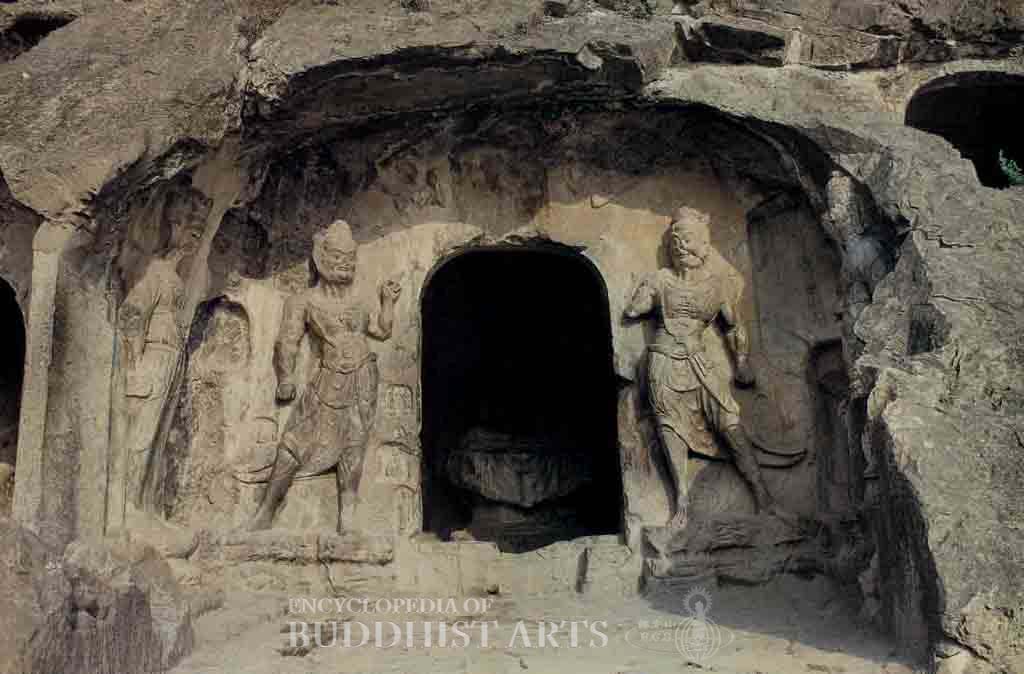
Longmen Grotto 403: Front Chamber
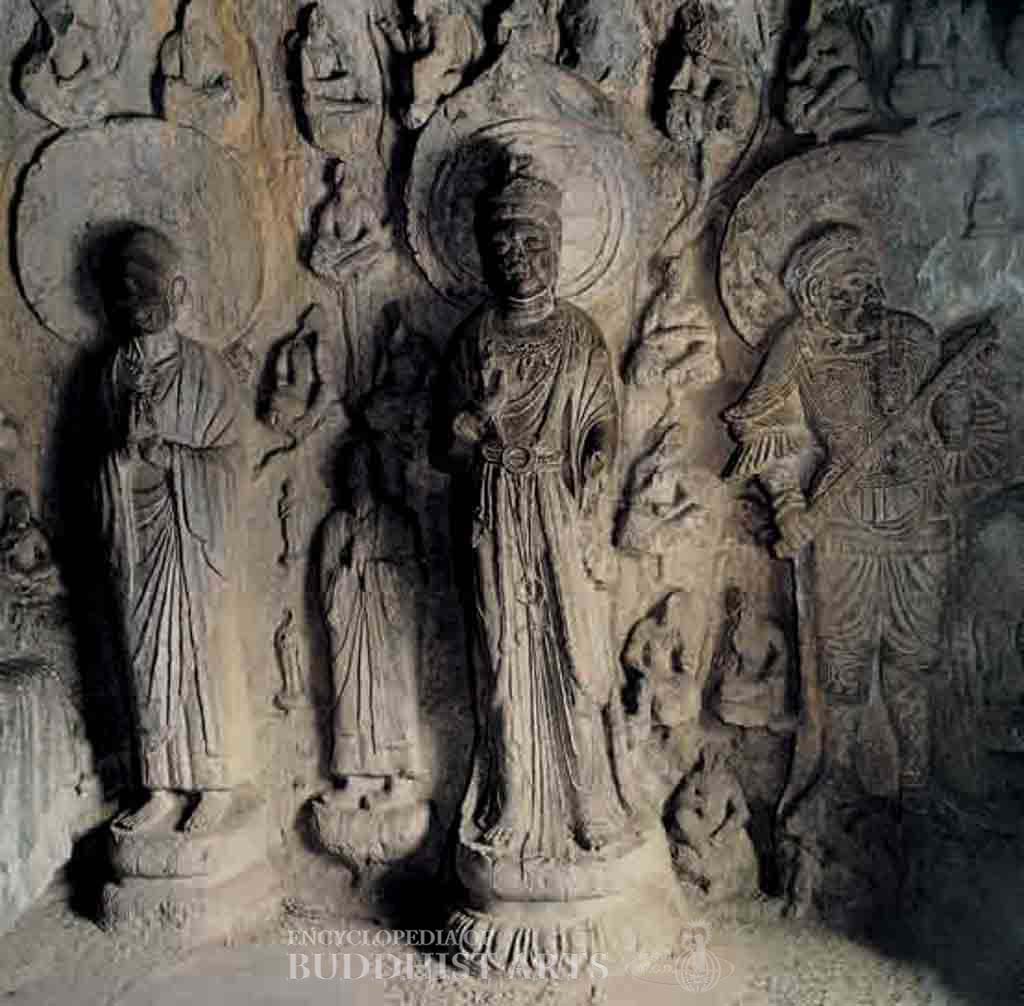
Longmen Grotto 403: Rear Chamber - Bodhisattva and Mahakasyapa (north wall)
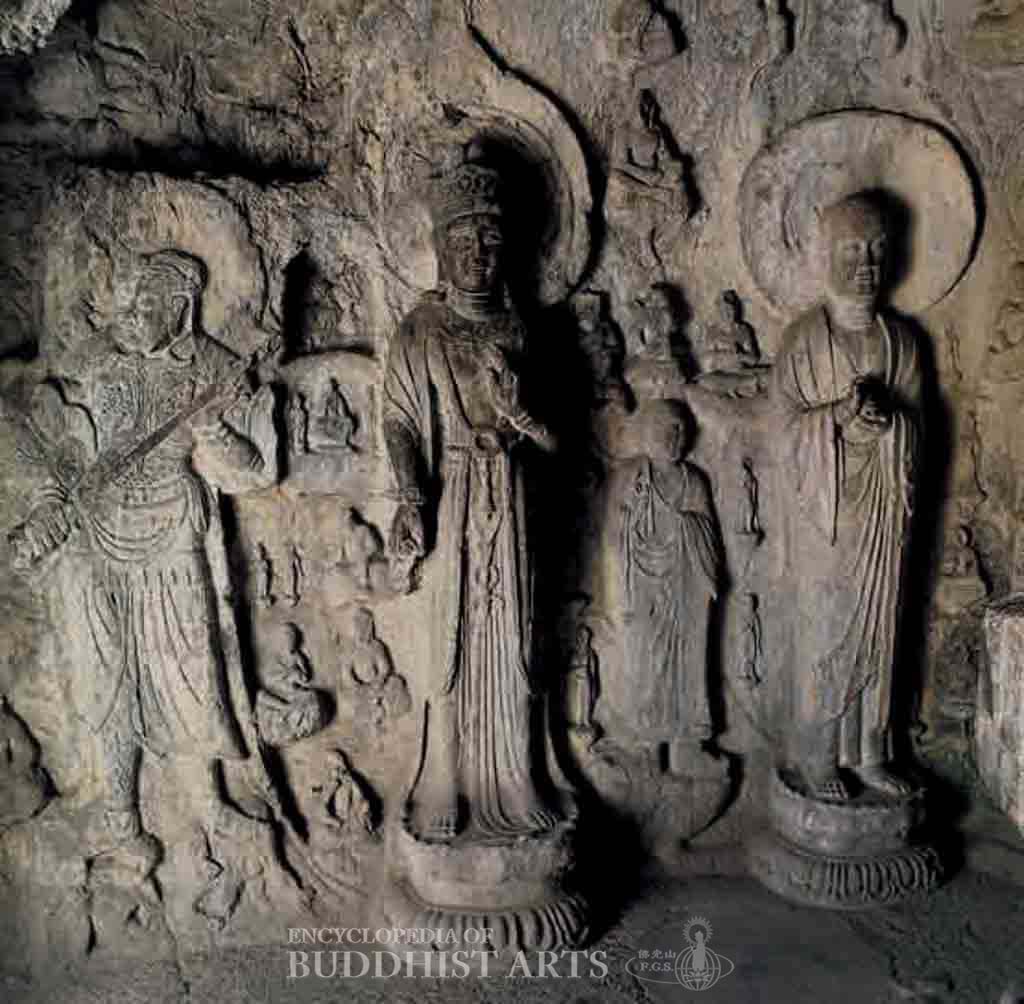
Longmen Grotto 403: Rear Chamber - Bodhisattva and Ananda (south wall)
Longmen Grotto 403
CHINA, Henan, Luoyang
This grotto is commonly referred to as Jingshan Temple. Situated in the northern area of the Yi River’s west bank, Grotto 403 is in a low area south of Grotto 159. It was constructed during the time of Emperor Gaozong (reigned 649–683) of the Tang dynasty. The grotto was commissioned by Consort Dowager Wei, who was a concubine of Emperor Taizong (reigned 626–649) and Prince of Ji’s mother. The front chamber is rectangular and the rear chamber is apsidal. It measures 3.7 m in width, 3.5 m in height, and 6.3 m in depth.
The ceiling of the front chamber has now collapsed. An apsara is located above and to either side of the entrance on the back (west) wall of the front chamber. Warriors who wear crowns and stand in powerful stances, with legs spread, are depicted on either side of the entrance. The warriors hold one fisted hand downward, while the other is raised before the shoulder. The north and south walls of the front chamber have carvings of Avalokitesvara and Mahasthamaprapta Bodhisattvas, respectively. The slightly damaged slender figures stand on double lotus pedestals. The three walls of the front chamber have numerous small niches.
Portrayed on the domed ceiling of the rear chamber is a lotus medallion and eight heavenly beings making offerings. The extant statues within the chamber include a Buddha, two disciples, two Bodhisattvas, and two Heavenly Kings. The main statue, Amitabha Buddha, has a high usnisa, a double-layered circular nimbus, and a mandorla. Wearing a monastic robe which covers both shoulders, the figure sits in full lotus position on an octagonal lotus throne. Amitabha’s robe drapes over the front of the throne, on each side of which is a lion carved in relief. On the north and south walls, the disciples Mahakasyapa and Ananda, stand barefoot on lotus pedestals. They are portrayed with circular nimbuses and robes with wide sleeves. Mahakasyapa holds an incense burner in both hands, while Ananda holds prayer beads. The two Bodhisattvas have petal-shaped nimbuses and hold one hand before the chest, while the other holds an object. Two Heavenly Kings, depicted in bas-relief, wear crowns, armor, and hold long swords. Interspersed between the main statue, the disciples, and the Bodhisattvas, there are smaller bas-relief images of disciples and Bodhisattvas who stand on lotus stems. The four walls are decorated with long-stemmed lotuses, topped with Bodhisattvas making offerings.
To the right of the grotto are niches constructed by Du Fali during the Early Tang period. The niches contain depictions of Yama and the hell realms, complete with images of an ox-headed jailer, the General of the Five Paths, and King Taishan. An inscription on the north wall of the front chamber, written by Li Xiaolun, Secretary of the Army in Xuande, records Consort Dowager Wei’s construction of the grotto.
For more details, go to the Encyclopedia of Buddhist Arts: Caves R-L, page 671.
Cite this article:
author = Hsingyun and Youheng and Johnson, Peter and Mankuang and Huntington, Susan and Edson, Gary and Neather, Robert,
booktitle = {Encyclopedia of Buddhist Arts: Caves R-L},
pages = 671,
title = {{Longmen Grotto 403}},
volume = 6,
year = {2016}}