

Longmen Grotto 1609: Lintel
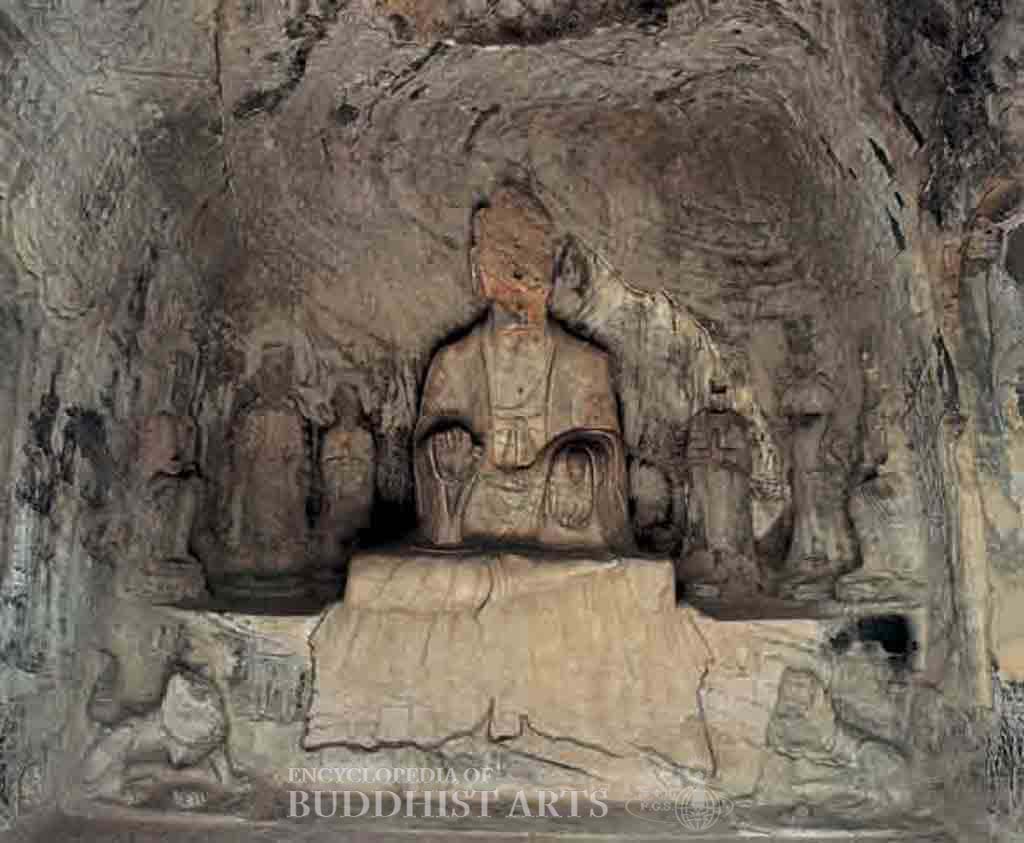
Longmen Grotto 1609: Sculptures (back wall)

Longmen Grotto 1609: Bodhi Tree and Monks
Longmen Grotto 1609
CHINA, Henan, Luoyang
This grotto, known as Lord Huangfu Grotto, is located in the southern area of the Yi River’s west bank. It was commissioned by the Commanding General Huangfu Du in the year 527 during the Northern Wei dynasty. The rectangular grotto, 7.25 m in width, 4.5 m in height, and 6.3 m in depth, has an arched entrance with a decorative ogee arched lintel, which portrays the Seven Buddhas of the Past. Above the lintel are two apsaras, one holding a lute, the other playing a flute, as their stoles swirl around them. The eaves, with rafter beams and tile shingles, extend above the apsaras. Decorative ornaments are found on either side of the eaves and a garuda is in the center. The door frame consists of two coiled dragons with honeysuckles held in their mouths. Beneath the dragons are decorated with lotus motifs. Warriors, severely weathered and no longer discernable, stand on either side of the entrance.
In the center of the ceiling is a lotus medallion carved in high relief that measures 2.4 m in diameter. Eight apsaras, with swinging stoles, hold instruments as they soar around the lotus. A 1 m high altar on the back (west) wall supports the sculptures of Sakyamuni Buddha, two disciples, and four Bodhisattvas. Seated in full lotus position, the slender Sakyamuni wears loose monastic robes. The inner robe is tied with a sash at the chest. Sakyamuni’s right hand forms the abhaya (fearlessness) mudra, while the left displays the varada (wish-granting) mudra. Two disciples dressed in monastic robes stand on lotus pedestals with palms joined in reverence. Two Bodhisattvas, 1.9 m in height, wear long robes and flowing stoles. One holds a wish-fulfilling jewel, and both stand upon lotus pedestals. The other two Bodhisattvas are dressed similarly and kneel in offering. The heads of all the figures are damaged. A pair of Dharma protecting lions is carved just below the altar, one on each side. Two Bodhisattvas in contemplation, each with two attendants, are found in the corners of the back wall. They are in the relaxation posture. Carved in relief on both sides of the back wall is a Bodhi tree. Above each tree are monks, six in the left corner and five in the right. The monks, with joined palms, wear robes with long, loose sleeves.
The lintel of a large arched niche, measuring 2.28 m in width, 1.64 m in height, and 1.26 m in depth, is centered on the north wall and decorated with images of the Seven Buddhas of the Past. Sakyamuni and Prabhutaratna Buddhas are found within the niche. Their heads and hands are damaged. The Buddhas, seated in full lotus position, wear loose monastic robes. The inner robes are tied with a sash at the chests. Two disciples with joined palms stand between the Buddhas. Two attendant Bodhisattvas, wearing stoles crossed at the waist, flank the Buddhas. Their long dhotis resemble those of the Bodhisattvas on the back wall. Outside the niche on the north wall’s corners are Bodhisattvas that hold offerings of an incense burner and a lotus. The Thousand Buddhas are depicted on the wall outside the niche.
The lintel of another large arched niche is centered on the south wall and measures 1.94 m in width and 2.18 m in height. It is carved with the Seven Buddhas of the Past, as well as Vimalakirti and Manjusri, who face each other seated at opposite ends of the lintel. Apsaras fly above the drapery framed scene. Two columns flank the niche on each side. A Bodhisattva seated in full lotus position within the niche is adorned with ornaments. The Bodhisattva wears a stole and long robes that drape over the front of an altar. The severely damaged statues of two Bodhisattvas and two disciples flank the central figure. Outside the niche on the south wall, a stele with a coiled dragon at the top chronicles the carving of the sculptures. Along the north and south walls below the niches are groups of figures making offerings. At the top of the south wall are five small niches, the middle three of which contain Sakyamuni and Prabhutaratna Buddhas, while those at either end house a standing Buddha and two standing Bodhisattvas. The north and south sides of the grotto floor are carved with lotus motifs.
For more details, go to the Encyclopedia of Buddhist Arts: Caves R-L, page 709.
Cite this article:
author = Hsingyun and Youheng and Johnson, Peter and Mankuang and Huntington, Susan and Edson, Gary and Neather, Robert,
booktitle = {Encyclopedia of Buddhist Arts: Caves R-L},
pages = 709,
title = {{Longmen Grotto 1609}},
volume = 6,
year = {2016}}