
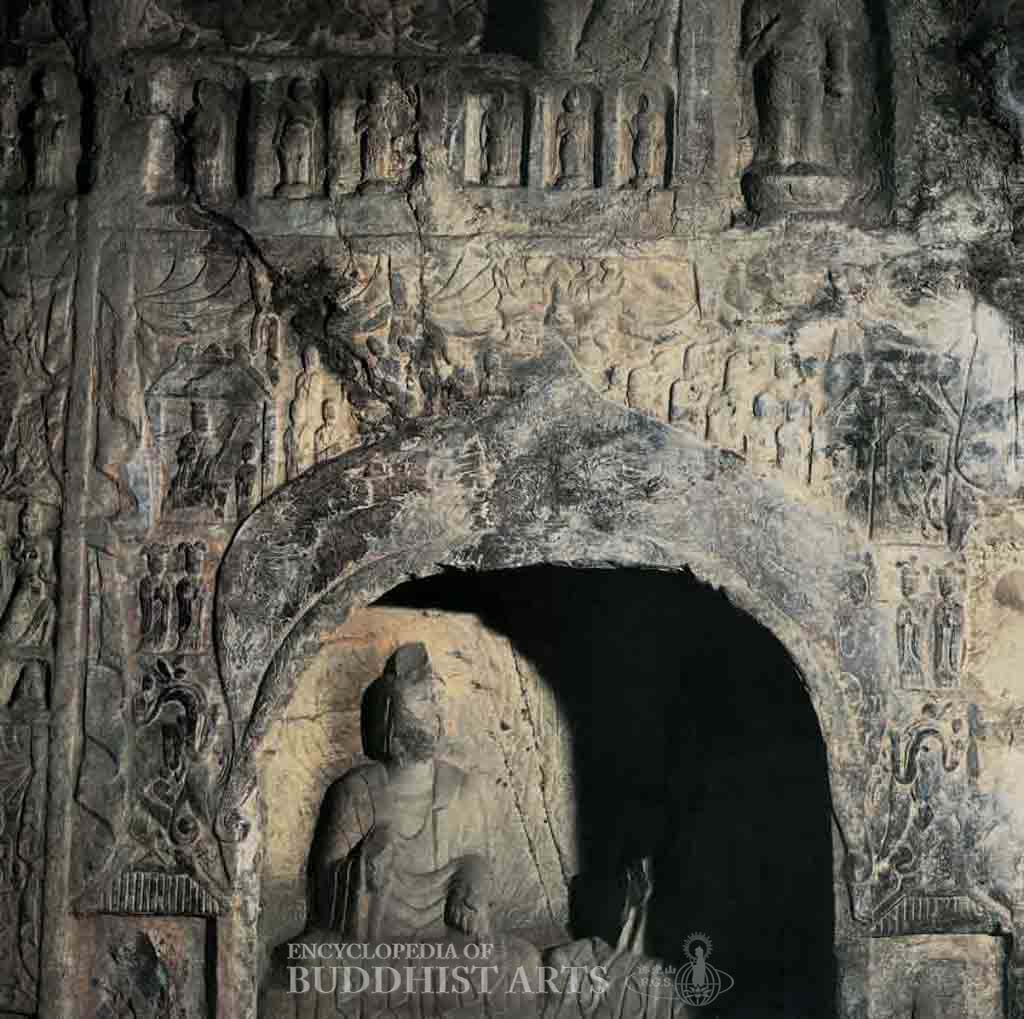
Longmen Grotto 1387: Sakyamuni and Prabhutaratna Buddhas
Stone
Longmen Grotto 1387: Sakyamuni and Prabhutaratna Buddhas
CHINA, Henan, Luoyang; Northern Wei dynasty
This niche is located in the center of the north wall of Grotto 1387, also known as the Yaofang (Prescription) Grotto. Constructed during the late Northern Wei dynasty (386–534), the grotto’s name is derived from the inscription of over 100 medical prescriptions on the walls of the corridor. The grotto measures 3.67 m in width, 4 m in height, and 4.4 m in depth. Most of the statues were created between the Northern Qi (550–577) and Tang (618–907) dynasties, although the Sakyamuni and Prabhutaratna Buddhas date from the late Northern Wei dynasty.
Carved reliefs above the niche display the head of an animal and curtains. Between the curtains and the lintel is an illustration of the Vimalakirti Sutra. Depicted on the right, Vimalakirti is seated upon a canopy bed and holds a whisk, as he appears to speak. An audience stands before Vimalakirti, with two attendants below. On the left, Manjusri Bodhisattva is seated inside a pavilion with a hip roof. Surrounded by monks, Manjusri holds an incense burner. The monks, some of whom bow in respect, appear to listen attentively to the discourse. Two female attendants, their hair tied in Y-shaped topknots, stand below on both sides with palms joined.
Apsaras are depicted flying on the ogee arched lintel and on each side is a dragon head. Sakyamuni and Prabhutaratna Buddhas sit side by side on a platform within the niche. Two disciples and two Bodhisattvas stand beside them. The Buddhas, similar in appearance and clothing, have sloping, narrow shoulders and wear double-collared loose robes. Both of them have the right hand positioned in front of the chest as the left palm faces out above the knee. Seated in full lotus position, their garments drape the front of the platform. The disciples wear monastic robes and stand with palms joined. The Bodhisattvas hold objects and wear headdresses, long stoles, and dhotis. An incense burner, with a lion on each side, is found on the lower section of the platform. At the bottom of the niche are two smaller house-shaped niches, each with an image of Vajrapanibalin inside.
For more details, go to the Encyclopedia of Buddhist Arts: Caves R-L, page 697.
Cite this article:
author = Hsingyun and Youheng and Johnson, Peter and Mankuang and Huntington, Susan and Edson, Gary and Neather, Robert,
booktitle = {Encyclopedia of Buddhist Arts: Caves R-L},
pages = 697,
title = {{Longmen Grotto 1387: Sakyamuni and Prabhutaratna Buddhas}},
volume = 6,
year = {2016}}