
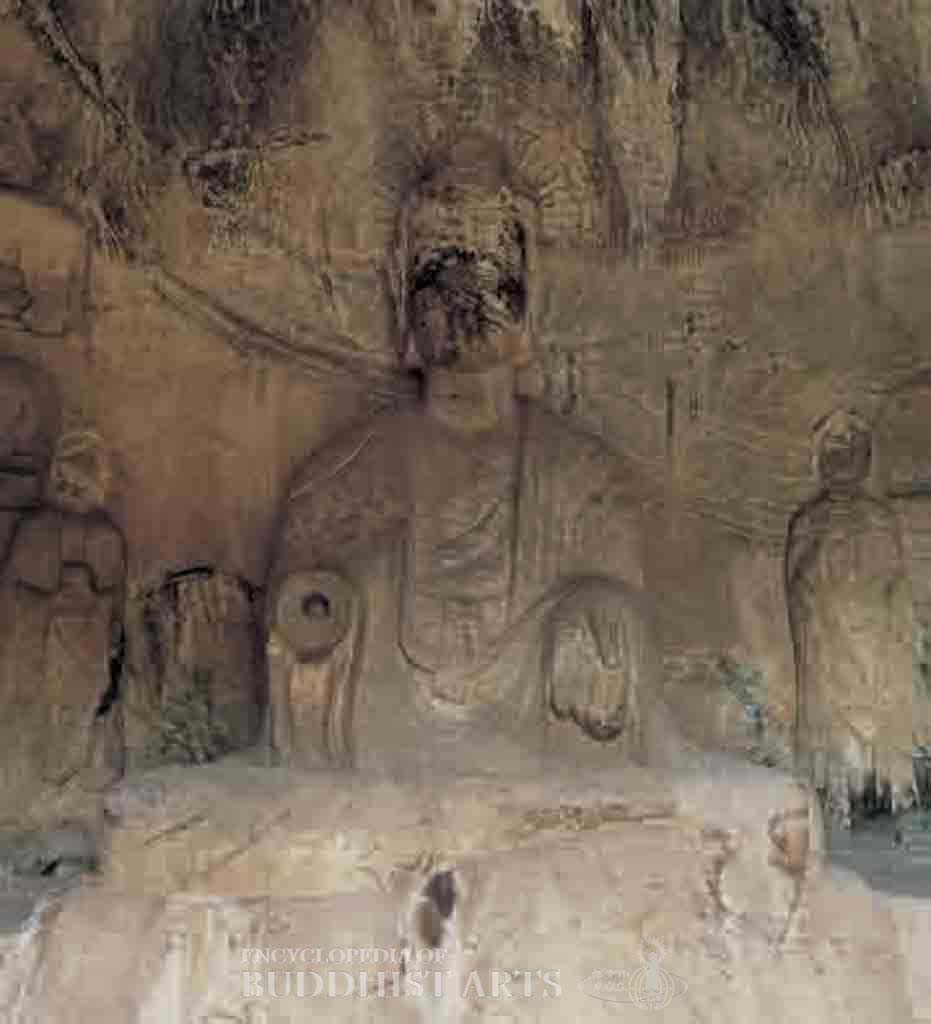
Longmen Grotto 1181: Seated Buddha
Stone
Longmen Grotto 1181: Seated Buddha
CHINA, Henan, Luoyang; Northern Wei dynasty
The main Buddha statue is seated on an altar along the back (west) wall. The Buddha has a large usnisa and the mouth turns up in a slight smile. The shoulders are narrow and rounded. The robes are incised with regular folds. An inner robe is fastened at the chest with a sash. The right hand is no longer present and the left hand forms the varada (wish-granting) mudra. The Buddha is seated in the lotus position. The robes, in decorative folds, drape over the front of the altar. The Buddha’s nimbus has a lotus petal pattern surrounded by six concentric circles and gives the impression of radiating light. In the outermost circle there is a vine-like design. Although the mandorla has faded, a flame pattern is still visible on the outer edge.
For more details, go to the Encyclopedia of Buddhist Arts: Caves R-L, page 690.
Cite this article:
author = Hsingyun and Youheng and Johnson, Peter and Mankuang and Huntington, Susan and Edson, Gary and Neather, Robert,
booktitle = {Encyclopedia of Buddhist Arts: Caves R-L},
pages = 690,
title = {{Longmen Grotto 1181: Seated Buddha}},
volume = 6,
year = {2016}}