
Longmen Grotto 1034
Longmen Grotto 1034
CHINA, Henan, Luoyang
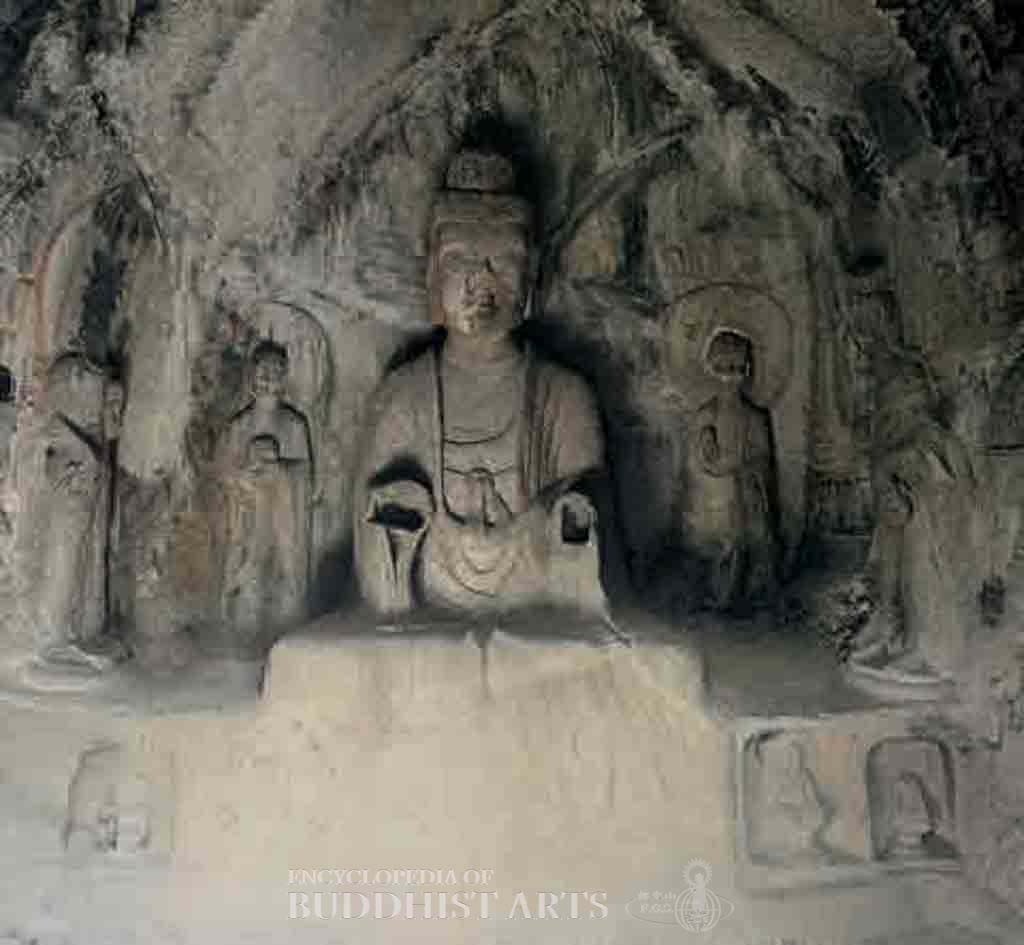
The grotto, also known as the Putai Grotto, is on the Yi River’s west bank and faces east. An inscription states that its construction, directed by the nun Huidao, began in 531. The grotto’s north and south walls display Buddha images created in the Northern Wei dynasty (386–534).
Accompanied by two disciples and two Bodhisattvas, Sakyamuni Buddha, the main statue, is centered on the back (west) wall. The 2.76 m high Buddha has a high usnisa, an oval face, and upturned lips. He wears a monastic robe over an inner robe that is tied with a sash at the waist. The robes are engraved with smooth, straight folds and descend over the front of the throne. The face is slightly damaged and the hands are no longer present.
For more details, go to the Encyclopedia of Buddhist Arts: Caves R-L, page 687.
Cite this article:
author = Hsingyun and Youheng and Johnson, Peter and Mankuang and Huntington, Susan and Edson, Gary and Neather, Robert,
booktitle = {Encyclopedia of Buddhist Arts: Caves R-L},
pages = 687,
title = {{Longmen Grotto 1034}},
volume = 6,
year = {2016}}