
Longmen Grotto 712: Buddha Niche
Stone
Longmen Grotto 712: Buddha Niche
CHINA, Henan, Luoyang; Northern Wei dynasty
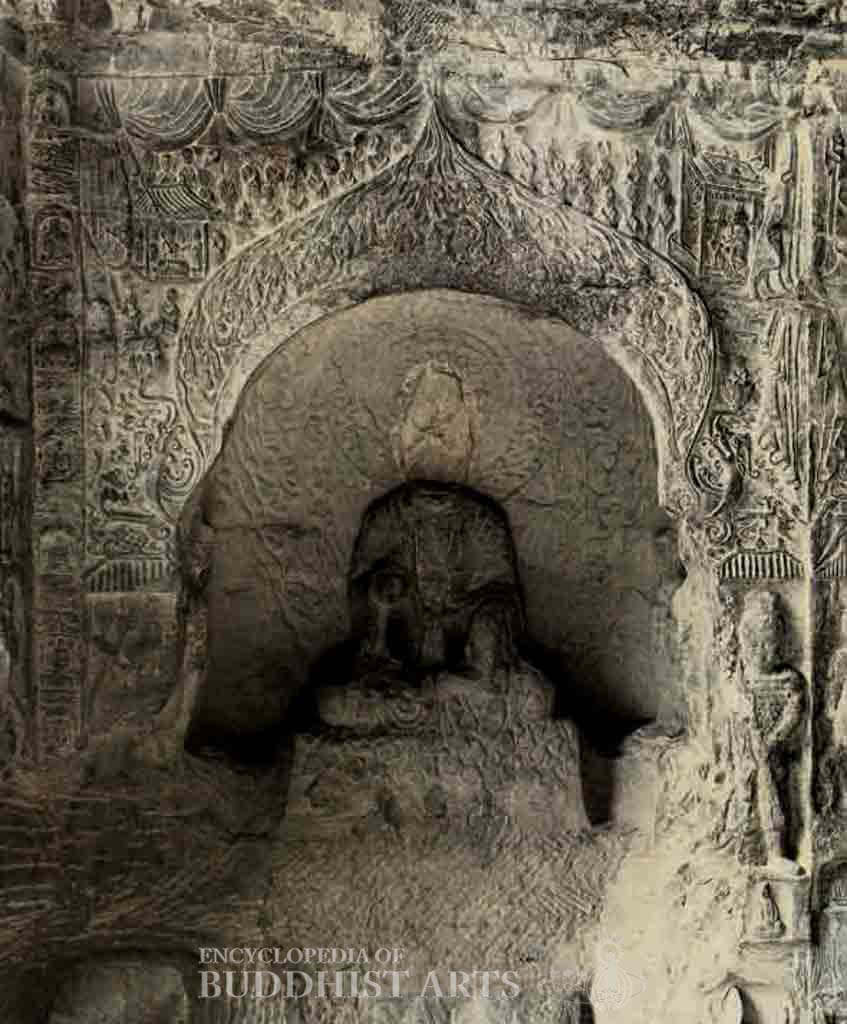
This niche, the second from the left on the lower tier of the south wall, was constructed during the Northern Wei dynasty (386–534). An ogee arched, flame-patterned lintel above the niche depicts eight apsaras who either play musical instruments or dance. Above the lintel, a lavish valance forms the uppermost border. Relief images from the Vimalakirti Sutra are found on either side. Portrayed on the right, Vimalakirti rests on a canopy bed while Manjusri sits within a pavilion on the left. Dragon heads with lotuses emerging from their mouths are portrayed on either side of the niche. Below them are two house-shaped niches, within which Bodhisattvas making offerings stand on circular lotus pedestals.
This Buddha niche houses statues of Sakyamuni Buddha and two Bodhisattvas. Sakyamuni has a circular nimbus and a mandorla fringed in a flame pattern. The statue’s head and hands are no longer present. Sakyamuni wears a long, loose monastic robe, which covers both shoulders. The Buddha sits in full lotus position on a square throne.
On the niche’s east and west walls are two reliefs from the Life of the Buddha, each depicting a Bodhisattva contemplating beneath a Bodhi tree. The east wall portrays a crowned Bodhisattva, with a petal-shaped nimbus, seated beneath a Bodhi tree. The bare-chested Bodhisattva sits atop a Sumeru throne in the relaxation posture. A vase containing a lotus is behind the Bodhisattva, while in front there are four figures dressed in robes. Adorned with a crown, the front figure holds an incense burner and kneels before the Bodhisattva. The other three figures hold parasols and a large ax. The similar relief on the west wall portrays a Bodhisattva seated beneath a Bodhi tree. Clothing hangs from the tree and a royal figure, who wears a crown and a long robe, kneels with palms joined before the Bodhisattva. Four attendants stand behind them dressed in loose robes and holding parasols, banners, and weapons. Apsaras fly through the air above both scenes. Below the niche there is a row of figures making offerings.
For more details, go to the Encyclopedia of Buddhist Arts: Caves R-L, page 686.
Cite this article:
author = Hsingyun and Youheng and Johnson, Peter and Mankuang and Huntington, Susan and Edson, Gary and Neather, Robert,
booktitle = {Encyclopedia of Buddhist Arts: Caves R-L},
pages = 686,
title = {{Longmen Grotto 712: Buddha Niche}},
volume = 6,
year = {2016}}