
Longmen Grotto 1443: Niche
Stone
Longmen Grotto 1443: Niche
CHINA, Henan, Luoyang; Northern Wei dynasty
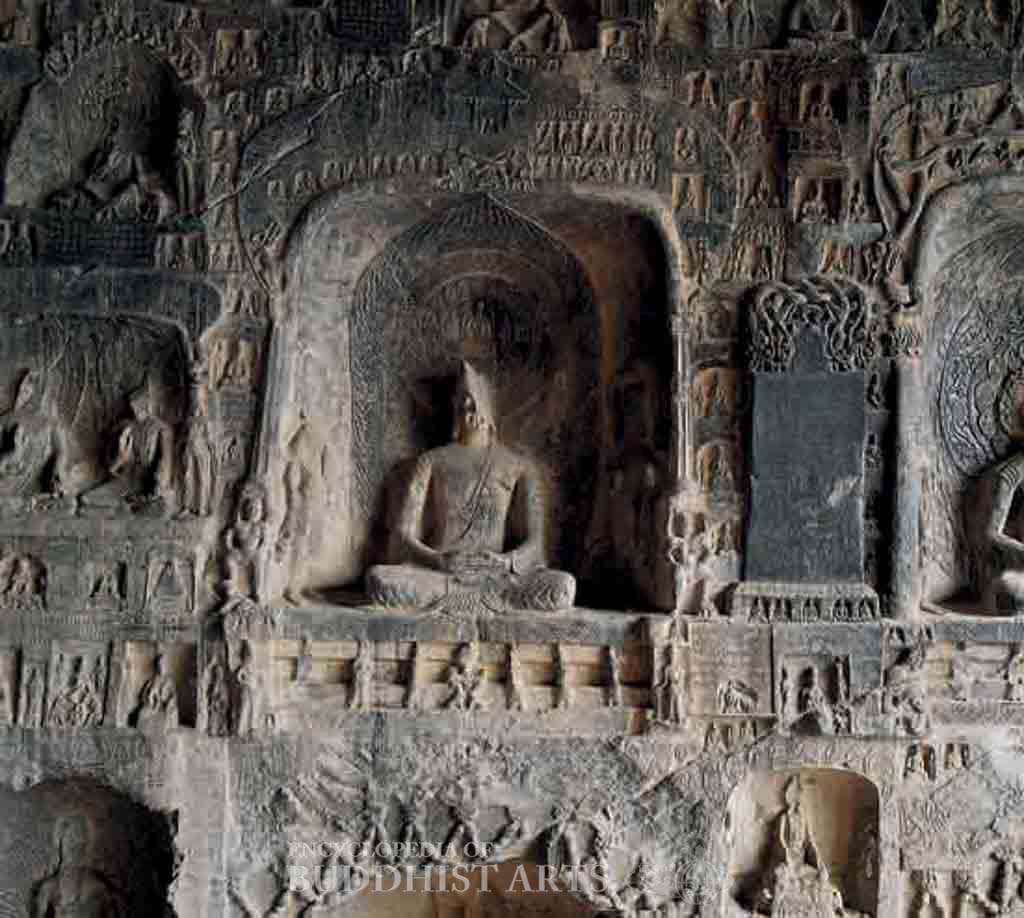
This niche, the third from the right in the upper tier of the north wall, was commissioned by Yang Dayan, a general of Chouchi (present day Gansu) as a blessing for Emperor Xiaowen (reigned 471–499) of the Northern Wei dynasty. An image of a hall with a single-eave hip roof covered in cylindrical tiles is depicted in the center of the lintel. A garuda stands on the roof ridge. Within the hall, a Buddha is seated in full lotus position on a Sumeru throne decorated with two coiled dragons. Buddha images, monks, and Bodhisattvas making offerings adorn both sides of the hall. A dragon head is carved on either side of the niche, and below it are octagonal columns with square capitals and rounded lotus bases. Beneath the bases, four-armed warriors stand upon demons. Each warrior supports a column with one pair of arms as the other pair of arms rests on the hips.
Sakyamuni Buddha and two Bodhisattvas are housed within the niche. The head of the Buddha is damaged. Portrayed with broad shoulders and a narrow waist, Sakyamuni sits in full lotus position, forming the dhyana (meditation) mudra. A monastic robe incised with folds crosses the left shoulder of Sakyamuni. The nimbus behind the figure contains four layers adorned with lotus petals, a Buddha triad, 13 seated Buddhas and 10 apsaras, while the mandorla is decorated with the Thousand Buddhas and flame patterns.
Images of five disciples and a row of apsaras are located on either side of the niche’s interior wall. The flanking Bodhisattvas have lotus-patterned nimbuses and wear long dhotis, stoles, and necklaces. Both of the Bodhisattvas’ heads are missing. Each of them stands with one hand positioned before the chest while the other hangs down naturally, holding either a wish-fulfilling jewel or a vase. The niche’s bottom edge is adorned with entwined honeysuckle pattern. Below it is an incense burner with six figures making offerings and two warriors. A stele with a coiled dragon at the top is found to the right of the niche. The stele inscription is one of the Twenty Outstanding Inscriptions of the Longmen Grottoes.
For more details, go to the Encyclopedia of Buddhist Arts: Caves R-L, page 707.
Cite this article:
author = Hsingyun and Youheng and Johnson, Peter and Mankuang and Huntington, Susan and Edson, Gary and Neather, Robert,
booktitle = {Encyclopedia of Buddhist Arts: Caves R-L},
pages = 707,
title = {{Longmen Grotto 1443: Niche}},
volume = 6,
year = {2016}}