

Longmen Grotto 1443
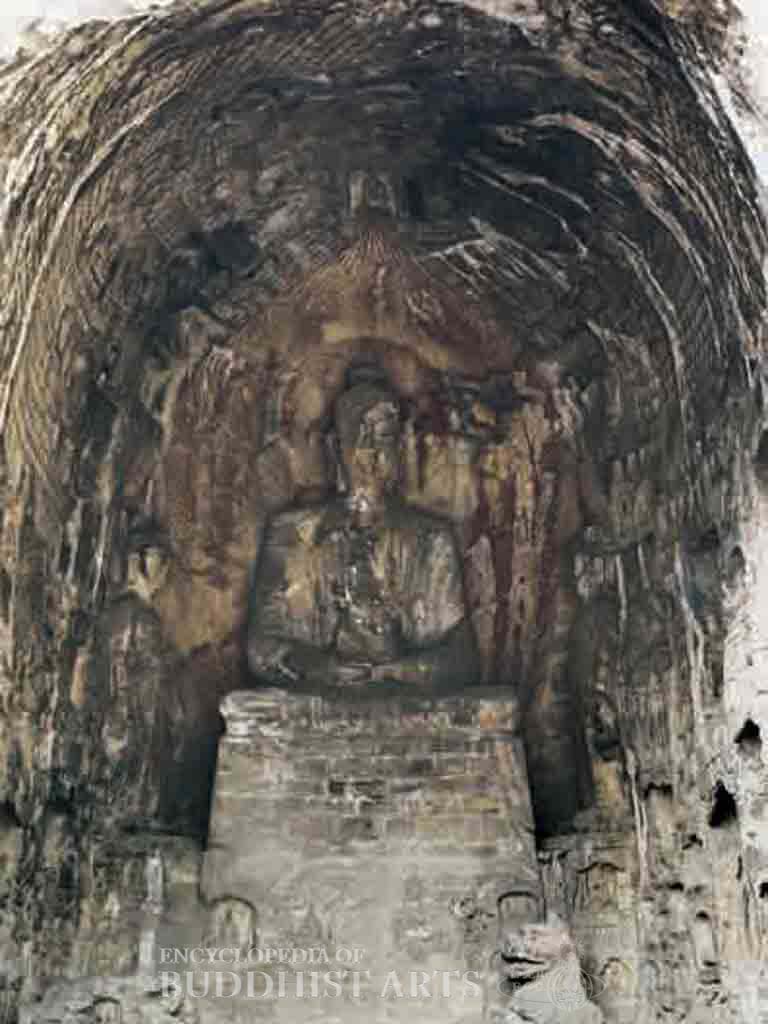
Longmen Grotto 1443: Seated Buddha (back wall)
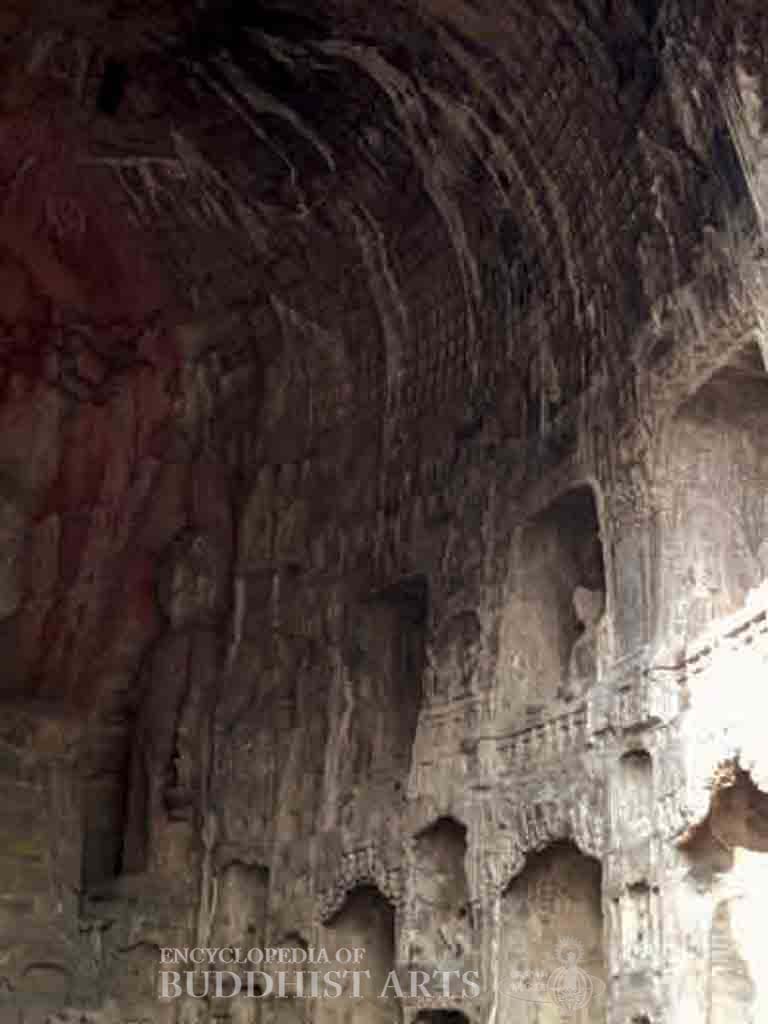
Longmen Grotto 1443: Niches (north wall)

Longmen Grotto 1443: Niche (north wall)
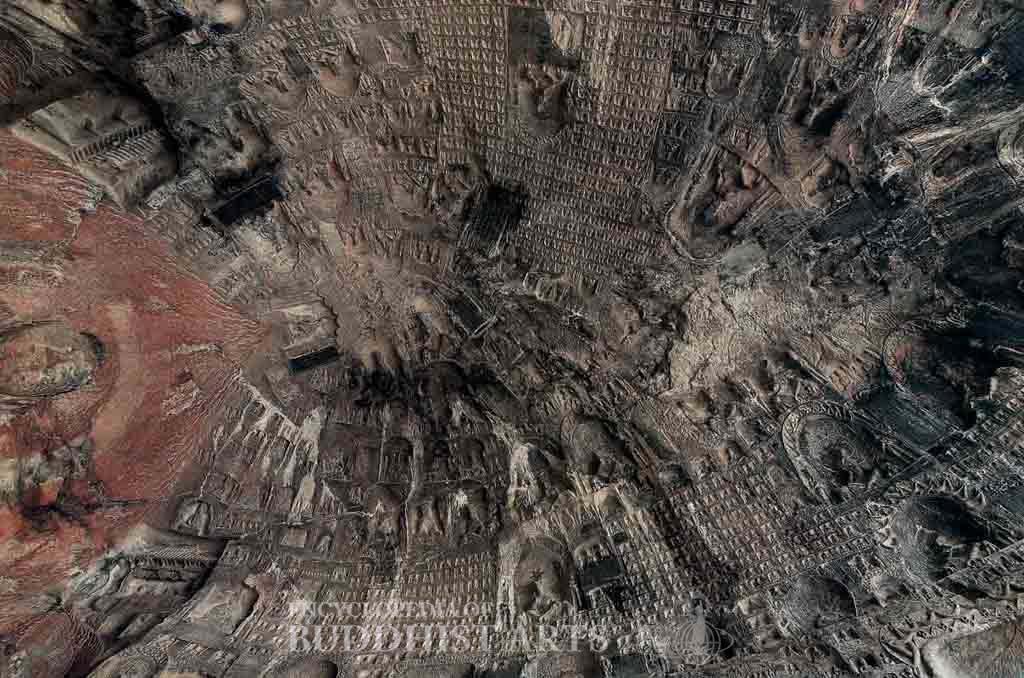
Longmen Grotto 1443: Ceiling
Longmen Grotto 1443
CHINA, Henan, Luoyang
Grotto 1443, known as Guyang Grotto, is located in the southern area of the Yi River’s west bank. It was constructed between 471 and 528 of the Northern Wei dynasty and is the earliest grotto at Longmen. The grotto features a vaulted ceiling and an apsidal layout, measuring 6.9 m in width, 11.1 m in height, and 13.55 m in depth.
A Buddha triad is found on the back (west) wall. The Buddha stands 4.85 m in height and has a four-layered nimbus and mandorla. The nimbus is decorated with a lotus pattern in the center, followed by a layer of apsaras, a layer of Buddhas seated in full lotus position, and an outer layer of apsaras. The mandorla features Bodhisattvas making offerings at the center, two layers of Buddhas seated in full lotus position, and flame-patterned edges. The Buddha, with a high usnisa, wears a loose monastic robe over an inner robe. The Buddha is seated in full lotus position on a rectangular throne with the hands forming the dhyana (meditation) mudra. Two inscriptions, which date to 794 and 798 during the Tang dynasty, are found on the lion in front of the throne.
There are 149 small niches on the back wall, 341 on the north wall, 217 on the south wall, and 157 on the ceiling. The construction of the niches was primarily commissioned by the Northern Wei imperial family and accomplished in three phases. The first phase was commissioned under Emperor Xiaowen (reigned 471–499). Two of the sponsors are Yuan Xiang, the Prince of Beihai, and his mother, Consort Dowager Gao, who was a concubine of Emperor Xiaowen. Other sponsors include Yuan You, the Prince of Qijun; Yuan Xie, the Prince of Anding; Consort Dowager Hou; Yang Dayan; Lady Yuchi, the wife of Qiumu Lingliang; local officials Wei Lingzang and Sun Qiusheng; and the monks Huizhen and Huicheng. The niches constructed in this phase have trapezoidal ceilings, and many feature Sakyamuni Buddha in meditation, cross-ankled Maitreya, and lintels with depictions of Vimalakirti and Manjusri in relief. The second phase of construction occurred during the reign of Emperor Xiaoming (reigned 515–528). In this phase, a row of large niches was added to the south wall with two additional rows added to the north wall. The third phase, which occurred during the Tang dynasty (618–907), included the construction of a Northern Wei style large niche statue on the north wall.
The multiple phases of excavation resulted in niches of various sizes and the razing of earlier niches by later generations. Most notable within the grotto are niches commissioned by Wei Lingzang, Yang Dayang, Prince of Beihai, Lady Yuchi, and the monk Huicheng on the north wall. Other significant niches include the niche commissioned by the monk Daojiang, which has an ogee-arched lintel carved with the Seven Buddhas of the Past. Sakyamuni and Prabhutaratna Buddhas are seated side by side within the niche. The niche commissioned by Zhang Yuanzu’s wife houses a Buddha and two Bodhisattvas. Significant niches on the south wall include those commissioned by Sun Qiusheng, the monks Fasheng and Huizhen, Yuan You, and Yuan Xie. The niche of Yuan You houses Maitreya Buddha with legs crossed and two flanking Bodhisattvas. The niche commissioned by Yuan Xie features a trapezoidal ceiling and houses Maitreya Buddha with legs crossed, flanked by two disciples and two Bodhisattvas.
A significant decoration on the grotto’s ceiling is the niche by Ma Zhenbai, which has a trapezoidal layout. The niche houses a Buddha triad with an incense burner, above which are heavenly beings making offerings. The niche of Consort Dowager Hou houses a cross-ankled Maitreya and two Bodhisattvas. The ceiling is decorated with drapery and other adornments. Inside the various niches, inscriptions attest to the devotion of the Northern Wei’s imperial family. Grotto 1443 contains 19 of the 20 calligraphic inscriptions known as the Twenty Outstanding Inscriptions of the Longmen Grottoes.
For more details, go to the Encyclopedia of Buddhist Arts: Caves R-L, page 698.
Cite this article:
author = Hsingyun and Youheng and Johnson, Peter and Mankuang and Huntington, Susan and Edson, Gary and Neather, Robert,
booktitle = {Encyclopedia of Buddhist Arts: Caves R-L},
pages = 698,
title = {{Longmen Grotto 1443}},
volume = 6,
year = {2016}}