
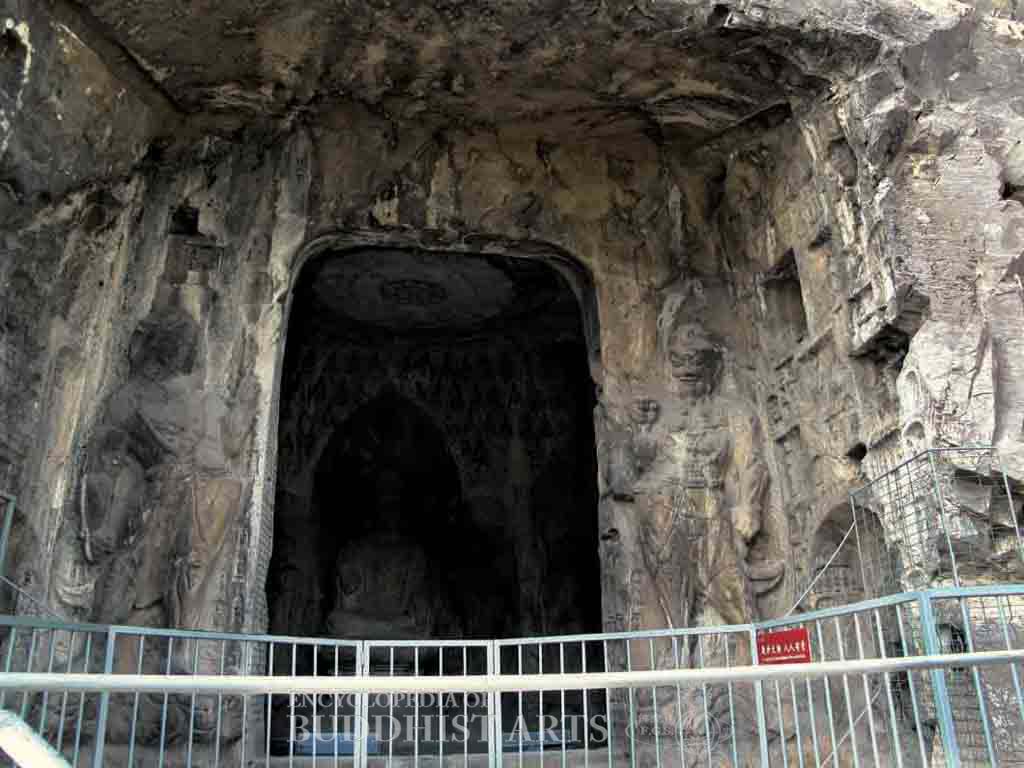
Longmen Grotto 543
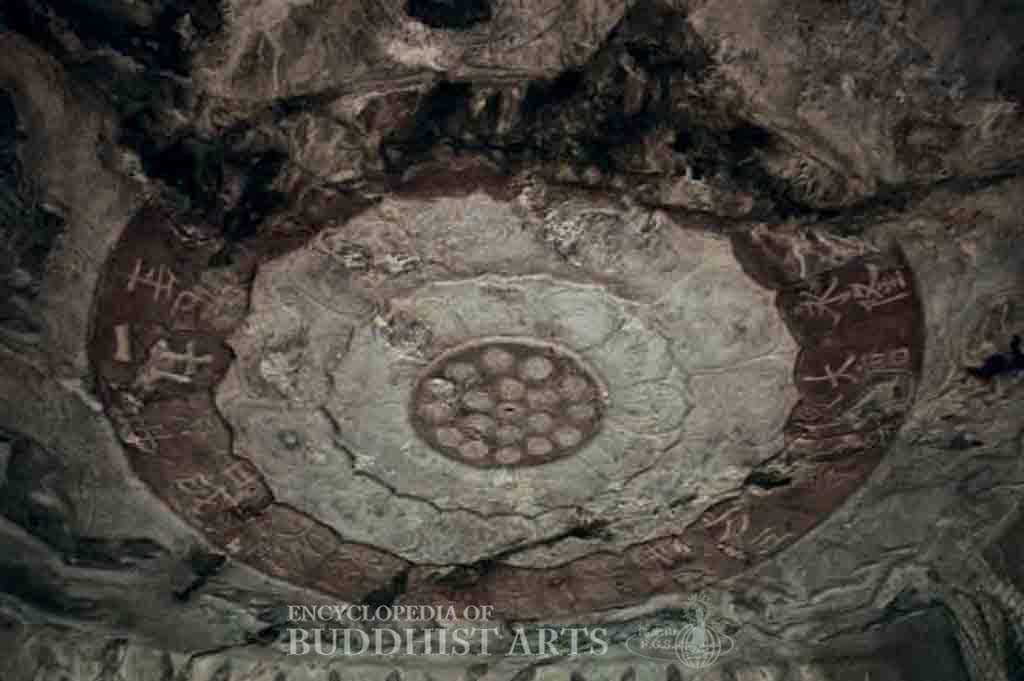
Longmen Grotto 543: Rear Chamber - Ceiling

Longmen Grotto 543: Dharma Protector (entrance, north side)
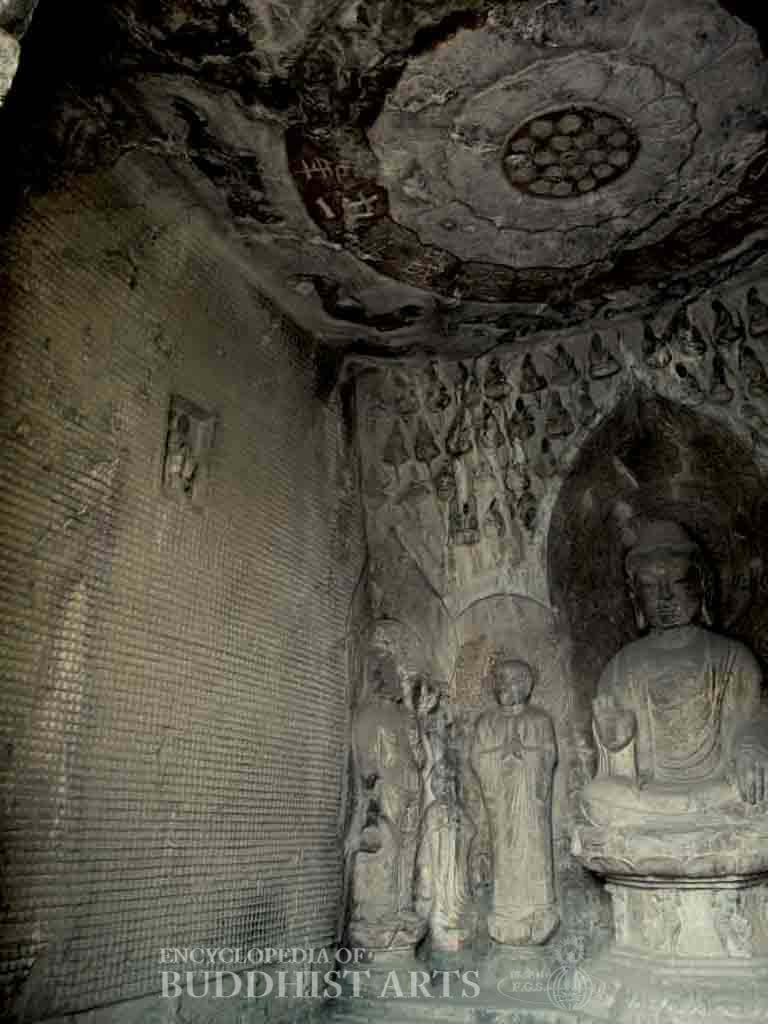
Longmen Grotto 543: Rear Chamber - Back and South Walls
Longmen Grotto 543
CHINA, Henan, Luoyang
Grotto 543, also known as the Ten Thousand Buddha Grotto, is located on the Yi River’s west bank. Construction was completed in the year 680 during the Tang dynasty. It was created by the nun Zhiyun and others as a blessing for Emperor Gaozong (reigned 649–683) and Empress Wu Zetian (reigned 684–705). The front chamber has a flat ceiling and is 4.9 m in width, 5.3 m in height, and 4.28 m in depth. The rear chamber is 5.87 m in width, 5.8 m in height, and 6.85 m in depth.
A Dharma protector, with a large head and short, muscular body, is found on each side of the entrance to the front chamber. The fists are clenched and the eyes appear to glare. There is an inscription on the upper section of the right side, which says, “The nun, Zhiyun, commissioned the carving of 15,000 Buddha niches for the emperor, empress, crown prince, and princes.” A niche containing a lion, now bereft of statues, is on both the north and south walls. An Avalokitesvara Bodhisattva niche, constructed in 681 of the Tang dynasty by the nun Zhenzhi from Xuzhou (present day Xuchang, Henan), can be found above the lion niche on the south wall. The 85 cm high Avalokitesvara has a full face and graceful features. The raised right hand holds a whisk, while the left holds a vase naturally at the side.
The ceiling of the rear chamber is decorated with a lotus encircled by an inscription that reads, “Yao Shenbiao, a female official, and Chan Master Zhiyun commissioned 15,000 sculptures in 680.” Eight apsaras surround the center of the ceiling. Amitabha Buddha, two disciples, two Bodhisattvas, and two figures making offerings are depicted on the back (west) wall. Seated in full lotus position on an octagonal lotus throne, Amitabha, wearing a monastic robe with an open collar, has a round face, a high usnisa, and wavy, curled hair. Four warriors support the center of the throne with raised arms. Both disciples stand on lotus pedestals and wear monastic robes similar to the one worn by Amitabha. Mahakasyapa holds a wish-fulfilling jewel at chest level and Ananda’s palms are joined before the chest. The two Bodhisattvas, with petal-shaped nimbuses, stand barefoot on lotus pedestals. Ornaments and stoles drape over their slender bodies. The heads and hands of both figures are no longer present.
On each side, between the disciple and Bodhisattva, there stands a small female donor figure. The figure on the right is dressed in a wide-sleeved shirt, short coat, and long coat, and stands with palms joined on a lotus pedestal. The figure on the left is severely damaged. Thick lotus stems, which diverge into 54 branches arranged into five rows, are depicted above the nimbuses of the Buddha and disciples. Fifty-two Bodhisattvas and two apsaras sit upon lotus flowers at the end of each branch, each in a different posture.
The north and south walls of the cave are covered with neatly arranged rows of the Thousand Buddha motif. An Udayana Buddha niche is found in the upper center of each wall. An inscription on the north wall states that the grotto was commissioned by Hu Zhenpu for his parents, while a similar inscription on the south wall states that the emperor also sponsored the grotto’s construction. A row of six apsaras carved along a decorative band can be seen below the Thousand Buddhas on each wall. Short, armored Heavenly Kings, who stand upon demons, are located on either side of the front (east) wall. The heads are no longer present. Numerous small niches in the front and rear chambers were added later, primarily during the Tang dynasty.
For more details, go to the Encyclopedia of Buddhist Arts: Caves R-L, page 678.
Cite this article:
author = Hsingyun and Youheng and Johnson, Peter and Mankuang and Huntington, Susan and Edson, Gary and Neather, Robert,
booktitle = {Encyclopedia of Buddhist Arts: Caves R-L},
pages = 678,
title = {{Longmen Grotto 543}},
volume = 6,
year = {2016}}