

Longmen Grotto 712

Longmen Grotto 712: Entrance
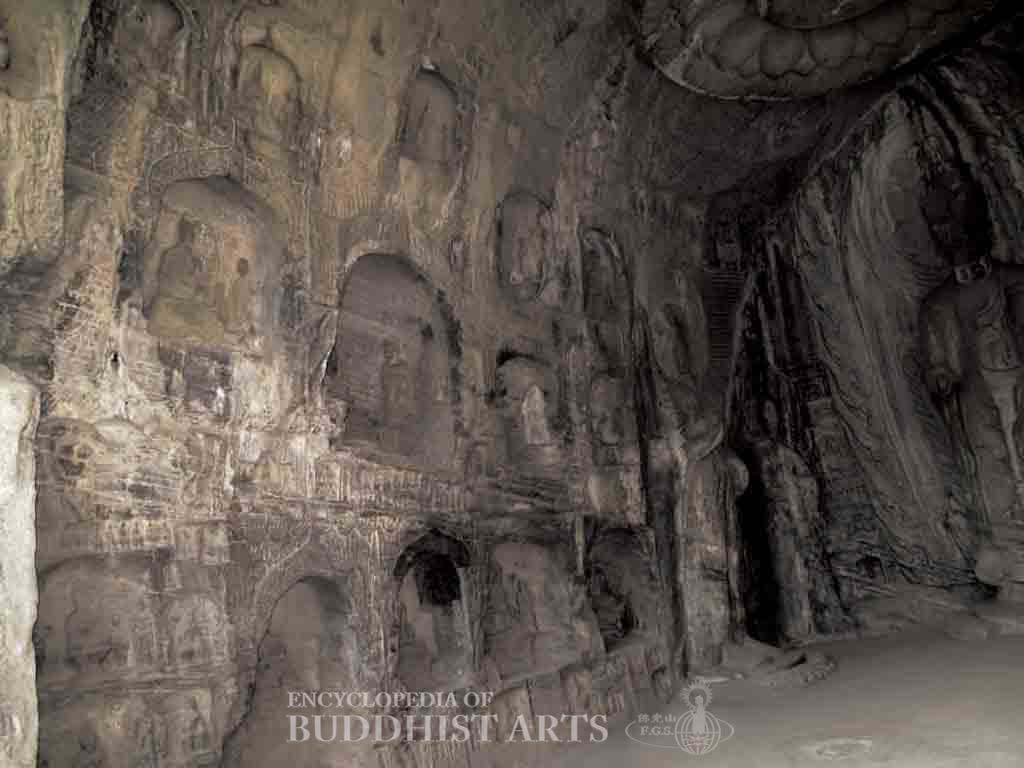
Longmen Grotto 712: Niches (south wall)
Longmen Grotto 712
CHINA, Henan, Luoyang
The grotto, commonly known as Lotus Flower Grotto, is located in the middle area of the Yi River’s west bank. It was constructed between 515 and 528 during the Northern Wei dynasty. The east-facing, rectangular grotto is 6.22 m in width, 5.9 m in height, and 9.78 m in depth. A flame pattern, with an animal head in the center, borders the entrance. On the entrance’s left is an image of Vajrapanibalin, who holds a vajra in the right hand, with the left hand raised before the chest.
Centered in the vaulted ceiling is a lotus flower motif that is 3.6 m in diameter and surrounded by six apsaras. The statues of a Buddha, two disciples, and two Bodhisattvas are on the back (west) wall. The Buddha, with narrow shoulders and slender body, stands on a low lotus pedestal. A loose monastic robe opens at the collar reveals an inner robe that is tied at the waist with a sash. On either side of the Buddha, disciples carved in relief stand with one hand at the chest and the other at the side. Two attendant Bodhisattvas stand beside the disciples. The Bodhisattvas wear headdresses with ribbons that extend to their shoulders. Long ornaments cross their chests and are threaded through a jade disc at the abdomen. The right Bodhisattva holds a wish-fulfilling jewel in each hand and the left Bodhisattva holds a lotus bud at the chest in the right hand, while the left is damaged at the wrist. Both Bodhisattvas, with damaged heads, stand on round lotus pedestals.
The four walls within the grotto are covered with both small and large niches, created at different times from the Northern Wei (386–534) to the Tang dynasty. Most of the niches are arched or trapezoidal. Created during the Northern Wei dynasty, the five large niches on the south wall and the first two niches on the left lower section of the north wall are the more significant ones. The spaces above the niche lintels are decorated with curtains, while the space beneath is carved with a debate scene between Vimalakirti and Manjusri. The niche lintels are carved with apsaras and the Thousand Buddhas. Triads consisting of a seated Buddha and two Bodhisattvas are found within the niches. All the central Buddhas wear loose monastic robes and display either the vitarka (teaching) or dhyana (meditation) mudra. The Buddhas’ thrones are flanked by lions. Carved on the upper section of the south wall is the Thousand Buddhas, each measuring 2 cm in height, and are the smallest sculptures in the Longmen Grottoes.
A stele topped by a coiled dragon is found on the south wall of the grotto. Although the inscription is no longer legible, the various images that cover the stele are still discernible. The images were created between the Northern Qi dynasty (550–577) and the Tang dynasty. There are three sutras engraved within the grotto, including two copies of the Heart Sutra, of which one is thought to have been engraved during the Northern Wei dynasty. The second Heart Sutra was engraved by Huangfu Yuanheng in 700 during the Tang dynasty. Situated outside the grotto on the upper section of the north wall is the third sutra, Usnisavijaya Dharani Sutra, engraved by monk Danfu of the Zhou dynasty in 692. The engraving is the earliest extant Chinese stone engraving of the Usnisavijaya Dharani Sutra. All the grotto walls have inscriptions dating from the Northern Wei to the Tang dynasty. The earliest engraving is from the Northern Wei dynasty and dates to 521.
For more details, go to the Encyclopedia of Buddhist Arts: Caves R-L, page 684.
Cite this article:
author = Hsingyun and Youheng and Johnson, Peter and Mankuang and Huntington, Susan and Edson, Gary and Neather, Robert,
booktitle = {Encyclopedia of Buddhist Arts: Caves R-L},
pages = 684,
title = {{Longmen Grotto 712}},
volume = 6,
year = {2016}}