
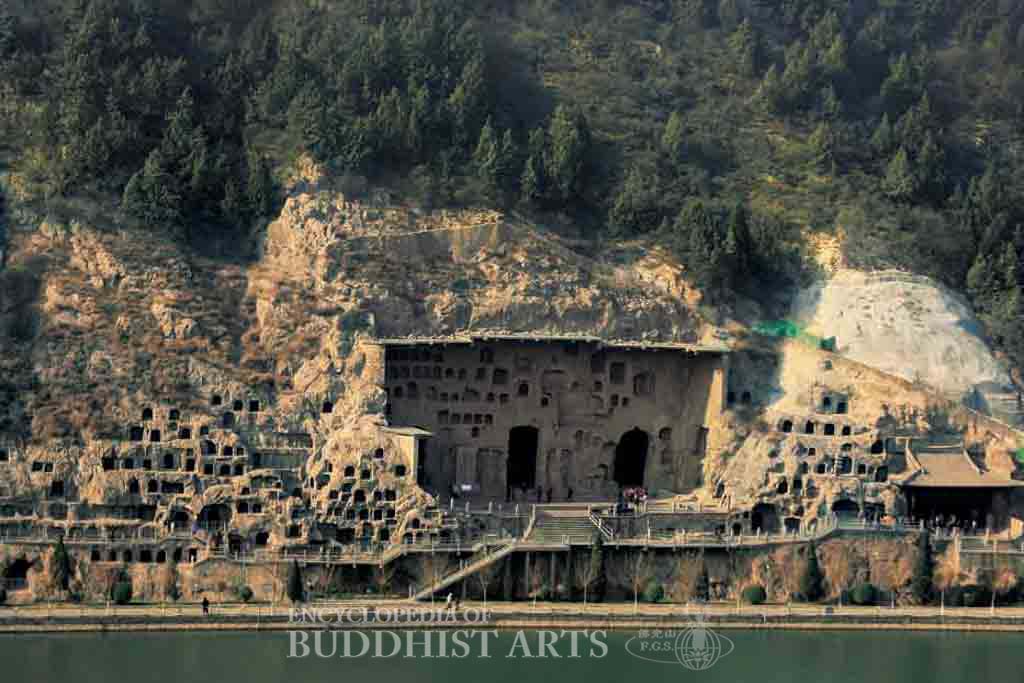
Longmen Grottoes 104, 140, and 159
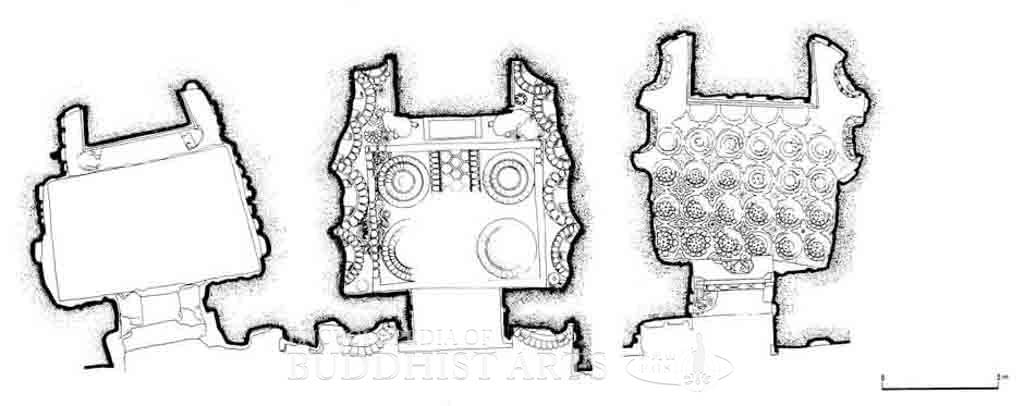
Longmen Grottoes 104, 140, and 159 (site layout)
Longmen Grottoes 104, 140, and 159
CHINA, Henan, Luoyang
This set of grottoes, known as the Binyang Grottoes, is located in the northern area of the Yi River’s west bank. Dated to the Northern Wei dynasty (386–535), the set was excavated from 505 to 523, and consists of Grottoes 104 (North Binyang Grotto), 140 (Central Binyang Grotto), and 159 (South Binyang Grotto). Grottoes 104 and 159 were initially left incomplete. The Book of Wei states that after Emperor Xuanwu (reigned 499–515) ascended the throne, he ordered the eunuch Bai Zheng to build two grottoes, namely Grottos 140 and 159, on Yiqueshan (also known as Longmenshan) to imitate those of the Yungang Grottoes. The grottoes were constructed in memory of his parents, Emperor Wen (reigned 471–499) and Empress Wenzhao. In 508, the eunuch Liu Teng sought permission to construct another grotto for Emperor Xuanwu, Grotto 104, thus forming the layout of these three grottoes. Grotto 140 required 18 years to complete. Following Liu Teng’s death in 523, construction of Grottoes 104 and 159 were postponed due to political conflict. Construction of Grotto 159 was re-established in the Sui dynasty (581–618). Li Tai, the Prince of Wei, completed Grottoes 104 and 159 in 641 during the Tang dynasty. Li Tai copied the Stele of the Yique Niches onto a stele as a blessing for his mother, Empress Zhangsun. A wooden structure that existed outside the Binyang Grottoes was destroyed during the Jin (1115–1234) and Yuan (1271–1368) dynasties. An additional opening was built outside each of the three grottoes during the Qing dynasty (1644–1911). Tiers of niches were added, primarily during the Tang dynasty, on the cliff face outside the three grottoes.
Grotto 140, the Central Binyang Grotto, has an apsidal layout with a vaulted ceiling. The entire grotto, including statues and relief carvings, is intact and present. A warrior stands on either side of the grotto entrance. The warriors, who hold vajras in outstretched hands, are vivid and carefully sculpted. On either side of the doorway within the grotto are Brahma and Sakra, while above them Bodhisattvas make offerings. The center of the grotto ceiling is carved with a blossoming lotus, surrounded by eight flying apsaras and two heavenly beings making offerings. The sculpture on the back (west) wall of the cave is Sakyamuni Buddha. The Buddha, with a nimbus and a mandorla and wearing a loose monastic robe, sits in full lotus position in the center of the wall on a Sumeru throne. Two lions below the throne look up at Sakyamuni, who is flanked by two disciples and two Bodhisattvas. The two robed disciples, Mahakasyapa and Ananda, have both hands positioned before their chests, either with palms joined or holding an object. Manjusri and Samantabhadra, the attendant Bodhisattvas, wear tall headdresses and flowing robes. One of their hands is raised to chest level, while the other hand holds an object.
Standing Buddhas with resplendent aureoles are found on both the north and south walls. Each of them stands barefoot on a round inverted lotus pedestal. Their facial features and loose monastic robes are similar. Flanking each Buddha are two Bodhisattvas dressed in robes. The Bodhisattvas’ heads and hands are damaged.
There are four registers of relief carvings on each side of the entrance on the front (east) wall . From top to bottom, the first register has an illustration of the Vimalakirti Sutra, which depicts Vimalakirti reclining on a bed with a whisk in hand. Vimalakirti debates with Manjusri, who listens attentively, surrounded by monks and warriors. The second register displays stories from the Jatakas. A depiction of the Prince Sudana Jataka, on the right side, has been removed. Portrayed on the left side, Prince Mahasattva’s brothers watch in horror as he allows himself to be eaten by a starving tigress and her cubs. Now removed, the third register once depicted the emperor and empress paying respect to the Buddha. The emperor with his officials and attendants were depicted on left side of the entrance, with the empress and her female attendants on the right side. The fourth register depicts ten deities, five on each side of the entrance, each holding a different Dharma instrument. The grotto is filled with elaborate decorative relief carvings, and the floor is embellished with lotus reliefs.
Grotto 159 has an apsidal layout and a vaulted ceiling adorned with lotuses and apsaras. Flanked by two disciples and two Bodhisattvas, the main Buddha on the back (west) wall sits in full lotus position on a throne. He has a low usnisa, a round face, and wears a loose monastic robe. There are large niches on the north and south walls. The niche on the north wall houses a standing Buddha with a monastic robe that covers both shoulders. The niche on the south wall houses a pentad with the Buddha seated in full lotus position, wearing double-collared monastic robes. Bodhisattvas and disciples flank the Buddha. There are many tiers of niches on each of the walls inside the grotto, most of which have inscriptions dated to around the Early Tang period (618–712).
For more details, go to the Encyclopedia of Buddhist Arts: Caves R-L, page 661.
Cite this article:
author = Hsingyun and Youheng and Johnson, Peter and Mankuang and Huntington, Susan and Edson, Gary and Neather, Robert,
booktitle = {Encyclopedia of Buddhist Arts: Caves R-L},
pages = 661,
title = {{Longmen Grottoes 104, 140, and 159}},
volume = 6,
year = {2016}}