
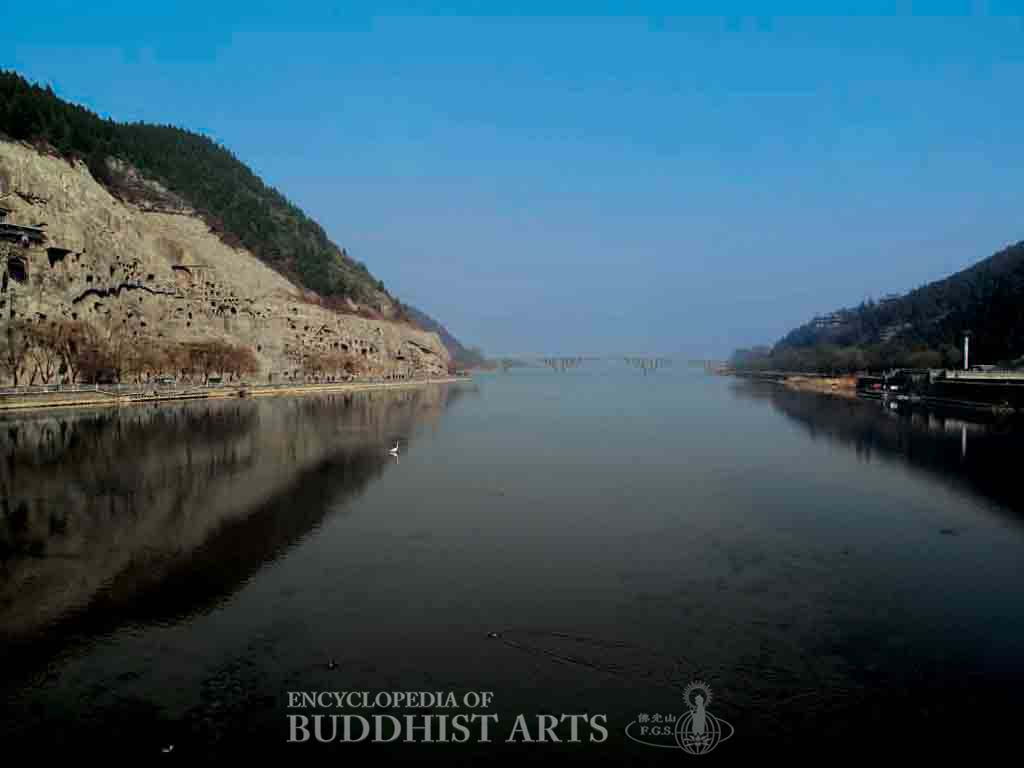
Longmen Grottoes: Yi River Banks
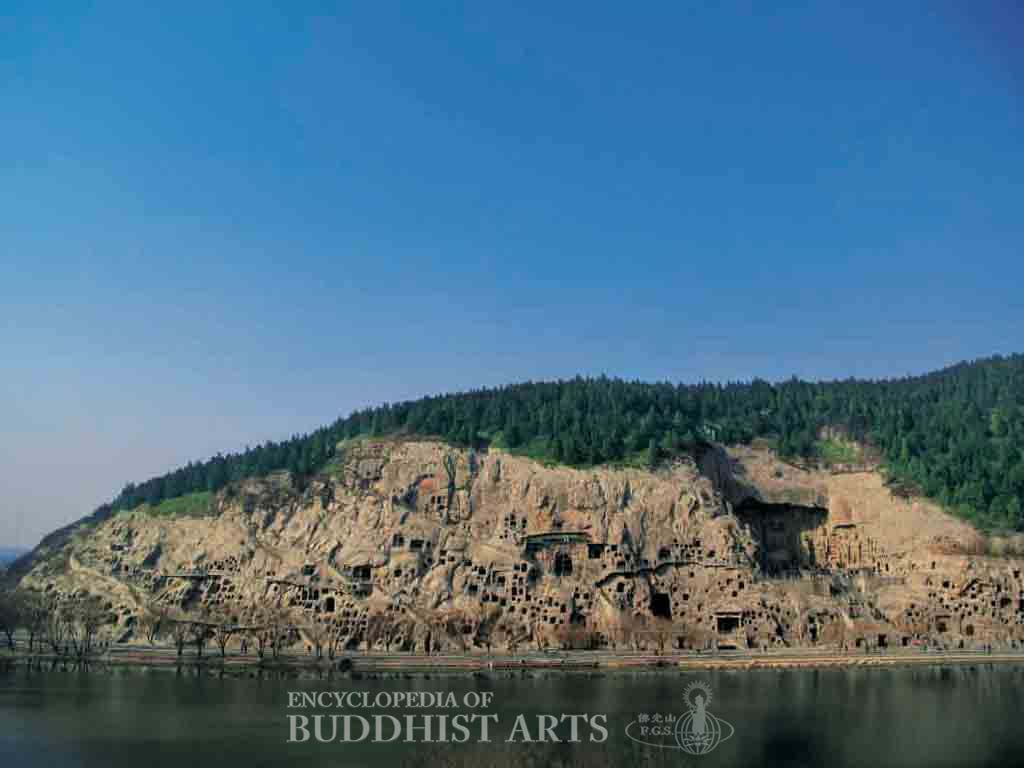
Longmen Grottoes: West Mountain
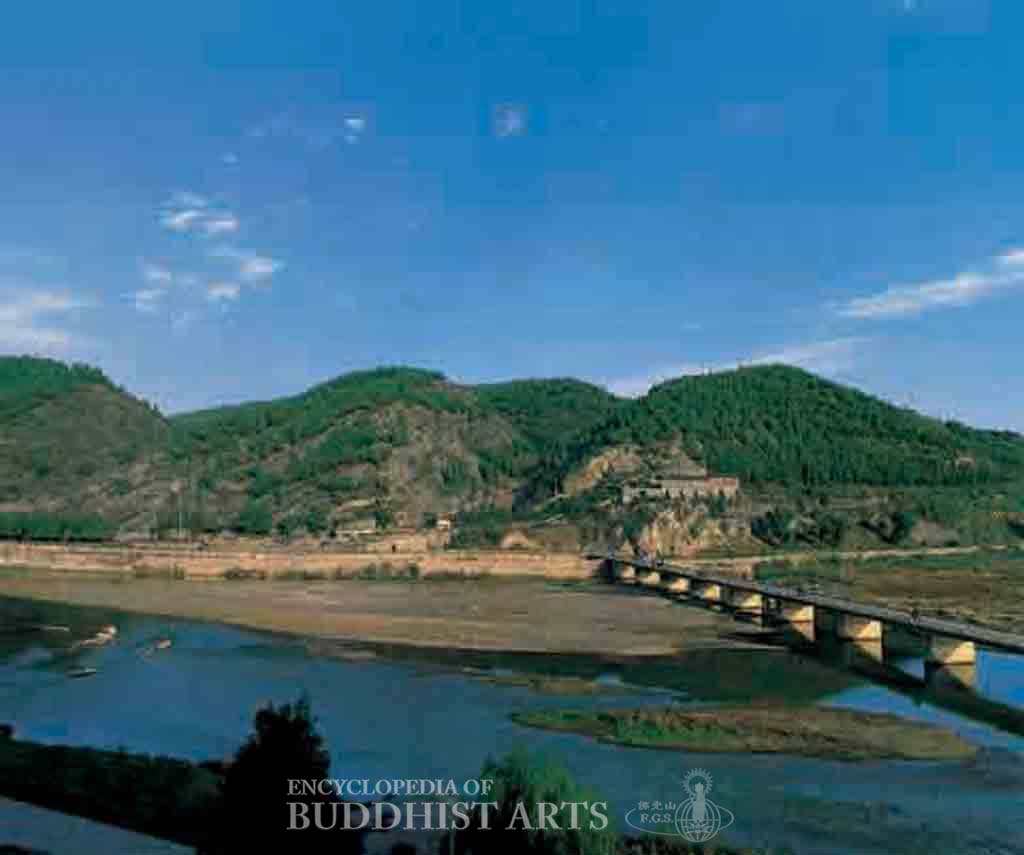
Longmen Grottoes: East Mountain
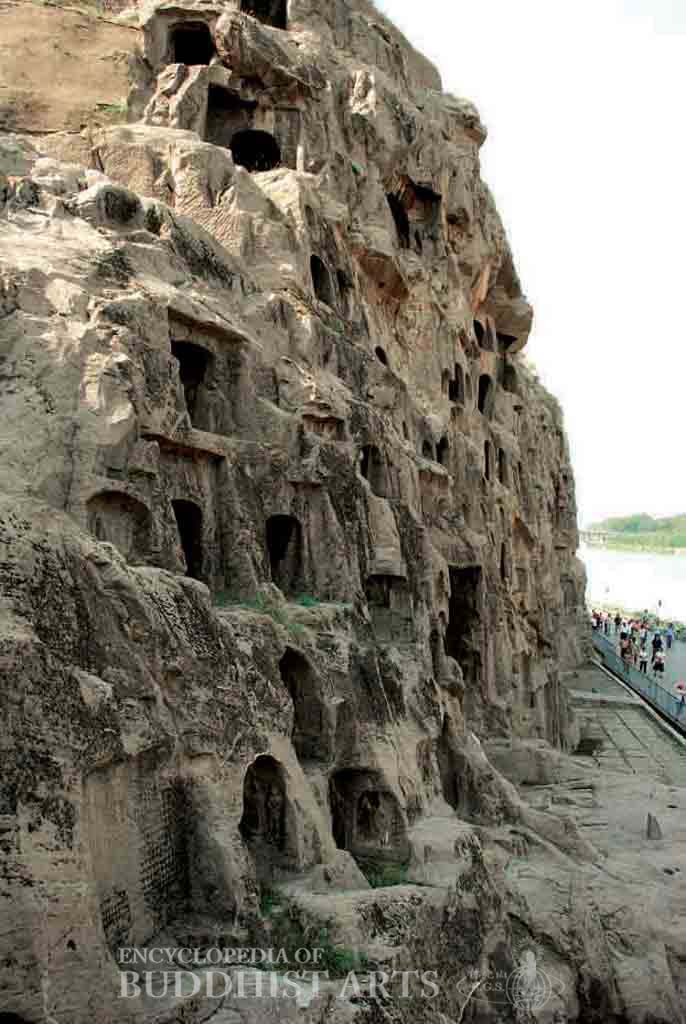
Longmen Grottoes
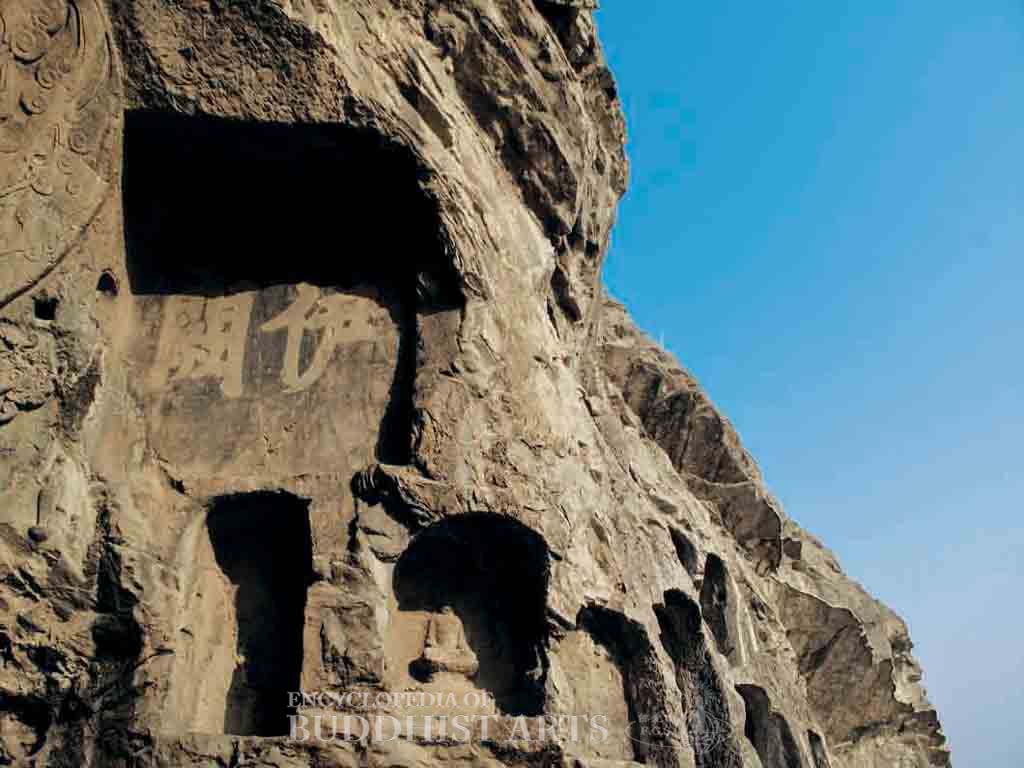
Longmen Grottoes: Grotto 712
Longmen Grottoes
CHINA, Henan, Luoyang
Longmen means Dragon Gate and it was formerly known as Yique. These grottoes are located on Longmenshan (Dragon Gate Mountain), 13 km south of Luoyang on the banks of the Yi River. Divided among the east and west banks of the Yi River, the grottoes extend for approximately 1 km. The construction began in 493 during the Northern Wei dynasty, and continued throughout the Sui (581–618), Tang (618–907), and Northern Song (960–1127) dynasties. During both the Northern Wei (386–534) and Tang dynasties, access to the site was restricted to members of the imperial family. These periods were the most productive in creating new grottoes and artworks. Longmenshan is composed of limestone, a rock highly suitable for carving, given its strength and smoothness. The grottoes are of various sizes and arranged in a dense, honeycomb-like pattern. There are 2,345 identified grottoes and niches, with over 100,000 sculptures, 60 carved pagodas, and more than 2,840 inscriptions. The site was listed as a National Cultural Heritage Site in 1961 and as a UNESCO World Heritage Site in 2000.
The Northern Wei grottoes concentrated on the west bank of the river contain about a third of the total sculptures at the site. The representative grottoes of this period include Grottoes 1443 (Guyang Grotto), 140 (Central Binyang Grotto), 712 (Lotus Flower Grotto), and 1181 (Weizi Grotto). The Northern Wei grottoes typically have either an apsidal or a rectangular layout, and the carvings are simple and have a stylistically free form. Grotto 1443, the earliest constructed, contains the greatest number of inscriptions. The Twenty Outstanding Inscriptions of the Longmen Grottoes are prized examples of Northern Wei’s unique calligraphy. Nineteen of these inscriptions are found in Grotto 1443. The walls and ceiling are covered in niches of various sizes and most are accompanied by inscriptions.
The Binyang Grottoes in the site’s northern area are on the west side of the river. The grottoes consist of Grottoes 104 (North Binyang Grotto), 140 (Central Binyang Grotto), and 159 (South Binyang Grotto). Construction began on Grottoes 140 and 159 in 505, and on Grotto 104 in 508. At the end of the Northern Wei dynasty in 534, only Grotto 140 was completed. The other two remained unfinished until the Tang dynasty. Between Grottoes 140 and 159 there is the famous Stele of Yique Buddha Niches engraved with over 1,800 characters of vows.
Grotto 712 was constructed during the time of Emperor Xiaoming (reigned 515–528) and has a large lotus relief on the ceiling. There are two copies of the Heart Sutra carved within the cave. One of these is thought to be from the Northern Wei dynasty, while the other, carved by Huangfu Yuanheng, has been dated to 700. An engraving of the Usnisavijaya Dharani Sutra by Shi Yanfu is situated on the outside of the upper north wall. Dated to 692, it is the earliest engraving of the sutra currently preserved in China.
The grottoes excavated during the Tang dynasty constitute almost two-thirds of the total at the site. Grottoes 1280 (Fengxian Temple), 20 (Hidden Stream Temple), 404 (Jingshan Temple), and 543 (Ten Thousand Buddha Grotto) in the west, plus Grotto 2194 (Kanjing Temple) and Grottoes 2050, 2055, 2062 (Three Leigutai Grottoes) in the east are representative works of the Tang dynasty.
Grotto 1280 houses the largest outdoor sculpture at the site. It was constructed by Emperor Gaozong (reigned 649–683) of the Tang dynasty, with donations later provided by Empress Wu Zetian (reigned 684–705). The quality of the work reflects the great artistic achievements of this period.
Grotto 159 began excavation in the Northern Wei dynasty and was completed in the Tang dynasty. It has played an important role in historical research of sculptural art of the Early Tang period. Grotto 543, completed in 680, has 15,000 Buddhist sculptures carved on the walls.
Grotto 2194, the first large grotto of the east bank and prized for its 29 Arhats, each 1.8 m high Arhats exemplifies the rise in popularity of the Chan school during the Tang dynasty. The four walls and ceiling of Grotto 2055 (Central Leigutai Grotto) house 10,128 carved Buddhist sculptures. Grotto 2050 (South Leigutai Grotto), houses a large statue of the Bodhi Figure as described in Master Xuanzang’s account of the Magadha region.
The Longmen Grottoes contain more than 70 Udayana Buddha images, which are rarely seen in other caves or grottoes. These sculptures were reproduced based on the image brought from India by Master Xuanzang. The sculptures are mainly distributed in Grottoes 104, 140, 159, 404, and 543.
With more than 400 years of history, the Longmen Grottoes are a priceless artistic and cultural treasure of medieval China.
For more details, go to the Encyclopedia of Buddhist Arts: Caves R-L, page 656.
Cite this article:
author = Hsingyun and Youheng and Johnson, Peter and Mankuang and Huntington, Susan and Edson, Gary and Neather, Robert,
booktitle = {Encyclopedia of Buddhist Arts: Caves R-L},
pages = 656,
title = {{Longmen Grottoes}},
volume = 6,
year = {2016}}