
Bodhidharma Facing the Wall
Ink and color on paper
Bodhidharma Facing the Wall
CHINA; Ming dynasty
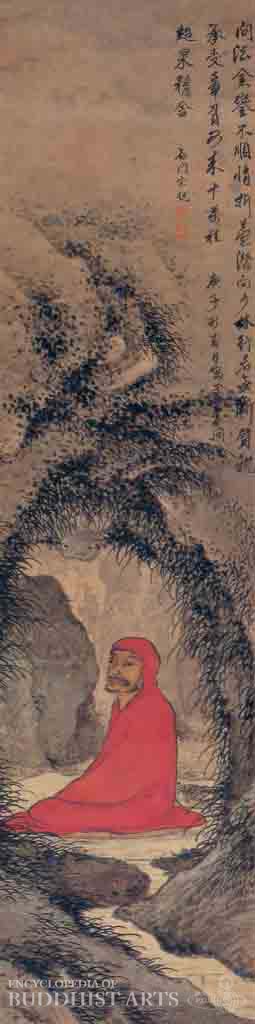
In this painting by Song Xu, Bodhidharma is shown facing the wall in a cave. A stream of water flows around him and down to the bottom of the picture. There is an inscription by the artist on the top right reading, “Discussing issues of injustice with the monarch is less rewarding than doing self-cultivation in Shaolin Temple. It is only through the extremely strong-willed practice of religious cultivation that the effort of the Buddha, who traveled thousands of miles to spread his teachings, can be honored.” This refers to Bodhidharma’s meeting with Emperor Wu (reigned 502–549) of the Liang dynasty (502–587) and his legendary nine years of meditation facing a wall in a cave near Shaolin temple.
The inscription dates the painting to the Chinese “Gengzi” year, which refers to either 1540 or 1600 when the artist was 16 or 76 years old respectively. Based on the mastery of technique displayed in the painting, the year 1600 is more likely to be correct.
Bodhidharma wears a bright red robe that contrasts starkly with the dark grasses, moss, and rock. The robe is simply drawn compared to the vegetation, which is painted with fine lines and dots of ink. Bodhidharma has large eyes, a strong jaw, and a thin beard. He appears peaceful and content despite the bleak, lonely atmosphere of the cave. Two similar images of Bodhidharma were painted by Liang Kai and Dai Jin, both contemporaries of Song Xu.
For more details, go to the Encyclopedia of Buddhist Arts: Painting A-H, page 111.
Cite this article:
author = Hsingyun and Youheng and Youlu and Wilson, Graham and Manho and Mankuang and Huntington, Susan,
booktitle = {Encyclopedia of Buddhist Arts: Painting A-H},
pages = 111,
title = {{Bodhidharma Facing the Wall}},
volume = 14,
year = {2016}}