
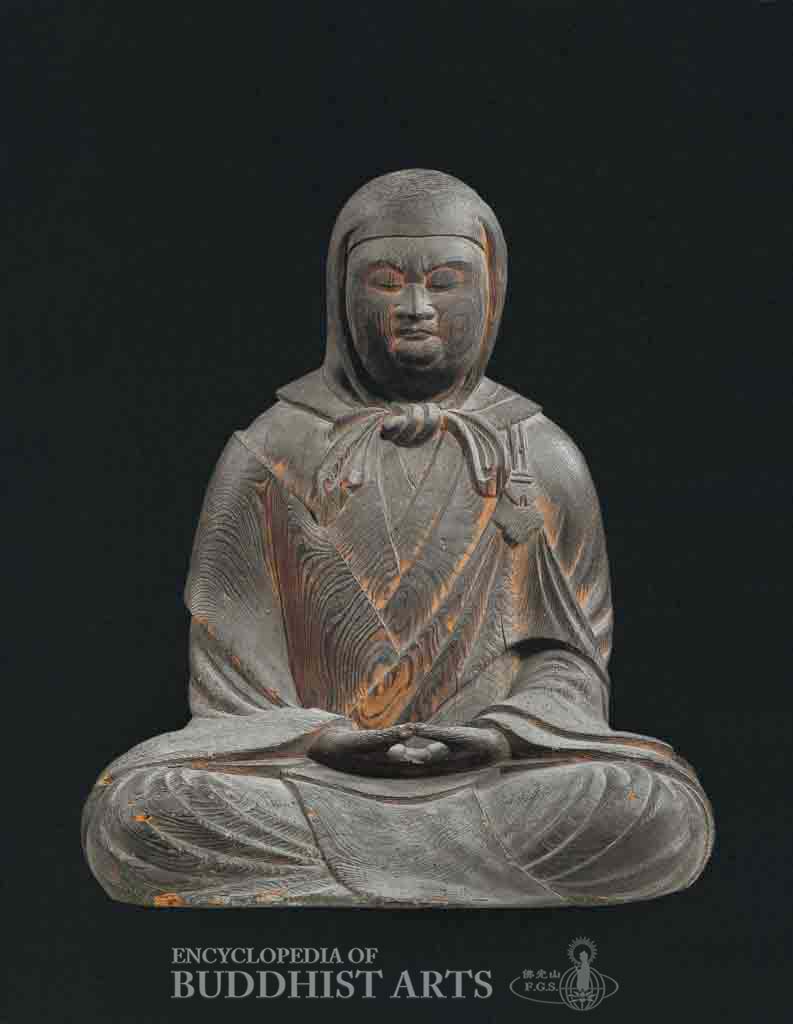
Saicho; Dated 1224
Wood
Saicho
JAPAN, Shiga; Heian period
Master Saicho was born Mitsu no Obito Hirono in Omi (present day Shiga) to a family of Chinese descent. The founder of the Tendai school of Buddhism in Japan, he joined the monastic order at the age of 14, and took his full ordination at Todaiji Temple in Nara when he was 19, after which he retreated to Hieizan for intensive practice.
In 788, Master Saicho established Hieizanji Temple, which was later renamed Enryakuji Temple. He was invited to Takaosanji Temple (present day Jingoji Temple) in 802 to teach the Lotus Sutra and other discourses. His Dharma classes were attended by Emperor Kammu (reigned 781–806) of Heian, as well as eminent monks, a result of which earned him a reputation and led to his eventual imperial order to seek the Dharma in China.
Accompanied by his disciple and interpreter Gishin, Master Saicho set off for China in 804. He returned to Japan the following year, and brought back with him numerous Tiantai school texts, documents, and teachings. He also brought with him 17 rubbings of steles which significantly impacted the development of Japanese calligraphy during the Heian period (794–1185). A talented calligrapher himself, Master Saicho was influenced by the Chinese calligraphers Wang Xizhi and Yan Zhenqing, in addition to Master Kukai from Japan. He studied the style of Preface to Sagely Teachings in Wang Xizhi’s Calligraphy and practiced writing sutras in regular script with light and elegant brushstrokes.
Saicho was then permitted to ordain two Tendai monks each year, thus establishing the Tendai school. After his passing at the age of 56, he was granted the posthumous title of Master Dengyo (Dharma Transmission). He is regarded as one of the Three Brushes of Heian, along with Master Kukai and Emperor Sage (reigned 809–823).
Existing works by Master Saicho include Catalog of Items Imported by Master Kukai, written in running script and currently kept at Toji Temple in Kyoto. In addition, works that are currently listed as National Treasures of Japan and kept at Enryakuji Temple in Otsu include Catalog of Items Imported by Master Saicho, comprising 230 sections and 460 fascicles, Catalog of Imported Ritual Implements, Records of the Tendai School, and Letter from Master Saicho, which is the only surviving letter written by Saicho, and is now preserved in the Nara National Museum.
For more details, go to the Encyclopedia of Buddhist Arts: People, page 224.
Cite this article:
author = Hsingyun and Youheng and Youlu and Pokorski, Stefanie and Yichao and Mankuang and Miaohsi,
booktitle = {Encyclopedia of Buddhist Arts: People },
pages = 224,
title = {{Saicho}},
volume = 19,
year = {2016}}