
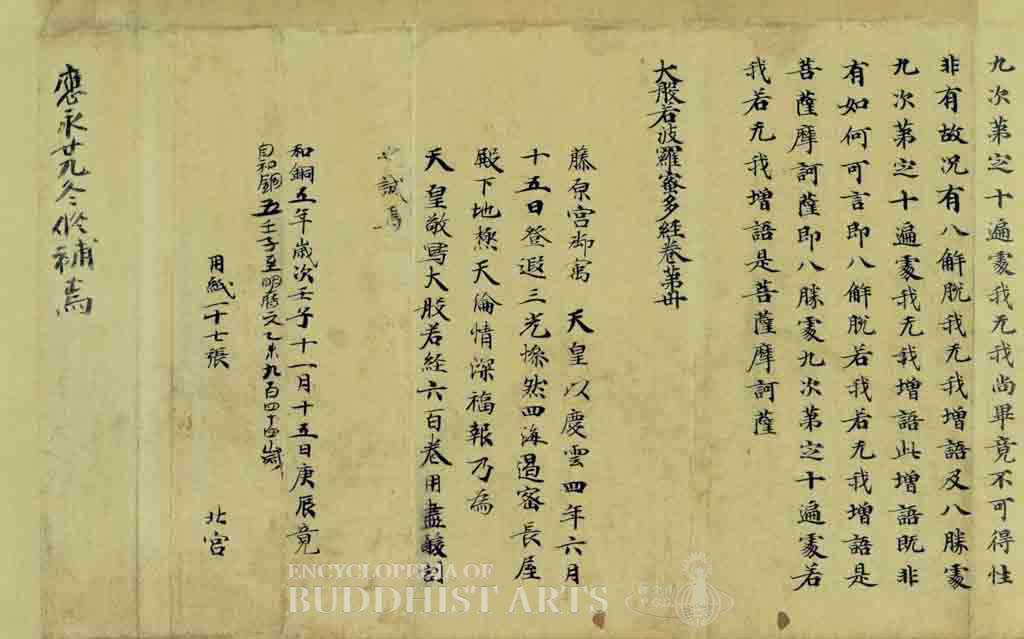
30th Chapter of Mahaprajnaparamita Sutra by Prince Nagaya (detail); Dated 712
Ink on linen
Prince Nagaya
JAPAN; Nara period
Prince Nagaya was also known as Nagaya no Okimi or Nagayao. He was the son of Prince Takechi and the grandson of Emperor Temmu (reigned 673–686). His mother was Princess Minabe, the daughter of Emperor Tenji (reigned 661–672). Promoted to the rank of Minister when Emperor Shomu (reigned 724–749) ascended the throne in 724, he held great power in politics as a member of the imperial family. He served for 5 years until his death in 729 which was caused by false accusation.
Prince Nagaya was known to invite scholars to his residence to engage in poetry recitation. Fond Recollections of Poetry recorded three of his Chinese poems and Collection of Ten-Thousand Leaves included five of his Japanese poems. According to Eastern Expedition of the Great Tang Master, the prince’s respect for Buddhism, which included his offering of 1,000 monastic robes to Chinese monks, was a influential factor in the Tang dynasty (618–907) monk, Master Jianzhen’s decision to travel to Japan.
His achievement in calligraphy was showcased through his sutra transcriptions. The majority of his calligraphic works exhibit clerical script with sturdy and compact brushstrokes. One of his pieces, Mahaprajnaparamita Sutra, also known as the Wado Sutra or Vow of Prince Nagaya Sutra, was written in commemoration of his brother, Emperor Monmu (reigned 697–707) in 712. The sutra, which is listed as a National Treasure of Japan, was transformed from a scroll to several accordian-fold books that are now kept in various locations. One hundred and forty-two copies are kept at Taiheiji Temple in Shiga, while 27 copies are kept Jomyoji Temple in Shiga. Pince Nagaya later rewrote the Mahaprajnaparamita Sutra in 728, this time in honor of his deceased parents, which he offered to the emperors of successive generations. This sutra is also known as the Jinki Sutra and is listed as an Important Cultural Property of Japan now kept at the Nezu Museum in Tokyo.
For more details, go to the Encyclopedia of Buddhist Arts: People, page 210.
Cite this article:
author = Hsingyun and Youheng and Youlu and Pokorski, Stefanie and Yichao and Mankuang and Miaohsi,
booktitle = {Encyclopedia of Buddhist Arts: People },
pages = 210,
title = {{Prince Nagaya}},
volume = 19,
year = {2016}}