
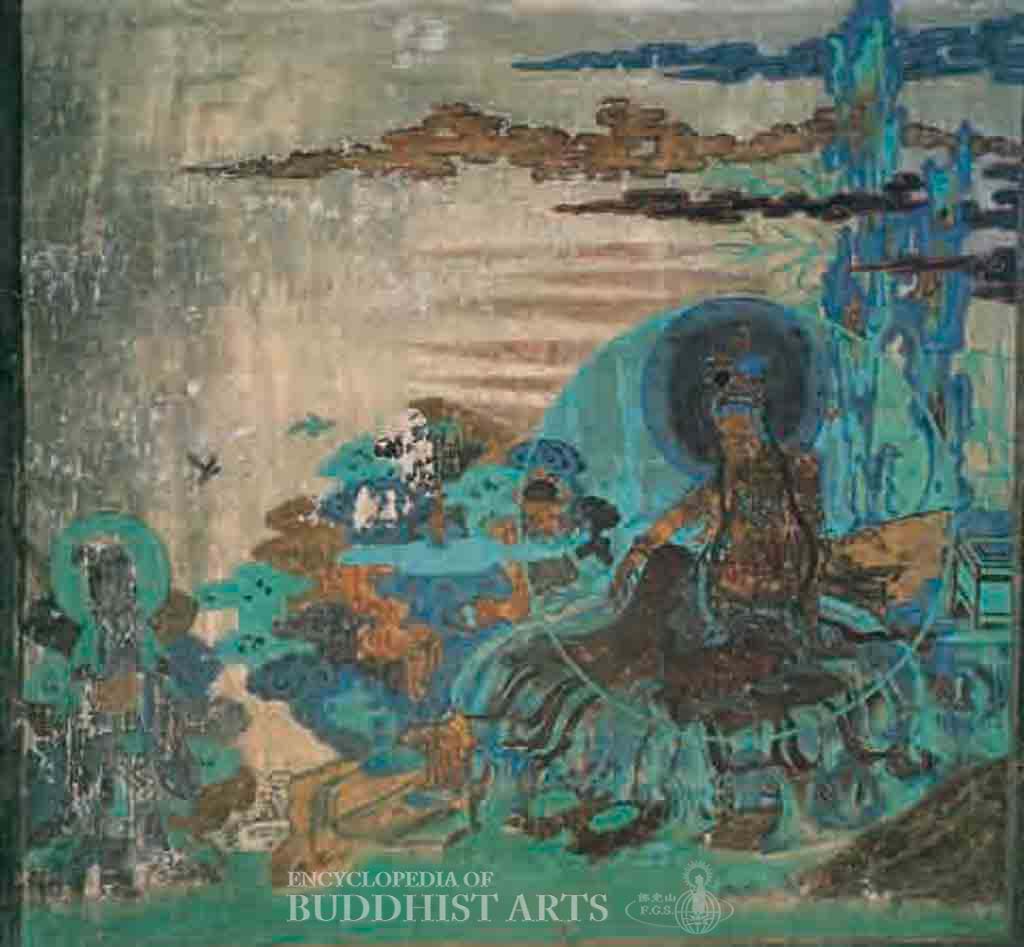
Yulin Cave 2: Water-Moon Avalokiteshvara (west wall, left side)
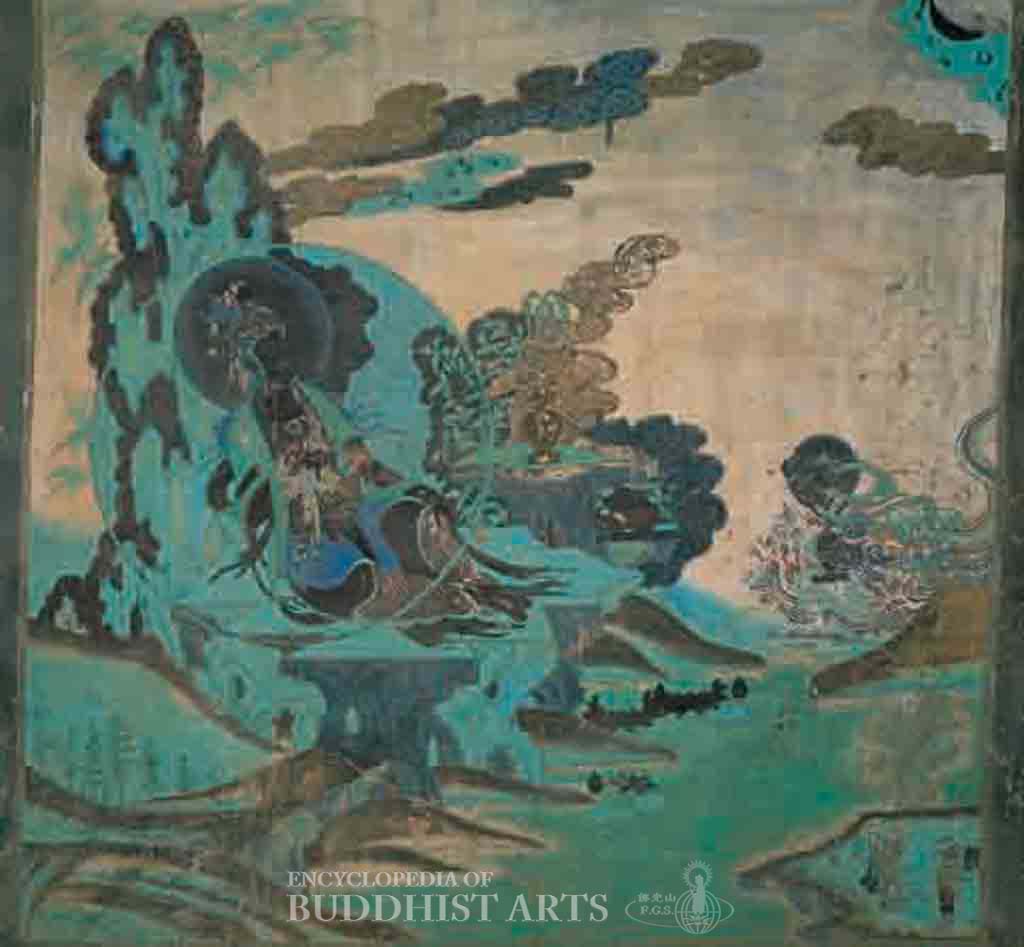
Yulin Cave 2: Water-Moon Avalokiteshvara (west wall, right side)
Yulin Cave 2: Water-Moon Avalokitesvara
CHINA, Gansu, Guazhou; Western Xia period
These illustrations are located on both sides of the entrance on the front (west) wall of the cave. The illustration on the left side of the doorway depicts Avalokitesvara Bodhisattva seated in royal ease posture upon a rock. A round transparent mandorla surrounds the figure and a dark blue nimbus surrounds the head. The Bodhisattva wears an elaborate headdress and ornaments, such as armlets and bracelets, as well as a long lower garment. One hand lightly grasps a string of prayer beads. A vase containing a willow branch and an offering of fresh flowers in a bowl is depicted on a rock to the left of the Bodhisattva. Behind the figure there is a rock formation that rises up into the clouds. The background depicts colorful clouds and the silhouettes of two birds. An azure-colored pond is in front of Avalokitesvara. On a rocky platform in the pond is Mahadevi with a turquoise nimbus.
The illustration on the right side of the entrance depicts the Bodhisattva reclined against a rock. This figure wears a long red and blue garment with a green stole draped over the shoulders. One hand rests upon the left knee, while the other holds an alms bowl at the chest. Bamboo shoots grow from the rock against which the Bodhisattva leans, as colorful clouds float in the sky above. A vase containing willow branches is next to the Bodhisattva resting upon a plantain leaf. The pond in front of the Bodhisattva contains lotuses in various stages of bloom. Sudhana is on the right side of the illustration, surrounded by billowing clouds. He is depicted with palms joined and a blue nimbus behind the head. An unusual detail in this mural is the small figures in the lower right corner depicting Master Xuanzang’s Journey to Obtain the Sutras. Clad in monastic robes, Xuanzang stands with palms joined and pays respect to Avalokitesvara. A monkey-like disciple grasps the reigns of a horse in one hand, with the other held up to shade his eyes. In the Great Tang Records on the Western Regions, Xuanzang wrote that those who wish to meet Avalokitesvara will be willing to lose their lives crossing mountains and rivers, and will forget all these hardships. The inclusion of this detail is uncommon in murals dated to the Western Xia period (1032–1227) and makes this image particularly unique.
For more details, go to the Encyclopedia of Buddhist Arts: Caves T-Z, page 1561.
Cite this article:
author = Hsingyun and Youheng and Johnson, Peter and Mankuang and Huntington, Susan and Edson, Gary and Neather, Robert,
booktitle = {Encyclopedia of Buddhist Arts: Caves T-Z},
pages = 1561,
title = {{Yulin Cave 2: Water-Moon Avalokitesvara}},
volume = 9,
year = {2016}}