
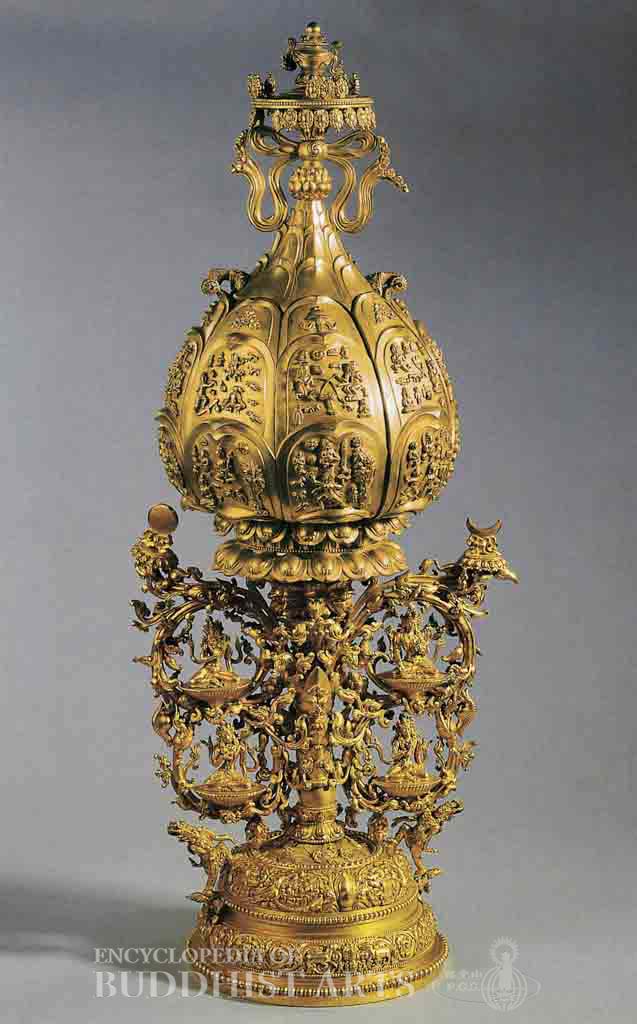
Mandala of Yamantaka (closed)
Gilt copper alloy
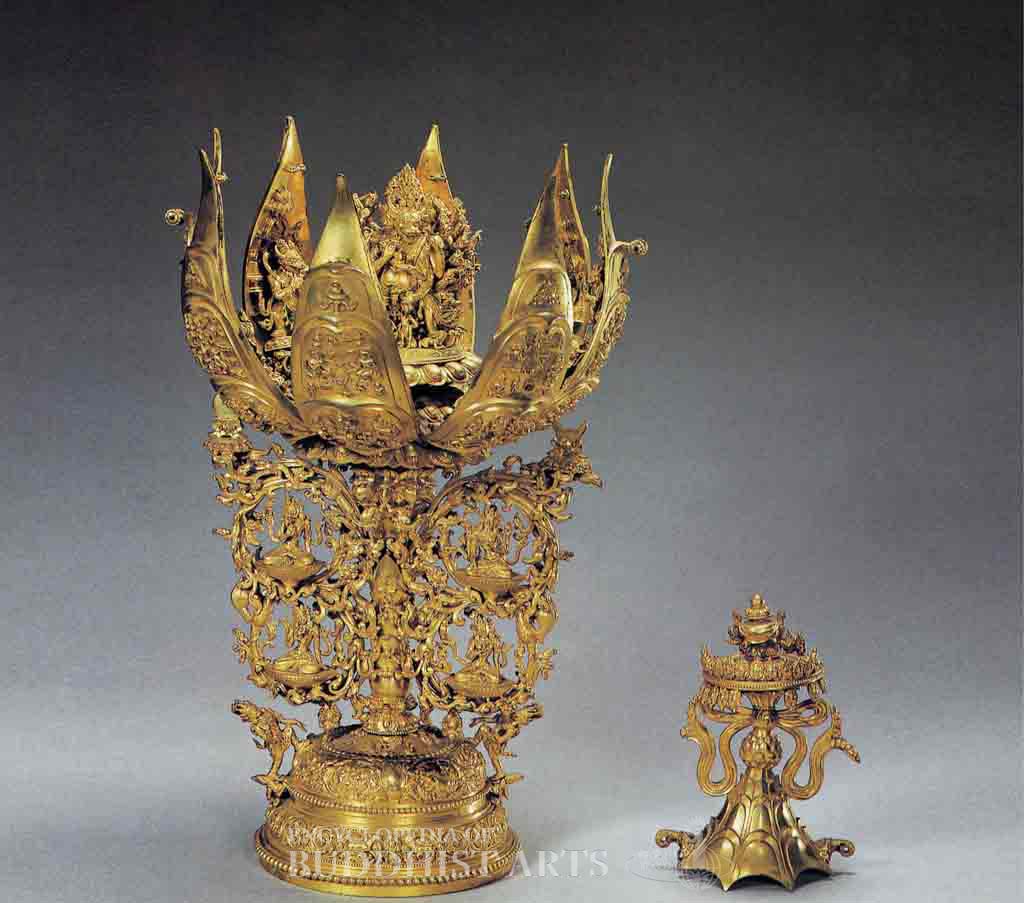
Mandala of Yamantaka (opened)
Mandala of Yamantaka
CHINA; Ming dynasty
Created under imperial command during the Ming dynasty (1368–1644), this artifact was a gift to Tibet. It was cast as an eight-petal lotus, supported by a two-tier round base divided by rings with bead patterns. The base depicts two deer and various patterns, with an inscription in the center stating that it was constructed during the rule of Emperor Yongle (reigned 1402–1424). Two warriors support the structure from beneath. On both sides of the lotus stem there are four circular scroll stems each containing a Bodhisattva seated on a lotus throne. The scroll stems are surmounted by a sun and a moon on opposite sides.
The mandala takes the form of a lotus with Buddhas, Dharma protectors, and other figures, as well as the eight auspicious symbols on its exterior. The petals of this metal lotus close to form a lotus bud and open to reveal Yamantaka standing on a lotus pedestal at the center. Yamantaka is a figure with a buffalo’s head and a human body embracing his consort. He has 16 legs and 34 arms holding Dharma instruments. There are miniature images of Yamantaka inside the eight petals. There is a canopy supported by lotus petals surmounted by a vase-shape finial. Hanging ornaments decorate the canopy’s fringe, though some are missing.
For more details, go to the Encyclopedia of Buddhist Arts: Artifacts, page 183.
Cite this article:
author = Hsingyun and Youheng and Youji and Pokorski, Stefanie and Mankuang and Fan, Wen,
booktitle = {Encyclopedia of Buddhist Arts: Artifacts },
pages = 183,
title = {{Mandala of Yamantaka}},
volume = 18,
year = {2016}}