
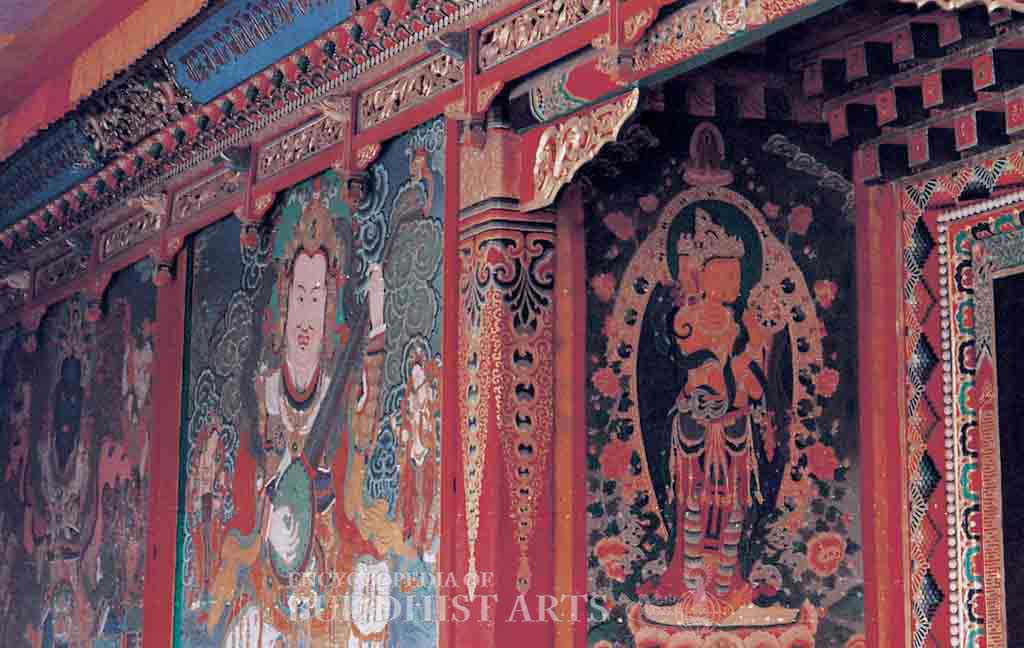
Kumbum Monastery Murals
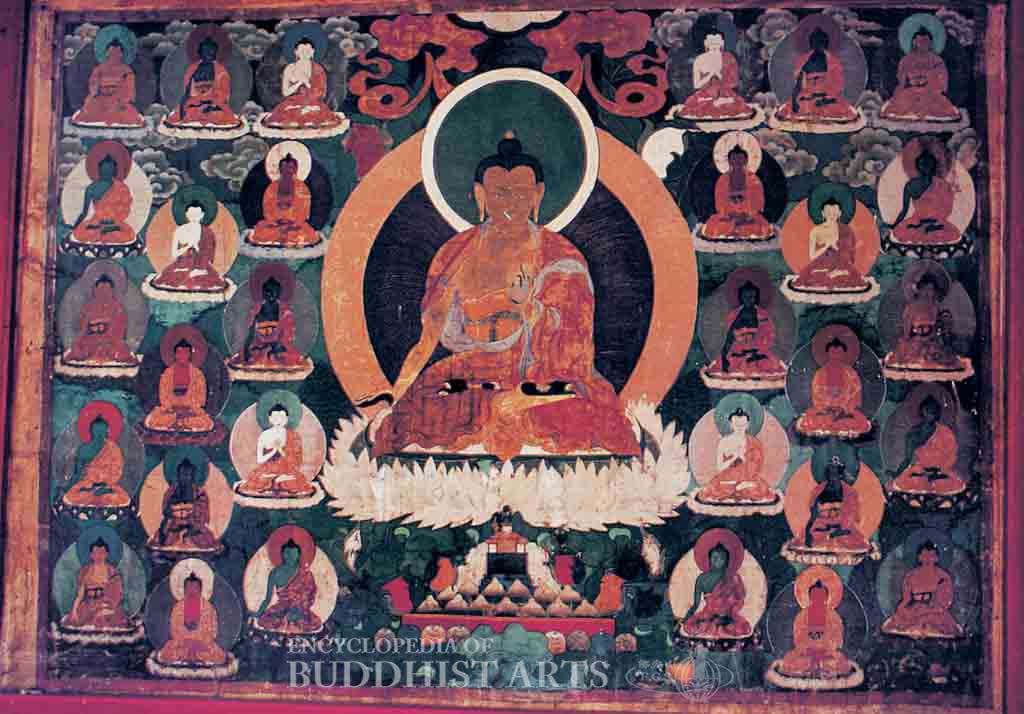
Kumbum Monastery Murals: Central Hall - Sakyamuni Buddha (portico)
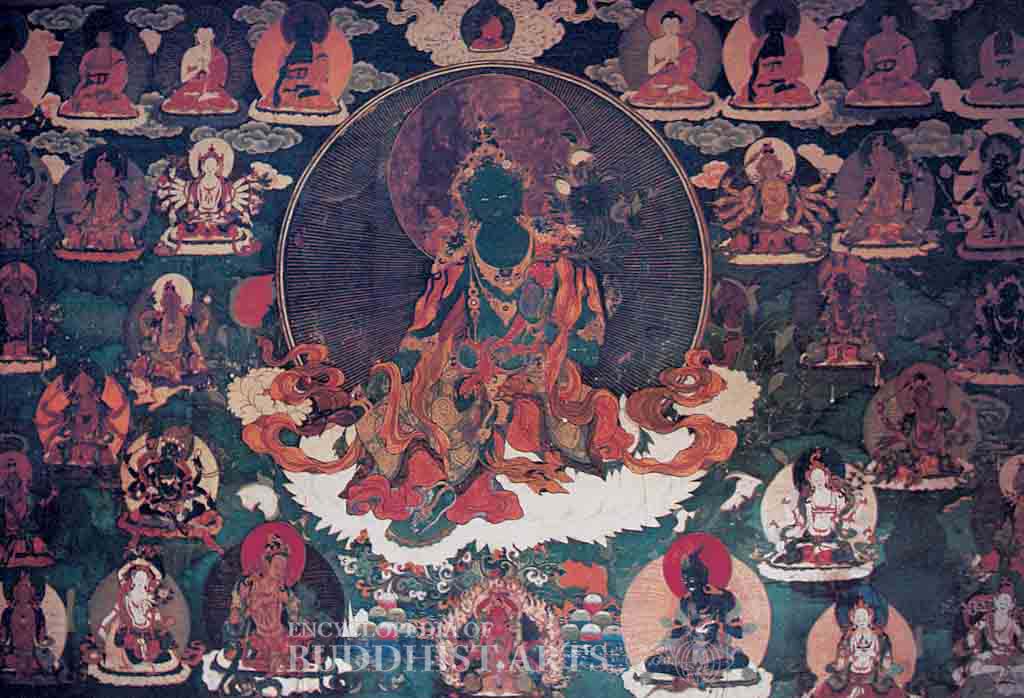
Kumbum Monastery Murals: Central Hall - Green Tara (portico)
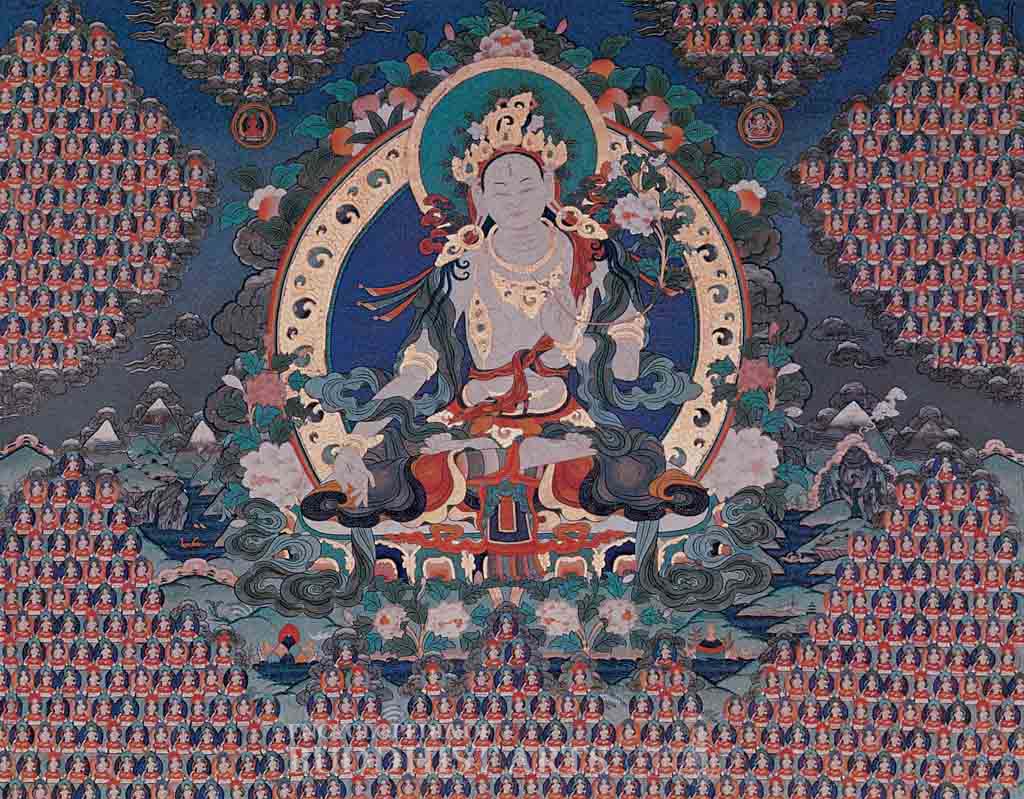
Kumbum Monastery Murals: White Tara
Kumbum Monastery Murals
CHINA, Qinghai, Xining; Qing dynasty
The Kumbum Monastery is known for its three treasures: butter sculptures, murals, and applique embroidery. The murals, attributed to Tibetan artists from Rebkong and Huangzhong, were painted in the various halls between the 17th and 20th centuries.
The central hall contains the largest assembly hall in the monastery. On the walls of the front portico, there are images of Sakyamuni Buddha, Thirty-Five Buddhas, Eleven-headed, Eight-Armed Avalokitesvara Bodhisattva, Samantabhadra Bodhisattva, and Tara. These resplendent murals were painted by Shenpa from Wutun village.
Sakyamuni Buddha is seated on a lotus throne in full lotus position. The Buddha has a tall usnisa and long ears, and gazes forward with an intense expression. His left hand forms the vitarka (teaching) mudra in front of his chest, while the right hand hangs down naturally. The green nimbus is surrounded by a white line. Thin, waving lines decorate the aureole. Thirty small seated Buddhas are arranged symmetrically to the left and right of Sakyamuni. They have white, red, or green skin, and form different mudras.
Green Tara is depicted sitting on a white lotus with her left leg tucked against her body and her right foot resting on a lotus pedestal. Her bright eyes stand out against her dark green skin. Tara wears a golden headdress, a patterned robe, a fluttering stole, and jewelry. She holds a lotus in her left hand and her right hand hangs down at her side. The mandorla is decorated with radiating golden lines.
The headdress, jewelry, nimbus, and mandorla of White Tara are painted bright gold, giving the figure a magnificent appearance. She sits in full lotus position, holding a lotus in her left hand. Tiny figures of Tara arranged into triangular groups surround the central figure. Some of the other notable murals in the monastery are the images of the Six Realms of Existence in the central hall and the Samaya Mandala on the ceiling of the Vajrayana College. The murals are brightly colored and beautifully painted with intricate details.
For more details, go to the Encyclopedia of Buddhist Arts: Painting I-O, page 462.
Cite this article:
author = Hsingyun and Youheng and Youlu and Wilson, Graham and Manho and Mankuang and Huntington, Susan,
booktitle = {Encyclopedia of Buddhist Arts: Painting I-O},
pages = 462,
title = {{Kumbum Monastery Murals}},
volume = 15,
year = {2016}}