
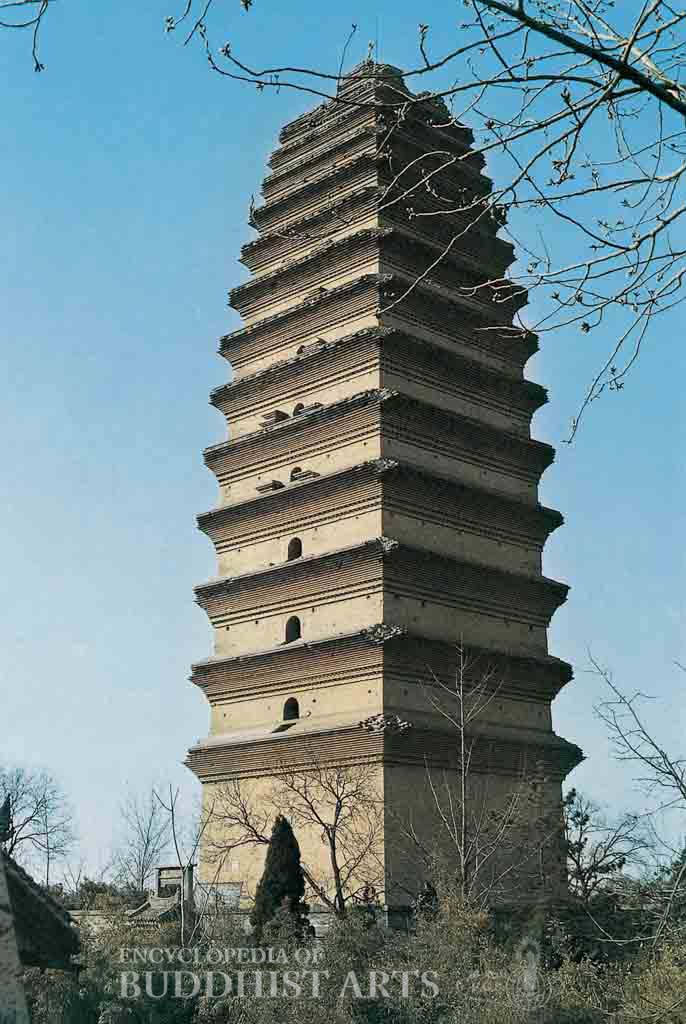
Xiaoyan Pagoda
Xiaoyan Pagoda
CHINA, Shaanxi, Xi’an
Xiaoyan means Little Wild Goose, and this pagoda is also known as Jianfu Temple Pagoda. It was built between 707 and 710 during the Tang dynasty, and faces the Dayan (Great Wild Goose) Pagoda. It originally had 15 stories, but the Guanzhong earthquake of 1487 during the Ming dynasty caused its roof to collapse. It was listed as a National Cultural Heritage Site in 1961.
The 13-story, square, brick pagoda is 43.4 m high. It is built on a square base. It has a single wall and is hollow. There is a spiral staircase that reaches to the top. The first story is much higher than the other stories. The upper stories become narrower towards the top, producing a tapered curved effect. The eaves of each story are in the form of corbeling with two courses of dogtooth bricks underneath. On the north and south sides are arched doors or windows with plain walls; however, between the fifth to the eleventh story the windows are flanked by a pair of small square pagodas. The doors on the lower stories have limestone lintels engraved with delicate carvings of flowers and Buddha images.
For more details, go to the Encyclopedia of Buddhist Arts: Architecture T-Z, page 1316.
Cite this article:
author = Hsingyun and Youheng and Johnson, Peter and Mankuang and Lancaster, Lewis,
booktitle = {Encyclopedia of Buddhist Arts: Architecture T-Z},
pages = 1316,
title = {{Xiaoyan Pagoda}},
volume = 4,
year = {2016}}