
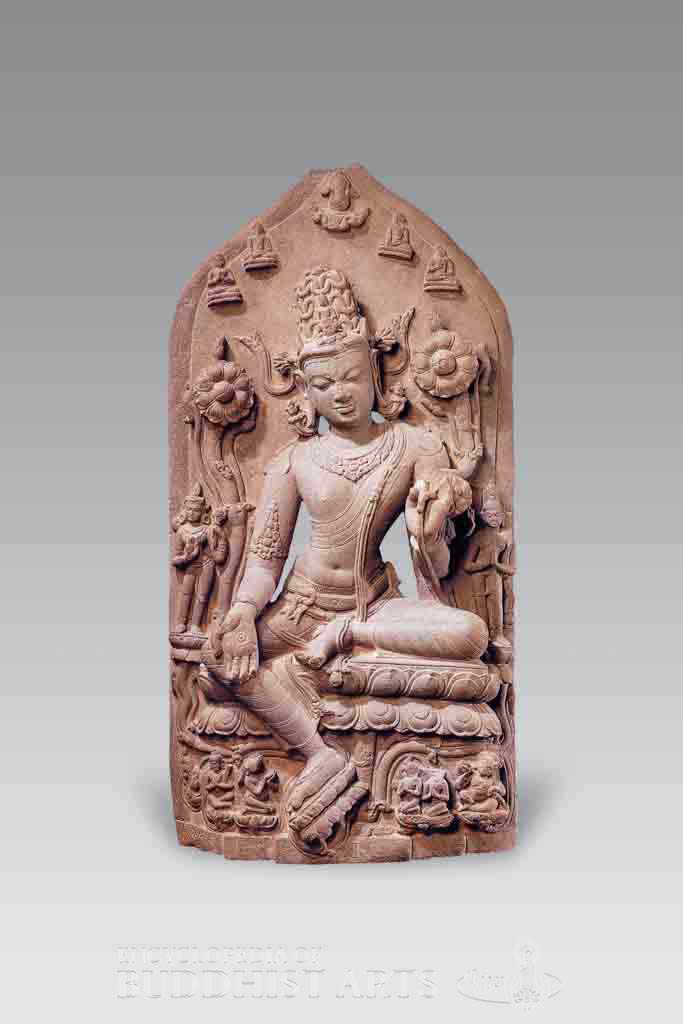
Avalokitesvara Bodhisattva
Schist
Avalokitesvara Bodhisattva
INDIA
The sculpture is believed to be from Bihar. The Bodhisattva wears a high topknot and a headdress that includes a tutelary Buddha image and ribbons flaring upwards. The figure wears jewelry and a sacred thread that runs diagonally across the body. The figure has broad shoulders and a slim waist, and sits in the relaxation posture with the right leg overhanging the double lotus throne and the foot supported on a blossom. The right hand is in the varada (wish-granting) mudra and shows the Dharma wheel in the center of the palm. Lotuses grow on either side of the figure, and one is held in the Bodhisattva’s hands. Two attendants stand in the tribhanga posture beneath the flowers, Tarani is on the left while Bhrkuti is on the right.
The Five Dhyani Buddhas are carved in mid-relief at the top, and along the border of the leaf-shaped mandorla. Sudhana, mentioned in the “Fifty-Three Visits of Sudhana” from the Avatamsaka Sutra, is located in the bottom left corner beneath the throne. Beside him is a kneeling hungry ghost, with palms joined in respect. His inclusion signifies the Bodhisattva’s indiscriminate will to liberate all sentient beings. Two kneeling figures on the opposite side are believed to be benefactors, with the seated figure of Hayagriva beyond them.
For more details, go to the Encyclopedia of Buddhist Arts: Sculpture A-F, page 95.
Cite this article:
author = Hsingyun and Youheng and Lovelock, Yann and Chou, Yuan and Huntington, Susan and Edson, Gary and Neather, Robert,
booktitle = {Encyclopedia of Buddhist Arts: Sculpture A-F},
pages = 95,
title = {{Avalokitesvara Bodhisattva}},
volume = 10,
year = {2016}}